Brief
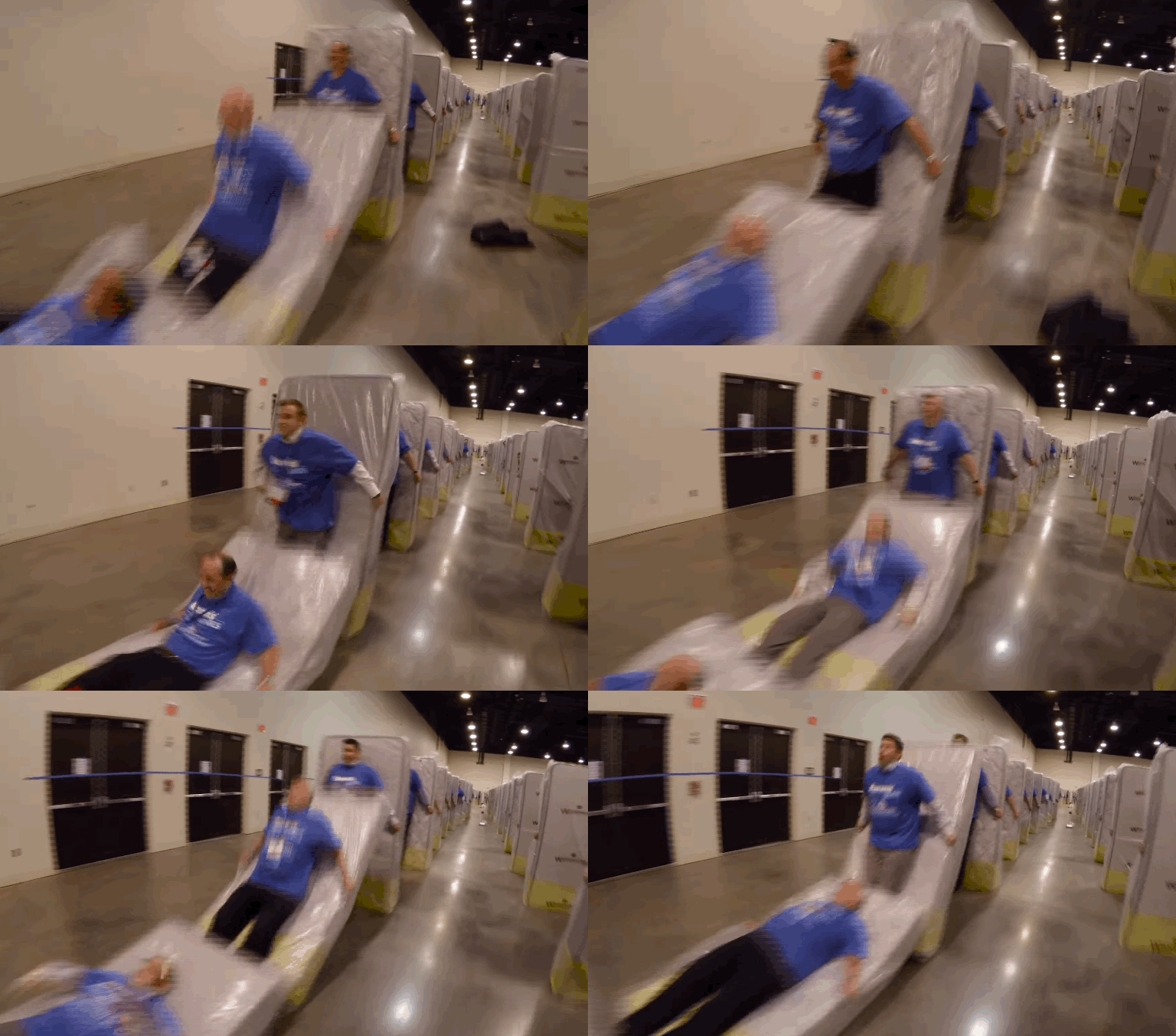
Write a 1250–1500-word paper (not including footnotes and bibliography) showing a connected chain of at least 4 different ideas, inventions, events, theories, or people. At least one of your 4 points should be directly related to art/design—a particular creative work, influence on an artist/designer or movement, an art/design technique, materials, etc. from the 20th or 21st century—with the other points connected to it linearly. You should illustrate linear causality (or at least reliance), meaning your connections should work like dominoes—A activates B which activates C and so forth (or A couldn’t have happened without B, which couldn’t have happened without C, etc.). Your art/design point can be A, B, C, or D.
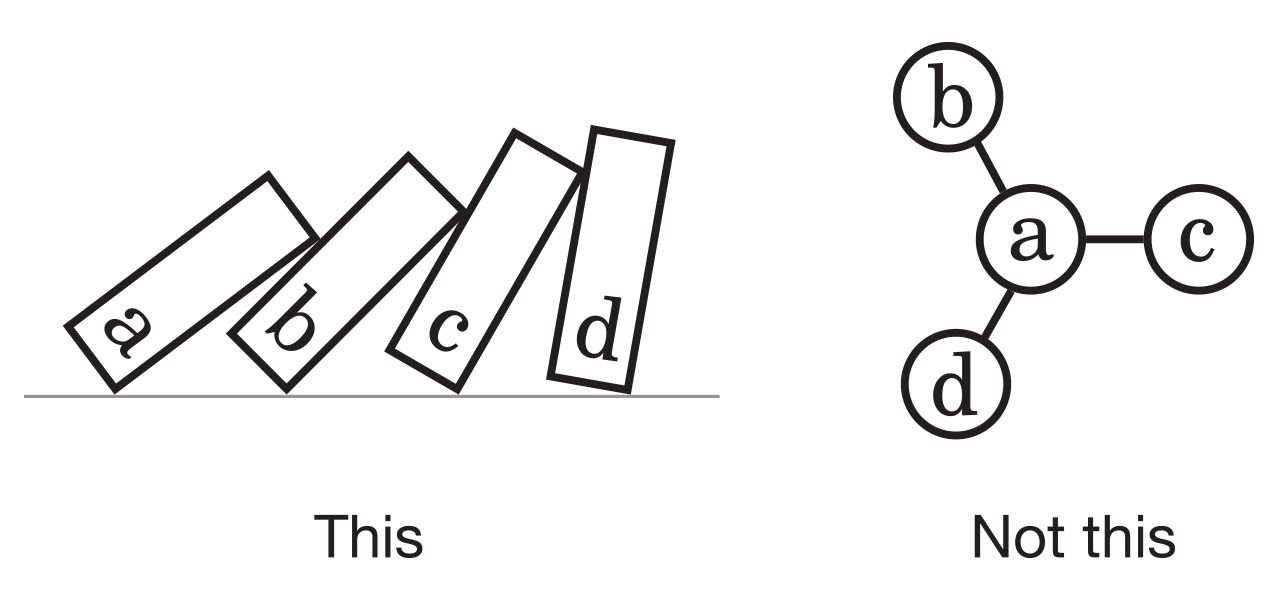
The key is to allow your research to drive the direction. Don’t attempt to come up with 4 points based on your current knowledge, and then try to weave them together. You may not be able to find appropriate causation. Don’t tread the well-worn paths of art history to tell the same threadbare narratives that are already out there. You will be weaving together a tight, gripping non-fiction story that pulls together seemingly disparate points in history to indicate how they cumulatively make something more significant than the individual parts. You are providing a longer and broader perspective to art. When you say, “[Domino A] leads to [Domino D],” it should sound surprising and intriguing, not commonplace and expected.
If you find yourself stuck in your research, ask yourself, “How exactly did this happen?” Try to figure out how certain events, inventions, artists and artworks came to be. What influenced them? What made them possible in the first place? Were there new technologocal advancements? Did an event such as a war or family tragedy result in an environmental shift that made something possible? As you trace backward or forward to other points, ask the same questions again. You may also schedule office hours with me if you’d like to bounce ideas around. I also recommend listening to the podcasts 50 Things That Made the Modern Economy and 30 Animals That Made Us Smarter to possibly help jostle some ideas. Each episode is only 8–15 minutes long and provides brief histories of some inventions and their influences.
Outline
Before you begin writing your paper, you need to first establish the events and connections you will write about. You will submit an outline for approval before you begin writing to make sure you are on the right patah. Your outline should be no longer than 200 words. It should consist of your four main points, with accompanying text to explain how they influence one another. You don’t need to include “introductions” or “conclusions” because those are assumed. For example:
- Domino A (don’t have Domino A, B, C, or D, just give a title to your domino)
- Short explanatory text
- Domino B
- Short explanatory text indicating how the previous step led to this one.
- Domino C
- Short explanatory text indicating how the previous step led to this one.
- Domino D
- Short explanatory text indicating how the previous step led to this one.
So, it might look something like this:
- Potatoes first cultivated
- Incas in Peru cultivated potatoes between 5,000 and 8,000 B.C.
- The Spanish bring potatoes from Peru to Europe
- Spanish Conquistadors, led by Francisco Pizarro, conquered Peru in 1536, and brought potatoes back to Europe. Without the cultivation of potatoes, there would be no potatoes to import.
- Kathy Etchingham’s lumpy mash leads to row with Jimi Hendrix
- In 1967, Kathy Etchingham made lumpy mashed potatoes for her boyfriend Jimi Hendrix who didn’t appreciate them, and they had a huge fight. Without the importing of potatoes to Europe, there would have been no lumpy mash, and therefore no argument.
- Hendrix apologizes in song
- To make up for his tantrum over lumpy mashed potatoes, Hendrix wrote Etchingham an apology song called “The Wind Cries Mary.” Without the argument over lumpy mashed potatoes, there would have been nothing to apologize for, and the song would not have happened.
Submit your outline as a Word doc via Learning Suite by the deadline.
Tips
- At the top of your paper include your name, submission date and a snappy title for your paper. Do not include a cover sheet.
- Follow these guidelines for formatting and punctuation.
- Use only trusted, reputable sources for your research. Random blogs, Tumblr sites, and poorly researched/written sites are not suitable. Please do not use Wikipedia or The Art Story as primary research sources.
- Be good storytellers. This shouldn’t read like a typical research paper. It should read like very good investigative reporting.
- Don’t just list a series of facts. Find compelling stories within your dominoes and bring them to the surface with dialogue, exposition, smells, sights, and so forth.
- Judiciously employ metaphor and simile.
- Inject compelling adjectives into the narrative—it’s not just “green,” but “emerald green,” or “the dense, verdant color of a Washington rainforest.” Paint vivid pictures for the settings of the story.
- Avoid rhetorical questions. It is an overused crutch of high-school and undergraduate writing. You can convey the same information in statements that don’t make it sound like you are unaware of the answers.
- Do not write this as you would a typical school paper. I don’t want any references to the assignment or the class—”For this assignment . . .” or “In this paper . . .” or “I didn’t know what to expect from this class . . .” Write this as you would if you were a professional submitting it for publication.
- Unnecessary repetition will lull your readers to sleep. If you find yourself using one word or phrase over and over, mix it up. Break out the Thesaurus. Rephrase your sentences to break yourself out of routine.
- Read your paper over a few times (out loud) before submitting it. If you have time, have a trusted friend/peer and/or the instructor look it over as well. In my experience, the Writing Centers at BYU do a lackluster job of helping students out. They are a good resource if English is not your primary language, and you need some help with the basics, but they don’t know the Chicago Manual of Style and they miss most spelling/grammar/syntax/punctuation mistakes.
- Take your paper in to the instructor for feedback prior to the due date. Peer review is one thing, but your peers won’t be assigning you your final grade. I cannot emphasize this enough.
Examples
The following are some example papers that scored well. Keep in mind that these papers are not perfect. There may still some phrasing, punctuation, and formatting issues, so don’t use these as a substitute for referring to the course style guide or the Chicago Manual of Style. These are meant to give you ideas of how to structure your own Dominoes paper.
- Through Beauty and Horror: The Journey from the Invention of Glass to the Building of the Los Angeles Holocaust Museum
- Whabbam: The Explosive Beginnings of the First Baby Monitor
Grading
This project will be graded on the following
- Conceptual Concerns (45%)
- Student demonstrates evidence that they understand and inventively integrate conceptual concerns. The student’s research is evident and ample given the allotted time.
- Excellent: Student demonstrates conversational familiarity with the material—making interesting connections between ideas, readings, and presentations.
- Average: Student is able to recall and recite material, but not do anything interesting with it.
- Below Average: Student struggles to demonstrate a grasp of the material and shows no facility in connecting ideas or new thinking.
- Student demonstrates evidence that they understand and inventively integrate conceptual concerns. The student’s research is evident and ample given the allotted time.
- Articulation (45%)
- When selecting a thesis or POV, the student is able to succinctly and plainly build a case using good storytelling techniques.
- This includes proper spelling, punctuation, sentence structure, grammar and formatting for written assignments; and annunciation, confidence and focused arguments for oral assignments.
- Excellent: Student understands modes of writing and presentation including style guides and oral confidence and is able to nimbly employ these tools in their writing and speaking.
- Average: Student makes some stylistic and formatting mistakes by ignoring provided guidance.
- Below Average: Student repeatedly makes the same mistakes and ignores instructor input and suggestions.
- Following Instructions (10%)
- The student adheres to the guidelines provided for the course and the assignment. If the paper has a particular framework, the student adheres to that framework. If an assignment is to be submitted as a Word doc on Learning Suite, the student does not email the instructor a PDF.
- Excellent: A detail-oriented student who takes instruction and fastidiously executes it within their work.
- Average: A student who misses some details because they didn’t read instructions thoroughly or take proper notes when instructions were given.
- Below Average: Student ignores basic instructions and guidance given for assignments.
- The student adheres to the guidelines provided for the course and the assignment. If the paper has a particular framework, the student adheres to that framework. If an assignment is to be submitted as a Word doc on Learning Suite, the student does not email the instructor a PDF.
- On-time Submission
- You will lose 5 points for each 24-hour period that the assignment is late. For example, if your assignment is submitted 5 minutes late, that is within the first 24-hour period, so you lose 5 points. If your assignment is submitted 73 hours late, then you will lose 20 points
Learning Outcomes
- Comprehension
Demonstrate a comprehension of modernism and postmodernism with their wide-ranging theories as related to visual culture and art.
- Spiritual and Ethical
Examine the spiritual and ethical implications of the varied artistic and cultural theories of the 20th Century.
- Strategies and Methodologies
Evaluate significant strategies and methodologies for art production during the 20th Century.