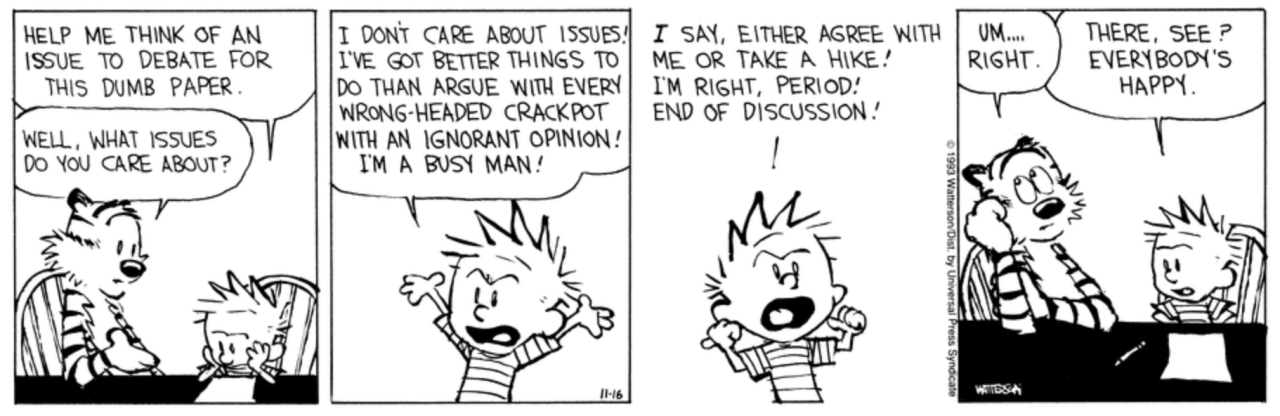
Calvin and Hobbes, November 16, 1993
Brief
Most class periods will include a one-on-one debate between students. Once during the semester, you will be assigned a topic and a point of view (POV) which you will need to research, and then prepare for a debate in front of the class. If you are in a one-on-one debate, the total time will be nine minutes—two minutes to introduce your case, two minutes of your opponent stating their case, and five minutes of debate. If you are in a two-on-two debate, the total time will be eleven minutes—two-and-a-half minutes to introduce your case (as a team), two-and-a-half minutes for your opponents to do the same, and six minutes of debate. You will have a timer in front of you to help you pace yourself. Topic and date assignments can be found at the bottom of this page.
If you are in a two-on-two debate, it is expected that both teammates will speak during the introduction, and each teammate is expected to speak twice during the debate portion. You will be graded on your oral presentation whenever you speak up. If you do not speak the minimum required times, it will count against you. If your opponent or teammate is being longwinded and sucking up the time, feel free to interject.
Whether you agree with your view point or not, you will need to build a strong case. You should expect your opponent’s thrusts and jabs, and be prepared to counter. Your preparation should include historical and theoretical research—reviewing assigned readings, digging up new readings, researching historical context of events and movements, etc.
These are not Oxford-style debates. These are just straight-forward, free debates.
You will not be submitting your writing to me for review. Your writing may take the form of note cards, bullet-pointed outlines, or whatever would work best for you. Just be prepared to refer to it quickly and conversationally. Your research must be evident in your debate. Don’t just argue from a “common sense” and “common knowledge” standpoint that shows no evidence of your work. Cite sources, quote from material, and give specific references to ideas found in your research.
Tips
- This is an oral presentation. It is partly about conveying information, but it is also about poise, energy, speaking dynamically (not just monotone), annunciation, pronunciation (correct pronunciation of names), and being engaging. Don’t just focus on your research, but practice being a dynamic presenter of ideas.
- During your introduction, do not just read from a piece of paper. Keep the debate conversational, and address your opponent. You may refer to your notes from time to time, but don’t just read from them verbatim.
- During the two minutes you’ve been given to state your case, get to your POV quickly. Don’t bury it at the end.
- Don’t spend all of your introduction giving historical background on your POV. Use that time to build a strong case. If some background is necessary, make it brief.
- Remember that your opponent(s) may go first to state their case, and they may give the necessary historical background. You would then need to adjust your introduction accordingly. Don’t restate information that has already been presented.
- Organize your notes so that you can be conversational when speaking, rather than halting and stalling while you search for the right quote/rebuttal/etc.
- During the debate portion, if your opponent asks you a question, answer her directly, but also be prepared to follow up immediately with your own question for your opponent. If she is allowed to ask all the questions, she controls the topics and direction of the debate and can steer it into territory with which you are unfamiliar.
- Do not forget the library. DO NOT rely on Google and Wikipedia alone. You want to have a stronger case than your opponent.
- Pay attention to when your debates take place and put them on your personal calendar. You may not be reminded that your debate is coming up, and if you miss it, you will not get a chance to make it up.
Grading
Assignment grades will be based on the following:
- Conceptual Concerns (45%)
- Student demonstrates evidence that they understand and inventively integrate conceptual concerns. The student’s research is evident and ample given the allotted time.
- Excellent: Student demonstrates conversational familiarity with the material—making interesting connections between ideas, readings, and presentations.
- Average: Student is able to recall and recite material, but not do anything interesting with it. The student did not select an interesting or innovative angle for their assigned POV.
- Below Average: Student struggles to demonstrate a grasp of the material and shows no facility in connecting ideas or new thinking. The student argues from a common sense viewpoint.
- Articulation (45%)
- When selecting a thesis or POV, the student is able to succinctly and plainly build a case using good storytelling techniques.
- This includes proper spelling, punctuation, sentence structure, grammar and formatting for written assignments; and annunciation, confidence and focused arguments for oral assignments.
- Excellent: Student exhibits oral confidence and is able to nimbly employ critical thinking and logic in their speaking. Opening remarks are focused and provide evidence of their research. Student has questions ready to keep opponent on their toes and answers questions satisfactorily. The debate portion also shows evidence of research.
- Average: Student may have prepared, but does not provide much evidence of research in oral presentation. The student may stumble on their remarks or mispronounce names.
- Below Average: Student does not use full two minutes for their opening remarks. Student lets their opponent steer the conversation. Very little to no evidence of research or preparation is present in the opening remarks or debate.
- Following Instructions (10%)
- The student adheres to the guidelines provided for the course and the assignment. If the paper has a particular framework, the student adheres to that framework. If an assignment is to be submitted as a Word doc on Learning Suite, the student does not email the instructor a PDF.
- Excellent: A detail-oriented student who takes instruction and fastidiously executes it within their debate.
- Average: A student who misses some details because they didn’t read instructions thoroughly or take proper notes when instructions were given.
- Below Average: Student ignores basic instructions, tips, and guidance given for the assignment.
Some debates will take place at the beginning of class. Others will take place near the end. Be prepared for either eventuality. If you are not present when your debate is supposed to take place, but you show up late and the debate happens before the end of class, you will lose five points. If you are inexcusably absent on the day your debate is scheduled, you will receive a zero for the assignment with no make up possible. Your opponent will debate the instructor with no penalty.
Learning Outcomes
- Design and Cultural History
Students will be able to identify ways in which visual design shapes and is shaped by society through communications, social relations, culture, economies, education, politics and history.
- Critical Discourse
Students will be able to understand, discuss, and write about the theoretical, philosophical, social, and critical discourse—the “whys” and “why nots” of design practice and visual culture—and how their work fits into these contexts.
- Image and Meaning
Students will be able to demonstrate fluency in interpretation and analysis of image systems, semiotics and meaning of visual culture in its diverse forms.
- Ethics and Innovation
Students will be able to understand the ethics of design and principles of innovation for engaging with and improving the world through design and image.