Brief
Almost every week, you will be required to submit one to two reading responses (125–250 words each, not including the listing of readings or time) to the week’s readings. These will be in response to one of the questions found under Response Questions at the end of the reading set. If there is one set of readings for a week, then you should submit one response. If there are two sets of readings in a week, you should submit two responses—addressing one question under each reading set. You will not only reference the required reading(s), but also the supplementary readings you did to help inform yourself for the class discussions, debates, and your assignments. Remember, these entries are evidence that you did the readings, and completed them. If you only finished a portion, indicate which portion you finished. Don’t fudge and round up.
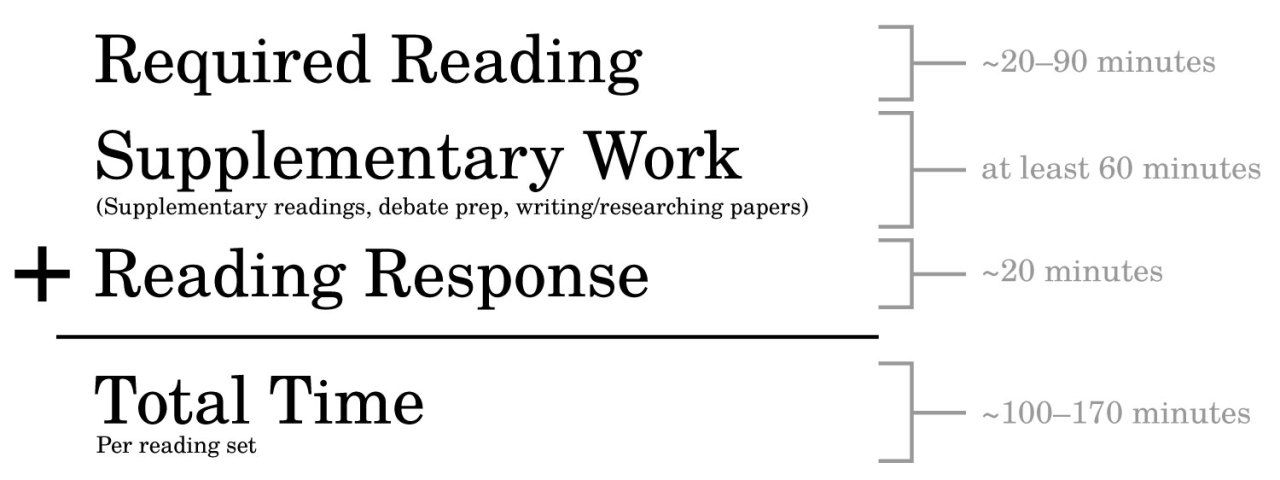
The expectation is that you are spending at least one hour per reading set on supplementary work which can include supplementary readings, debate prep, or research/writing of papers) in addition to the time spent on required readings. This, combined with the time spent on your reading response shouldn’t exceed 3 hours. Supplementary work is never meant to supplant required readings. Don’t spend three hours on debate prep and neglect the required readings. If you are given a “day off” to work on a paper or essays, use that time wisely. There is no expectation of a reading response for those days, but you should make full use of the expected time for the course.
What is a reading response?
For this course, I am asking for analytical/critical responses to the readings that address one of the response questions listed on the accompanying readings’ page. Quoting from the readings is allowed, but not if it is sacrificing much of your word count. Most of your response should be your own writing. Keep in mind, this is how we evaluate not only that you’ve completed the readings, but how you’ve processed them. If you only address one small portion of the readings, we can’t evaluate the breadth of your work. In addition, I will be asking you to provide the following information:
- a list of all supplementary readings you completed, or indicate the portions read (these don’t need to be in bibliographic format; you can just copy and paste from the reading list);
- time spent on the readings;
- time spent writing the reading response;
- time spent on other course-related activities like papers or debate prep.
Tips
- Always refer to the course style guide for proper formatting and punctuation.
- Plagiarism is not allowed. Most of the time I see this, it is due to not properly citing quotes or thoughts that are not your own. If a quote or idea is not coming directly from the reading addressed in your response, then you need to create a footnote with the proper attribution.
- Always reread your writing after you are done to help spot errors. What works even better is reading it out loud.
- Responses will be randomly examined over the course of the semester. We will not be going over these with a fine tooth comb, but please be attentive to your writing, punctuation, and formatting. Egregious errors will be corrected and result in a reduced grade.
- When reading just a portion of material—i.e., pages 10–37 of a book—please indicate which pages/portions you read as part of your list. That will help me understand the extent of the work you completed.
- If you have questions, always contact the instructor.
Template
It will be easiest if you use the Reading Response Template and just change the appropriate information each week. The template can be accessed here: https://byu.box.com/s/wlc8i6f63lt2p1n13vnipmhzzs2sziut. This file also serves as an example of how to write your weekly reading responses.
Grading
This project will be graded on the following
- Conceptual Concerns (45%)
- Student demonstrates evidence that they understand and inventively integrate conceptual concerns. The student’s research is evident and ample given the allotted time.
- Excellent: Student demonstrates conversational familiarity with the material—making interesting connections between ideas, readings, and presentations.
- Average: Student is able to recall and recite material, but not do anything interesting with it.
- Below Average: Student struggles to demonstrate a grasp of the material and shows no facility in connecting ideas or new thinking.
- Student demonstrates evidence that they understand and inventively integrate conceptual concerns. The student’s research is evident and ample given the allotted time.
- Articulation (45%)
- When selecting a thesis or POV, the student is able to succinctly and plainly build a case using good storytelling techniques.
- This includes proper spelling, punctuation, sentence structure, grammar and formatting for written assignments; and annunciation, confidence and focused arguments for oral assignments.
- Excellent: Student understands modes of writing and presentation including style guides and oral confidence and is able to nimbly employ these tools in their writing and speaking.
- Average: Student makes some stylistic and formatting mistakes by ignoring provided guidance.
- Below Average: Student repeatedly makes the same mistakes and ignores instructor input and suggestions.
- Following Instructions (10%)
- The student adheres to the guidelines provided for the course and the assignment. If the paper has a particular framework, the student adheres to that framework. If an assignment is to be submitted as a Word doc on Learning Suite, the student does not email the instructor a PDF.
- Excellent: A detail-oriented student who takes instruction and fastidiously executes it within their work.
- Average: A student who misses some details because they didn’t read instructions thoroughly or take proper notes when instructions were given.
- Below Average: Student ignores basic instructions and guidance given for assignments.
- The student adheres to the guidelines provided for the course and the assignment. If the paper has a particular framework, the student adheres to that framework. If an assignment is to be submitted as a Word doc on Learning Suite, the student does not email the instructor a PDF.
- On-time Submission
- You will lose 5 points for each 24-hour period that the assignment is late. For example, if your assignment is submitted 5 minutes late, that is within the first 24-hour period, so you lose 5 points. If your assignment is submitted 73 hours late, then you will lose 20 points
Learning Outcomes
- Design and Cultural History
Students will be able to identify ways in which visual design shapes and is shaped by society through communications, social relations, culture, economies, education, politics and history.
- Critical Discourse
Students will be able to understand, discuss, and write about the theoretical, philosophical, social, and critical discourse—the “whys” and “why nots” of design practice and visual culture—and how their work fits into these contexts.
- Image and Meaning
Students will be able to demonstrate fluency in interpretation and analysis of image systems, semiotics and meaning of visual culture in its diverse forms.
- Ethics and Innovation
Students will be able to understand the ethics of design and principles of innovation for engaging with and improving the world through design and image.