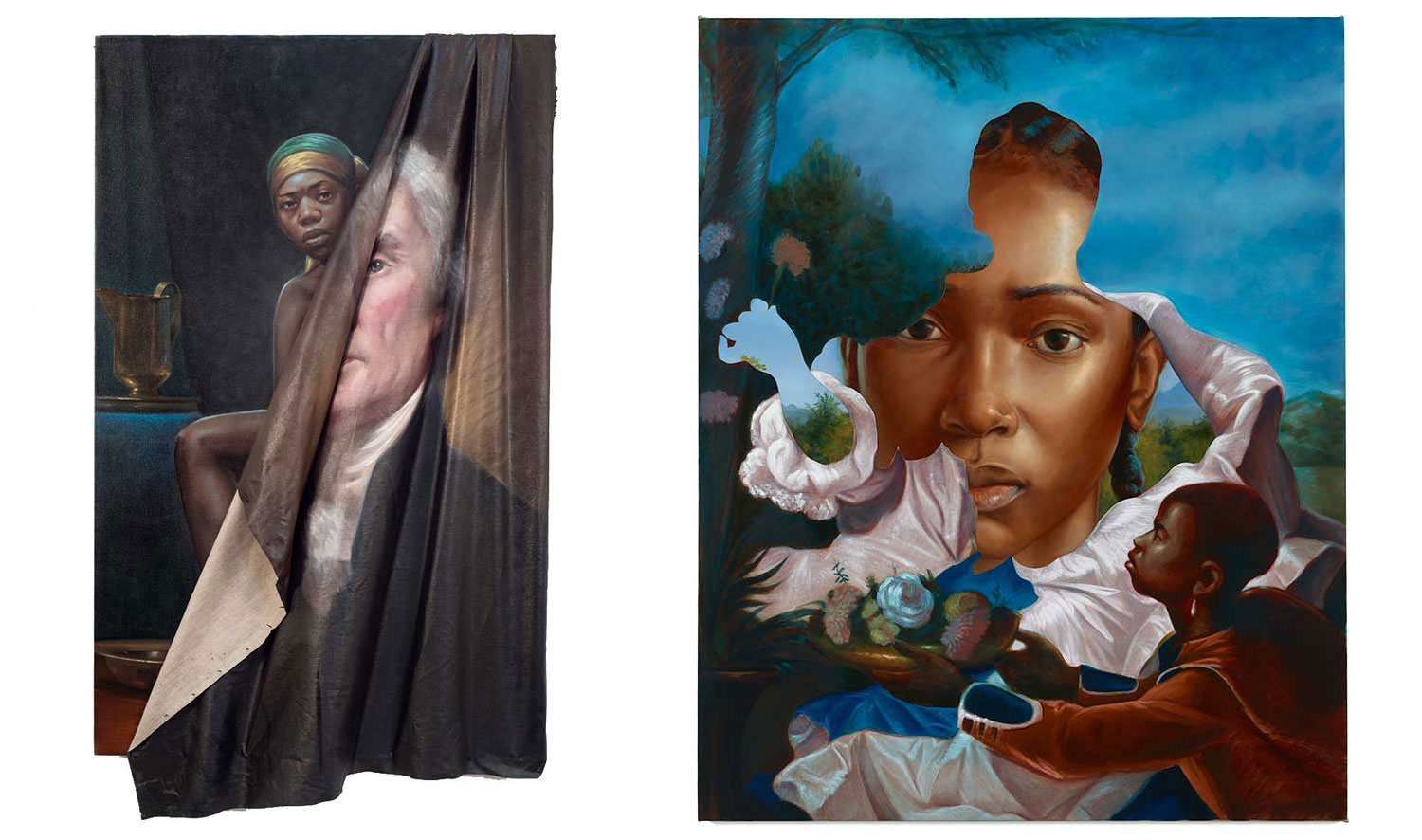
Seeing Through Time, 2018, oil on canvas, 48 × 60 in. (122 × 152.4 cm). (© Titus Kaphar, photograph by Christopher Gardener)
Brief
In Tandem is a chance to bring artists, artworks, and movements into focus that have been placed on the fringe of art history due to gender, race, geography, or class issues. You will be writing a 500–750-word feature (not including footnotes, bibliography, title, etc.) that includes at least one properly captioned image of suitable resolution. Since we are seeking to discuss these artists as worthy of deeper consideration, your writing should move beyond pure biography to make the artist’s work a primary focus of your contemplation.
What Will Make a Successful In Tandem Report?
Your In Tandem paper should be thought of as a chapter of a larger book that champions the artists from the margins of art history. Do not state or restate the theme of the assignment, because if everyone did that, it would make for some repetitive reading. Dive in and evaluate this artist’s contributions.
The title of your paper should just be your artist’s name. If you want to give it a snappy subtitle, go for it.
Your feature shouldn’t just be a straight-forward listing of facts. You want to make this engaging reading. Find interesting stories about artists or artworks and weave those into your account. Think and write critically about your subjects. These don’t have to be fluff pieces that function merely as cheerleaders, but you can discern why someone may have been overlooked and address societal issues that kept them back. You can argue that a portion of their work is stronger than others, and explain why. You can indicate that they were not good people, but great artists (or vice versa).
There is the phrase “paint me a picture” that is used when giving descriptions. Think of what you would have to do an know in order to paint an appropriately representative picture of an event. Is it indoors or outdoors? What was the weather like that day? What were people wearing? You should think about how you describe scenes to people. Just saying, “He arrived at his home,” carries some information, but “He climbed the twelve steps to the carved oak door of his two-story Brooklyn brownstone—the crisp October air creeping underneath his flowing scarf and chilling his neck,” tells a better story. Research your subjects as if you were going to paint a picture.
Use the describe, interpret, and evaluate method to introduce and dissect artworks. When describing works, include only the detail that will be pertinent to your interpretation and evaluation of the work. Don’t just list the characteristics of the work but tell a story about the work—conjure animated descriptions using appropriate and rich language. Even if you are including an image of the work to which you are referencing, you should still seek to describe it so the reader will notice what you notice.
When interpreting works, make sure that your description supports your conclusions. Don’t just leap to conclusions, you need to bring the reader along for the ride. When evaluating, you are indicating what the work seems to be telling you, and then using that measuring stick to appraise how well it achieving those ends. For example, if a work seems to be about a very serious subject—like global hunger—and is depicting a starving child with a bulbous, and bloated belly; but it is drawn Anime-style using a ballpoint pen on a post-it note, and then is framed in a thick, ornate, gold frame; then you might think that the approach is too goofy, comic, and lighthearted to be appropriate to the subject matter. You could also explore what the work is actually saying when those odd bits are put together in a single work, but indicate that because of the seriousness of the other work, that this piece sticks out like a sore, and awkward thumb. Don’t just state, “This sculpture is successful,” or, “Because the work is trying to portray a dog, and it looks like a dog, then it is doing a good job.” Those aren’t supported or suitable evaluations. Rather, build your case through your description and interpretation, so that your evaluation seems clear and obvious.
Do not skimp on, or omit an evaluation of either the artworks or the overall subject of your paper. Rather than just a meditation or rumination, you must answer, “How and why does the piece work or not work, why does it matter, or is this artist important?”
Images and Captions
Place your captions at the end of the paper below the bibliography and upload your image(s) separately. Include the filename of the image with your caption. Please refer to the course style guide for how to poperly caption an image.
Sample Caption
File: neshat-passage.jpg
Caption: Shirin Neshat (1957–), Passage (still), 2001, color video and sound installation, 00:11:30. Solomon R. Guggenheim Museum, New York, 2001.70 (artwork and image © Shirin Neshat)
Tips
- Always refer to the course style guide for proper formatting and punctuation.
- Plagiarism is not allowed. Most of the time I see this, it is due to not properly citing quotes or thoughts that are not your own. If a quote or idea is not coming directly from the reading addressed in your response, then you need to create a footnote with the proper attribution.
- Always reread your writing after you are done to help spot errors. What works even better is reading it out loud.
- Use only trusted, reputable sources for your research. Random blogs, Tumblr sites, and poorly researched/written sites are not suitable.
- Please do not use Wikipedia or The Art Story as primary research sources. Avoid sources that are not authoritative or peer reviewed.
- Watch your verb tenses. Students have a tendency to mix up past and present tense when writing papers on historical subjects. Remain consistent in the tense you use.
- Please do not begin your paper with, “____________ was born in,” “Many artists are overlooked in history,” or, “____________ is a painter who socialized with the ______________ movement.” Find a more engaging way to introduce the paper. See the next point, below.
- Be good storytellers. This shouldn’t read like a typical research paper. It should read like very good investigative reporting.
- Don’t just list a series of facts.
- Judiciously employ metaphor and simile.
- Inject compelling adjectives into the narrative—it’s not just “green,” but “emerald green,” or “the dense, verdant color of a Washington rainforest.” Paint vivid pictures for the settings of the story.
- Do not just parrot texts that you read. Draw your own conclusions based on your own observations and experience with the art.
- Avoid rhetorical questions. It is an overused crutch. You can convey the same information in statements that don’t make it sound like you are unaware of the answers.
- Keep in mind the notions of manifest and latent texts.
- Be cautious about dictating to the reader what she will see/think/feel. Phrasing such as, “You notice that . . . ,” or, “You feel that the work . . . ,” or, “we understand that . . . ,” tells them what they think, see, and feel. Speak about your experience, if you feel that you need to, but don’t be bossy, and don’t make it all about you. This should be about the work. Here are some other examples:
- Avoid “you,” “your,” “us,” “we,” and other such pronouns. This makes the writing feel like a Choose Your Own Adventure book where you make the reader the protagonist. This also leads to other problems outlined below.
- It can be seen as dictatorial to say, “You feel scared walking into the dark of the gallery space.” Not everyone will, and the phrasing is a bit hyperbolic anyway. Just describe a dark gallery space, and let the reader determine how it might make them feel.
- Phrasing such as, “The work forces you to consider . . . ,” “the gallery makes you look at . . ., ” etc. are equally bossy. When was the last time you felt like an artwork forced you to do or think anything? These are hackneyed writing tropes that should be avoided.
- Instead of writing, “You see a section of cerulean in the upper-right corner of the painting,” just say, “There is a section of cerulean in the upper-right corner of the painting.”
- Rather than saying, “I felt that the work was mocking me. I couldn’t decipher a distinct meaning,” just say, “The work frustrates attempts at distinct interpretation.” There’s nothing inherently wrong about using “I” sometimes. Just be judicious and frugal so that the paper isn’t all about you. It’s understood that critiques and papers are subjective and from your POV, so don’t beat the reader over the head with it.
- Do not write this as you would a typical school paper. I don’t want any references to the assignment or the class—”For this assignment . . .” or “In this paper . . .” or “I didn’t know what to expect from this class . . .” Write this as you would if you were a professional submitting it for publication.
- Unnecessary repetition will lull your readers to sleep. If you find yourself using one word or phrase over and over, mix it up. Break out the Thesaurus. Rephrase your sentences to break yourself out of routine.
- Read your paper over a few times (out loud) before submitting it. If you have time, have a trusted friend/peer and/or the instructor look it over as well. In my experience, the Writing Centers at BYU do a lackluster job of helping students out. They are a good resource if English is not your primary language, and you need some help with the basics, but they don’t know the Chicago Manual of Style and they miss most spelling/grammar/syntax/punctuation mistakes.
- Send your paper to the instructor for feedback prior to the due date. Peer review is one thing, but your peers won’t be assigning you your final grade. I cannot emphasize this enough.
Grading
This project will be graded on the following
- Conceptual Concerns (45%)
- Student demonstrates evidence that they understand and inventively integrate conceptual concerns. The student’s research is evident and ample given the allotted time.
- Excellent: Student demonstrates conversational familiarity with the material—making interesting connections between material.
- Average: Student is able to relate material, but not do much interesting with it.
- Below Average: Student struggles to demonstrate a grasp of the material and shows no facility in connecting ideas or new thinking.
- Student demonstrates evidence that they understand and inventively integrate conceptual concerns. The student’s research is evident and ample given the allotted time.
- Articulation (45%)
- When selecting a thesis or POV, the student is able to succinctly and plainly build a case using good storytelling techniques.
- This includes proper spelling, punctuation, sentence structure, grammar and formatting for written assignments; and annunciation, confidence and focused arguments for oral assignments.
- Excellent: Student understands modes of writing and presentation including style guides and is able to nimbly employ these tools in their writing and speaking.
- Average: Student makes some stylistic and formatting mistakes by ignoring provided guidance.
- Below Average: Student repeatedly makes the same mistakes and ignores instructor input and suggestions.
- Following Instructions (10%)
- The student adheres to the guidelines provided for the course and the assignment. If the paper has a particular framework, the student adheres to that framework. If an assignment is to be submitted as a Word doc on Learning Suite, the student does not email the instructor a PDF.
- Excellent: A detail-oriented student who takes instruction and fastidiously executes it within their work.
- Average: A student who misses some details because they didn’t read instructions thoroughly or take proper notes when instructions were given.
- Below Average: Student ignores basic instructions and guidance given for assignments.
- The student adheres to the guidelines provided for the course and the assignment. If the paper has a particular framework, the student adheres to that framework. If an assignment is to be submitted as a Word doc on Learning Suite, the student does not email the instructor a PDF.
- On-time Submission
- You will lose 5 points for each 24-hour period that the assignment is late. For example, if your assignment is submitted 5 minutes late, that is within the first 24-hour period, so you lose 5 points. If your assignment is submitted 73 hours late, then you will lose 20 points.
Learning Outcomes
- Design and Cultural History
Students will be able to identify ways in which visual design shapes and is shaped by society through communications, social relations, culture, economies, education, politics and history.
- Critical Discourse
Students will be able to understand, discuss, and write about the theoretical, philosophical, social, and critical discourse—the “whys” and “why nots” of design practice and visual culture—and how their work fits into these contexts.
- Image and Meaning
Students will be able to demonstrate fluency in interpretation and analysis of image systems, semiotics and meaning of visual culture in its diverse forms.
- Ethics and Innovation
Students will be able to understand the ethics of design and principles of innovation for engaging with and improving the world through design and image.