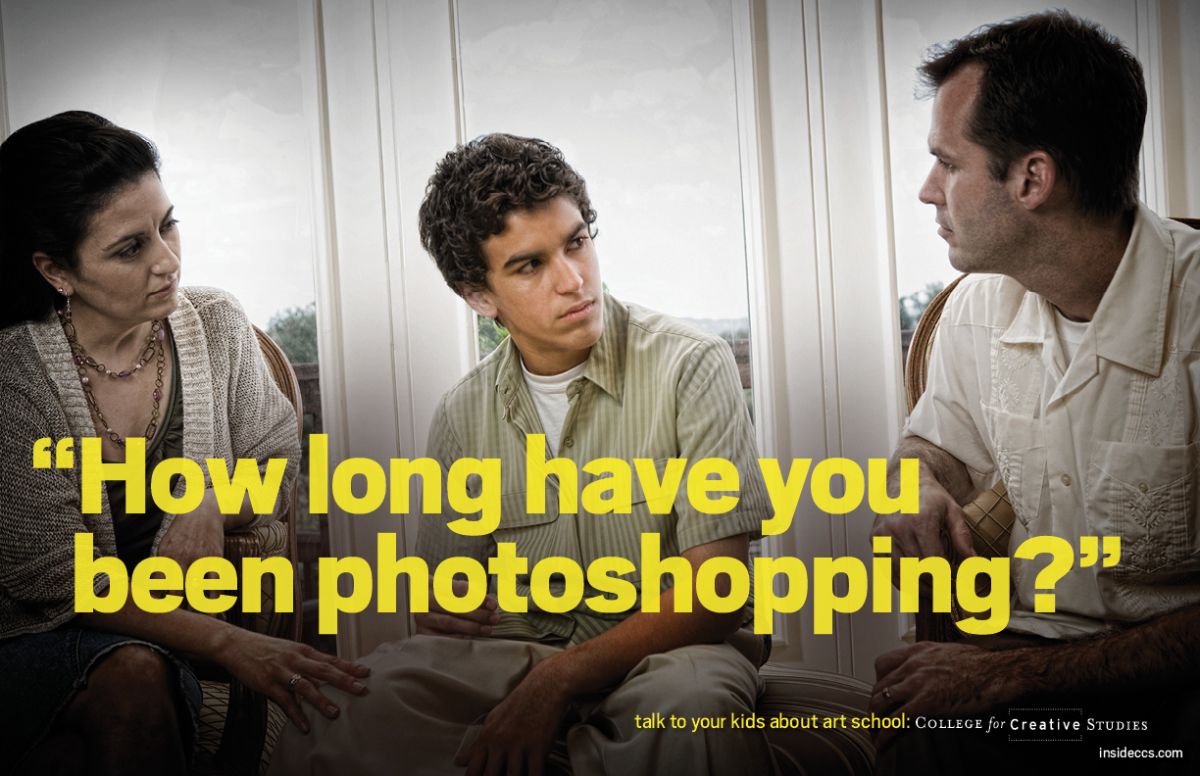
Campaign for the College for Creative Studies, 2011
Why?
Educational frameworks and content have a very large impact on how culture is shaped. Educators and programs decide what is taught and what isn’t, what is considered worthy of notice and what should be ignored, what is good and what is bad. Just consider the language in which you are taught, and the limitations of and historical baggage associated with that language. It is a useful exercise to question the base assumption that all educational systems are for the good of all. I’m sure you’ve seen friends who don’t learn well in certain classes, or your interests are not addressed in your textbooks, or historical narratives that are given places of privilege ignore your or your friends’ cultures. How do you make sure that your education is yours and not something that caters to an imaginary average student?
Required
Supplementary Readings
- Pedagogy
-
BBC Documentary – Bauhaus 100 – 100 Years of Bauhaus, BBC
“In 1919 an art school opened in Germany that would change the world forever. It was called the Bauhaus. A century later, its radical thinking still shapes our lives today. Bauhaus 100 is the story of Walter Gropius, architect and founder of the Bauhaus, and the teachers and students he gathered to form this influential school. Traumatised by his experiences during the Great War, and determined that technology should never again be used for destruction, Gropius decided to reinvent the way art and design were taught. At the Bauhaus, all the disciplines would come together to create the buildings of the future, and define a new way of living in the modern world.” - The MFA Question
-
Why Get an MFA?, The New York Times
“Do you care about the oppressive lack of diversity in M.F.A. programs—what Junot Díaz calls ’M.F.A. vs. P.O.C.’ [People of Color]—that seems to translate into the astonishingly narrow range of contemporary writing? How is any of this relevant for you?”An M.F.A. Degree Is Too Expensive, and That’s Only the Start of the Problem, Vulture
“What’s different now is that MFA programs are exorbitantly priced luxury items. At the top-shelf East Coast schools like Yale, RISD, SVA, and Columbia, the two-year cost can top $100,000. This doesn’t include room, board, materials, etc. Add all that in, and you’re hovering near a quarter-million dollars. No matter how wonderful the M.F.A. experience, that’s straight-up highway robbery.”Debating an MFA? The Lowdown on Art School Risks and Returns, HuffPost
“So how will you know which program is right for you? Should the current metrical obsession with determining success in higher education by the rate of post-graduation employment be translated into art world terms? If sales are to serve as the marker, then tradition-bound programs stressing craft would win. If visibility is the barometer, then the interdisciplinary programs that turn out idiosyncratic hipsters who talk big and make quirky assemblages stand out. If eligibility for teaching is what you seek—cognizant that the field is overwhelmingly composed of poorly paid adjuncts—then the statistical dominance of introductory courses in drawing and design should suggest to you that cultivating technical skills will open more doors.”Is Getting an MFA Worth the Price?, Artnet News
“We tracked down where each artist on the list went to graduate school, either from publicly available sources or by contacting the artists or their representatives. (For a very few, we were unable to find any information; we’ve left their fields blank in the attached table.) With that data in hand, we could then look for patterns as to how educational choices correlate with this measure of early-career success.”Can You Make Your Own MFA?, Temporary Art Review
“Now like most young hopeful artists I was filled with the confidence and hubris pretty much required to embark on such a career in the first place, and felt pretty convinced that my decision was sound and I wouldn’t look back. Years later, while I have made the absolute most of my education, my move to the United States and the community I entered in Chicago, I would be happier without the debt that has hung around my neck like an albatross the last 14 years. The list of things I could’ve done, had it not been for the debt is long, so I do my best to not obsess over it – but my experience, and the knowledge that that debt is not easily alleviated by the teaching opportunities available at this point, leads me to think of some other solutions.”
Response Questions
Remember to cite specific instances from the text to support your views.
- What are you being taught at BYU? Why? Conversely, what are you not being taught at BYU? Why?
- For example, why might the topics, histories, artists, styles, cultures that are covered at BYU be taught? Why might others be omitted? Why might they be taught the way that they are taught—set class times, types of classrooms, etc.?
- What do you gain by being at a liberal arts university? What do you lose? What might you gain/lose if you were at an art school? What might you gain/lose if you didn’t go to school at all, but rather cobbled together your own education online and with job experience?
- Think about your required curriculum. What do you think will be useful to your growth? What is missing from the curriculum that could help your growth? How might you get exposure to, or learn more about those missing pieces? How might you take ownership of your education rather than being a passive participant submitting to an existing system?
- How might you take ownership of your education rather than being a passive participant who is just submitting to an existing system?