10.1: Postmodernism

Questioning Everything
Read by Thu Mar 11,
Reading Response due Wed Mar 17,
Demolition of the Pruitt-Igoe housing complex, 1972 (photo courtesy of U.S. Department of Housing and Urban Development)

Why?

There is much debate over when Modernism died and when Postmodernism began (or if either actually did). There is also debate over whether we are still in a Postmodern age, or if we have moved on to Post-Postmodernism, Metamodernism, Pseudomodernism, Jive Modernism, or any number of other permutations. The readings you have below help to define how academics see Postmodernism and the shift from Modernism. It’s up to you to determine if you think we are currently in a Modern, Postmodern, or Post-Postmodern condition and what that means.

Required

What is Postmodernism?
Ask an Expert: What is the Difference Between Modern and Postmodern Art?, Smithsonianmag.com

Supplementary Readings

Timeline

View larger

Postmodernism
Postmodern and Late Modern: the Essential Definitions, Chicago Review
“Clement Greenberg, long acknowledged as the theorist of American Modernism, defined Postmodernism in 1979 as the antithesis of all he loved: that is, as the lowering of aesthetic standards caused by 'the democratization of culture under industrialism.’ Like our 'Decadence’ columnist, he saw the danger as a lack of hierarchy in artistic judgment although he did not go so far as the Frenchman in calling it simply 'nihilism’. Another art critic, Walter Darby Bannard, writing in the same prestigious magazine five years later, continued Greenberg’s crusade against the heathens and restated the same (non-) definitions, except with more brutal elaboration: ‘Postmodernism is aimless, anarchic, amorphous, self-indulgent, inclusive, horizontally structured and aims for the popular.’”
Introduction & Chapter 2, Postmodernism, or, the Cultural Logic of Late Capitalism
“Fredric Jameson’s most wide-ranging work seeks to crystalize a definition of ‘postmodernism.’ Jameson’s inquiry looks at the postmodern across a wide landscape, from ‘high’ art to ‘low,’ from market ideology to architecture, from painting to ‘punk’ film, from video art to literature.” Full book: Postmodernism, or the Cultural Logic of Late Capitalism, 438 pages.
Good History/Bad History, Looking Closer: Critical Writings on Graphic Design
“The eighties were a decade of comebacks: suspenders, mini-skirts, Roy Orbison, Sugar Ray Leonard…. But the really big comeback was history. We got rid of history in the sixties; saw what the world looked like without it in the seventies; and begged it to come back in the eighties. And it did; it came back with a vengeance. In design, history came back as well. Suddenly, there were countless books-big, glossy, oversize volumes-and starchy little journals devoted to the history of design. Careers were constructed around this fascination. Conferences, too. And there’s nothing wrong with studying the history of design. In fact, it’s healthy and smart, especially for design professionals. At the same time, the indiscriminate use of history has produced some really bad, unhealthy design. History in itself isn’t bad, but its influence can be.”
Did We Ever Stop Being Postmodern?, Design Observer
“One probable reason for this decision is that postmodernity is simply too complicated to reference and explain in short introductory wall texts, which would have to be loaded with great gobbets of Jameson and Lyotard. Large-scale exhibitions in public museums must always strike a balance between doing a subject adequate intellectual justice and appealing to ordinary visitors who are likely to know little or nothing about the theme.”
Postmodernism: What is It Good For?, Up Close
“On this episode of the Up Close podcast, literary theorist Professor Brian McHale explains the origins and trajectory of postmodernism, muses on its role in our cultural expression, and speculates on its demise.”
Episode 21: Climate of Denial, Ministry of Culture
“Human-caused climate change is real and growing in impact. Yet many Americans see climate change as a belief that they can opt out of. Two belief structures are to blame: American Protestantism and postmodernism.”
Is Mormonism a Postmodern Religion?, Patheos
“I want to explain three postmodern themes and describe how they relate to Mormon theology. These postmodern themes often reveal a hidden tension within the Mormon faith, caused by seemingly paradoxical claims and suggestions. These themes are continuing revelation, the theological hierarchy of the church, and its approach to pluralism.”

Response Questions

Remember to cite specific instances from the text to support your views.

  • Modernism’s concerns with purity, reductionism, futurism, and utopias started to fall apart in the 1960s through the 1970s. How would you characterize Postmodernism?
  • How might second wave feminism, the civil rights movement, and postcolonial theory that pushed for plurality over single visions have led to the downfall of Modernism?
  • Make note of the various characteristics of Postmodernism stated within the various readings. Do you see those as still in effect today, or have we moved into a new era? What may be the events or technologies that signal that we are beyond Postmodernism?

8.1: Race, Nationality, and Intersectionality as Cultural Lenses, part 2

How Race, Nationality, Colonialism, and Intersectionality Shape Culture
Read by Thu Feb 25,
Reading Response due Wed Mar 03,
Johnny Miller, Unequal Scenes
Johnny Miller
Kya Sands/Bloubosrand, Johannesburg, 2016

From Unequal Scenes, a series documenting segregation of urban spaces throughout the world

Why?

Now that we have introduced postcolonialism, the question is, what we we do with colonial histories (and present iterations) rather than just study them, and what does this have to do with art? I’m sure you can probably quickly identify a few points where postcolonialism and art intersect, but we want to dig a bit deeper and walk around the issue a bit to see it from different sides. You’ll also start to notice where this might overlap with our discussions of economy, gender, education, semiotics, and ethics.

Required

Mapping, Critical Perspectives on Art History
Discrimination by Design, ProPublica

Supplementary Readings

Race and Postcolonialism in Art and Design
Art On My Mind
“In her first book about art and the ‘politics of the visual,’ hooks, a writer known for her clarifying views on feminism and black women, addresses the deplorable absence of discourse on black artists, especially by black critics. Why, she asks, has art played a minimal role in the lives of most African Americans?”
Where Are the Women of Color in New Media Art?, Hyperallergic
“With Santos’s encouragement, I decided it would be valuable to do a follow-up piece and include perspectives from WOC and QTWOC (queer or transgender women of color) artists and writers regarding Deep Lab, new media and technology-based art, and representation. We emailed a small questionnaire to 20 such women. Seven responded, and their comments are featured below along with Santos’s own answers.”
Why Get an MFA?, The New York Times
“Do you care about the oppressive lack of diversity in M.F.A. programs—what Junot Díaz calls ’M.F.A. vs. P.O.C.’ [People of Color]—that seems to translate into the astonishingly narrow range of contemporary writing? How is any of this relevant for you?”
ARTS.BLACK: An Editorial Note, Temporary Art Review
“Though we are in the age of ‘democratized media’, its facilitators and content are hardly reflective of the artists, and the individuals who consume it. The lack of Black writers in the critical arts realm influences an industry that is completely one dimensional.”
This is What Intersectional Feminist Art Looks Like, Chicago Tribune
“The Vietnamese language does not have a word for feminism. But the country did and does have feminists, including Nguyen Thi Minh Khai, a revolutionary leader of the Indochinese Communist Party in the 1930s. Her elusive figure lurks everywhere and nowhere in "To Name It is to See It," a solo exhibition by Huong Ngo upstairs at the DePaul Art Museum.”
The Age of the Algorithm, 99% Invisible
“Most recidivism algorithms look at a few types of data—including a person’s record of arrests and convictions and their responses to a questionnaire—then they generate a score. But the questions, about things like whether one grew up in a high-crime neighborhood or have a family member in prison, are in many cases ‘basically proxies for race and class,’ explains O’Neil. The score generated by the algorithm is used by judges when making decisions about the defendant. People with higher scores will often face higher bail, longer sentences, and lower chances of parole. Instead, O’Neil believes these results could be used to select people for rehabilitation programs or to better understand society’s structural inequalities.”
How the Racism Baked Into Technology Hurts Teens, The Atlantic
“Last month, Twitter users uncovered a disturbing example of bias on the platform: An image-detection algorithm designed to optimize photo previews was cropping out Black faces in favor of white ones. Twitter apologized for this botched algorithm, but the bug remains.”
“The Evolution of a Black Aesthetic, 1920-195”: David C. Driskell and Race, Ethics, and Aesthetics, Callaloo

“This article considers David Driskell's catalogue essay, "The Evolution of a Black Aesthetic, 1920-1950," in the context of the author, the times, and exigencies behind the exhibition "Two Centuries of Black American Art" (1976). Situated historically, Driskell's essay manifests the dominant voices and parameters relative to race and artistic practice in African-American art at that time (1970s). Nonetheless, it is also a deeply individualistic essay, written from the perspective of a practicing artist significantly indebted to modernist conceptions of art and scholastic aesthetic philosophy.”

Black Art: In the Absence of Light
Requires HBO subscription. “Inspired by the late David Driskell’s landmark 1976 exhibition, ‘Two Centuries of Black American Art,’ the documentary Black Art: In the Absence of Light offers an illuminating introduction to the work of some of the foremost Black visual artists working today. Directed by Sam Pollard (Atlanta's Missing and Murdered: The Lost Children) the film shines a light on the extraordinary impact of Driskell’s exhibit on generations of Black artists who have staked a claim on their rightful place within the 21st-Century art world. Interweaving insights and context from scholars and historians, along with interviews from a new generation of working African American curators and artists including Theaster Gates, Kerry James Marshall, Faith Ringgold, Amy Sherald and Carrie Mae Weems, the documentary is a look at the Contributions of Black American artists in today’s contemporary art world.”
Race in Art and Design Education
Decolonial Strategies for the Art History Classroom
“A (more) decolonized art history may be possible, if we are able to rethink both what we teach and how we teach it. How might this manifest through re-reading and reassessing the traditional canon? How might it manifest through challenging the traditional lecture format, inviting students to relate to each other and their own histories more closely? We come together in this open workshop format to discuss how we are working towards decolonizing our art history classrooms. This workshop unites educators committed to such a material reconfiguration of art history, as well as the potential impacts of such a reconfiguration beyond the classroom.”
Decolonizing and Diversifying Are Two Different Things: A Workshop Case Study, Art History Teaching Resources
“There is a long history of decolonial work in educational spaces. We acknowledge that the tools we shared with participants during this workshop as well as the thoughts we share here are a small part of this process. We recommend continuing this work in conversation with others who are also attempting to decolonize their classrooms (as well as spaces outside of academia).”
Why Get an MFA?, The New York Times
“Do you care about the oppressive lack of diversity in M.F.A. programs—what Junot Díaz calls ’M.F.A. vs. P.O.C.’ [People of Color]—that seems to translate into the astonishingly narrow range of contemporary writing? How is any of this relevant for you?”
Episode 51: Race & Racism in Ancient & Medieval Studies, Part One: the Problem, The Endless Knot
“What are the problems surrounding race and racism in the fields of Classics and Medieval Studies today? Where did these fields come from, and how does that affect the way we think about the past, and how we construct the present? For this episode (and the next) we interviewed eight scholars and put it together into an exploration of these unfortunately timely topics. Thank you to Katherine Blouin, Damian Fleming, Usama Ali Gad, Rebecca Futo Kennedy, Asa Mittman, Dimitri Nakassis, Helen Young, and Donna Zuckerberg for their generous contributions of time and thoughtful discussion of these difficult subjects.”
Episode 52: Race & Racism in Ancient & Medieval Studies, Part Two: Responses, The Endless Knot
“In part two of our discussion about racism, we talk about ways to respond to the problems in the field, in teaching, scholarship, and more.”
Renowned Feminist Art Historian Amelia Jones Believes that the Discipline of Art History Should be Restructured to Embrace New Narratives and Diverse Voices
“What I am trying to do in my academic life is change art discourse. I want to change the field of art history. It is time to have a new narrative and it is time to bring new, more diverse voices to the field.”
A Toolkit for Breaking Down Racialized Design in the Classroom, Racism Untaught, AIGA
“Constructing necessary conversations in the classroom about issues of race in design isn’t an easy or comfortable task to take on. Our lack of information, limited personal experiences, or the fact that the conversation has been absent from design classrooms during our own education, make many design educators reluctant to integrate the concept of race into their classrooms. Many institutions offer resources and methods on how to initiate the conversation and create awareness in the classroom in order to support greater diversity and inclusion efforts, but little hone in on the forms of racialized design that surround us everyday. Two design educators, Terresa Moses and Lisa Mercer, are passionate about creating a design approach for other educators that provide an informed and intentional process to analyzing racialized design, understanding how it is systemically perpetuated, and then working to unteach it. The following Q+A with Lisa and Terresa share their project titled ‘Racism Untaught’.”
Decolonizing/Decanonizing/Decentering
Decolonization is Not a Metaphor, Decolonization: Indigeneity, Education & Society
“Our goal in this article is to remind readers what is unsettling about decolonization. Decolonization brings about the repatriation of Indigenous land and life; it is not a metaphor for other things we want to do to improve our societies and schools. The easy adoption of decolonizing discourse by educational advocacy and scholarship, evidenced by the increasing number of calls to ‘decolonize our schools,’ or use ‘decolonizing methods,’ or, “decolonize student thinking”, turns decolonization into a metaphor. As important as their goals may be, social justice, critical methodologies, or approaches that decenter settler perspectives have objectives that may be incommensurable with decolonization. Because settler colonialism is built upon an entangled triad structure of settler-native-slave, the decolonial desires of white, nonwhite, immigrant, postcolonial, and oppressed people, can similarly be entangled in resettlement, reoccupation, and reinhabitation that actually further settler colonialism.”
Decolonial Strategies for the Art History Classroom
“A (more) decolonized art history may be possible, if we are able to rethink both what we teach and how we teach it. How might this manifest through re-reading and reassessing the traditional canon? How might it manifest through challenging the traditional lecture format, inviting students to relate to each other and their own histories more closely? We come together in this open workshop format to discuss how we are working towards decolonizing our art history classrooms. This workshop unites educators committed to such a material reconfiguration of art history, as well as the potential impacts of such a reconfiguration beyond the classroom.”
Decolonizing and Diversifying Are Two Different Things: A Workshop Case Study, Art History Teaching Resources
“There is a long history of decolonial work in educational spaces. We acknowledge that the tools we shared with participants during this workshop as well as the thoughts we share here are a small part of this process. We recommend continuing this work in conversation with others who are also attempting to decolonize their classrooms (as well as spaces outside of academia).”
Do Not ‘Decolonize’ . . . If You Are Not Decolonizing: Progressive Language and Planning Beyond a Hollow Academic Rebranding, Critical Ethnic Studies
“ I have started to see the complexity inherent in how decolonizing has been co-opted from a vibrant and critical engagement to an academic buzzword. This was recently bought home to me when I saw a student wearing a rather colourful t-shirt with a ‘Decolonize the …” typed in boldface in the front. While it was unclear to me what they wanted to decolonize, I was troubled by the text on the shirt, not because of my dislike of buzzwords (I’ve used them before) or because of the student wearing it, but rather it was just at the end of a long line of hollow ‘decolonizing’ moves I had witnessed—online and offline. Within the academy, I have seen the sloppy attempts to ‘decolonize’ a syllabus or a programme without any real structural changes—in the programme, the class, the faculty, or the university. This is NOT decolonizing the syllabus, or the programme, or the university. To take on decolonizing work without having ever engaged with the long tradition of scholars who have written on decolonizing—is sloppy and opportunistic. Especially sloppy if you have not read the seminal Tuck and Yang article which asks you to not use decolonizing as a metaphor.”
Cultural Appropriation
Teenager’s Prom Dress Stirs Furor in U.S. — but Not in China, The New York Times
“When Keziah Daum wore a Chinese-style dress to her high school prom in Utah, it set off an uproar—but not because of its tight fit or thigh-high slit. After Ms. Daum, 18, shared pictures on social media of her prom night, a Twitter user named Jeremy Lam hotly responded in a post that has been retweeted nearly 42,000 times. ‘My culture is NOT’ your prom dress, he wrote, adding profanity for effect. ‘I’m proud of my culture,’ he wrote in another post. ‘For it to simply be subject to American consumerism and cater to a white audience, is parallel to colonial ideology.’ Other Twitter users who described themselves as Asian-American seized on Ms. Daum’s dress—a form-fitting red cheongsam (also known as a qipao) with black and gold ornamental designs—as an example of cultural appropriation, a sign of disrespect and exploitation.”
Someone I’m Not: Chris Ware, Art21
“From his home and studio in Oak Park, Illinois, artist Chris Ware shares motivations and challenges for telling stories from the perspectives of others in his work. ‘I distinctly remember being told by my teachers, if you draw women, you’re colonizing them with your eyes,’ Ware recalls of art school. ‘Do you not draw women and then maintain an allegiance to some sort of experience that only you have had? Or do you try to expand your understanding and your empathy for other human beings?’”
When Chefs Become Famous Cooking Other Cultures’ Food, NPR
“So you walk into the new Korean joint around the corner and discover that (gasp) the head chef is a white guy from Des Moines. What’s your gut reaction? Do you want to walk out? Why? The question of who gets to cook other people’s food can be squishy—just like the question of who gets to tell other people’s stories. For some non-white Americans, the idea of eating ‘ethnic cuisine’ (and there’s a whole other debate about that term) not cooked by someone of that ethnicity can feel like a form of cultural theft. Where does inspiration end? When is riffing off someone’s cuisine an homage, and when does it feel like a form of co-opting? And then there’s the question of money: If you’re financially benefiting from selling the cuisine of others, is that always wrong?”
A Much-Needed Primer on Cultural Appropriation, Jezebel
“This can include unauthorized use of another culture’s dance, dress, music, language, folklore, cuisine, traditional medicine, religious symbols, etc. It’s most likely to be harmful when the source community is a minority group that has been oppressed or exploited in other ways or when the object of appropriation is particularly sensitive, e.g. sacred objects.”
The Dos and Don’ts of Cultural Appropriation, The Atlantic
“‘It’s not fair to ask any culture to freeze itself in time and live as though they were a museum diorama,’ says Susan Scafidi, a lawyer and the author of Who Owns Culture?: Appropriation and Authenticity in American Law. ‘Cultural appropriation can sometimes be the savior of a cultural product that has faded away.’”
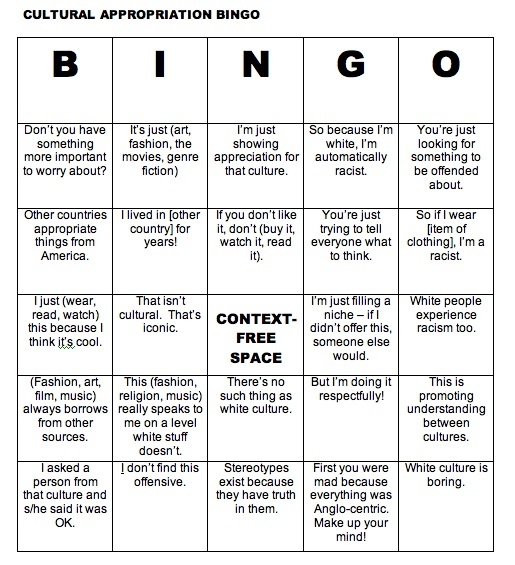
Cultural Appropriation Bingo: Proving your Comments are Unoriginal and Ignorant, Native Appropriations
Dr. Sheila Addison, Cultural Appropriation Bingo

Dr. Sheila Addison
Cultural Appropriation Bingo

Pretendians and What to Do with People Who Falsely Say They’re Indigenous Put Infocus, APTN News

“Pretendians – noun – A person who falsely claims to have Indigenous ancestry – meaning it’s people who fake an Indigenous identity or dig up an old ancestor from hundreds of years ago to proclaim themselves as Indigenous today. They take up a lot of space and income from First Nation, Inuit and Metis Peoples. It’s not a new phenomenon – but the conversation about what to do about these fraudsters continues to evolve. In the wake of the most recent identity scandal that rocked the arts world and ended with award-winning filmmaker Michelle Latimer apologizing for falsely claiming connection to Kitigan Zibi, some are calling for harsh penalties for anyone who can’t back up their identity claim – fines of $250,000 or five years in jail.”

Afrofuturism
The Origins and Impact of Afrofuturism, African and Afro-Diasporan Talks
“‘The Origins and Impact of Afrofuturism’, with Naima Keith and Zoe Whitley, curators of 'The Shadows Took Shape’ on at Studio Museum until March 2014.”
Afrofuturism Takes Flight: from Sun Ra to Janelle Monáe, the Guardian
“Culturally, Afrofuturism’s reach is vast. It encompasses the literature of writers such as Octavia E Butler and Ishmael Reed, films such as John Sayles’s The Brother From Another Planet, and the visual art of Jean-Michel Basquiat and Ellen Gallagher. It has been retrospectively applied to the work of musicians ranging from Jimi Hendrix and Sun Ra to Public Enemy and Lee "Scratch” Perry. It has an expansive and pliant musical heritage, which film-maker and Afrofuturist author Ytasha Womack argues stretches all the way back to ancient African griot traditions; she also notes the frequent references to Egyptian astronomy and the pyramids.“
George Clinton, Sun Ra And The Sci-Fi Funk Of Afrofuturism, WBUR
“Cultural critic Mark Dery coined the term 'Afrofuturism’ in 1993 to describe the particular strain of science fiction concerned with black experiences. P-Funk’s universe was inspired by Clinton’s love of television shows like ‘Star Trek’ and films like ‘Close Encounters of the Third Kind.’”
Space is the Place
“Avant-garde jazz musician Sun Ra stars in the movie version of his concept album Space Is the Place. Not following a linear plot line, this experimental film is a bizarre combination of social commentary, blaxploitation, science fiction, and concert performance. The opening scene is set in an intergalactic forest, with Sun Ra introducing his plan to use music as salvation for the black community. Back on Earth, he wears a disguise as Sunny Ray, a piano player in a 1940s Chicago strip club who causes an explosion with his sounds. Switching to a scene in a desert, he plays a card game called "The End of the World,” with the Overseer (Ray Johnson), who is dressed in white and drives a white Cadillac. Sun Ra pulls out a spaceship card and the Arkestra play the song “Calling Planet Earth” as their spaceship lands in Oakland, CA. Perpetually dressed in sparkling gold robes and headdresses, he sets out to save the black people from oppression.“
The Mundane Afrofuturism Manifesto
"The undersigned, being alternately pissed off and bored, need a means of speculation and asserting a different set of values with which to re-imagine the future. In looking for a new framework for black diasporic artistic production, we are temporarily united in the following actions. […] The most likely future is one in which we only have ourselves and this planet.” See also the Mundane Afrofuturist Manifesto page on Martine Syms' site.
We Are in the Future, This American Life
“One of our producers, Neil Drumming, has recently become fascinated with Afrofuturism. It's more than sci-fi. It’s a way of looking at black culture that’s fantastic, creative, and oddly hopeful—which feels especially urgent during a time without a lot of optimism.”
Intersectionality
Introduction, Black Feminism Reimagined: After Intersectionality
“In Black Feminism Reimagined Jennifer C. Nash reframes black feminism's engagement with intersectionality, often celebrated as its primary intellectual and political contribution to feminist theory. Charting the institutional history and contemporary uses of intersectionality in the academy, Nash outlines how women's studies has both elevated intersectionality to the discipline's primary program-building initiative and cast intersectionality as a threat to feminism's coherence. As intersectionality has become a central feminist preoccupation, Nash argues that black feminism has been marked by a single affect—defensiveness—manifested by efforts to police intersectionality's usages and circulations. Nash contends that only by letting go of this deeply alluring protectionist stance, the desire to make property of knowledge, can black feminists reimagine intellectual production in ways that unleash black feminist theory's visionary world-making possibilities”
Mapping the Margins: Intersectionality, Identity Politics, and Violence Against Women of Color, Stanford Law Review
“The problem with identity politics is not that it fails to transcend difference, as some critics charge, but rather the opposite—that it frequently conflates or ignores intra group differences. In the context of violence against women, this elision of difference is problematic, fundamentally because the violence that many women experience is often shaped by other dimensions of their identities, such as race and class. Moreover, ignoring differences within groups frequently contributes to tension among groups, another problem of identity politics that frustrates efforts to politicize violence against women. Feminist efforts to politicize experiences of women and antiracist efforts to politicize experiences of people of color' have frequently proceeded as though the issues and experiences they each detail occur on mutually exclusive terrains. Although racism and sexism readily intersect in the lives of real people, they seldom do in feminist and antiracist practices. And so, when the practices expound identity as "woman" or ‘person of color’ as an either/or proposition, they relegate the identity of women of color to a location that resists telling.”
Demarginalizing the Intersection of Race and Sex: A Black Feminist Critique of Antidiscrimination Doctrine, Feminist Theory and Antiracist Politics, The University of Chicago Legal Forum
“One way to approach the problem of intersectionality is to examine how courts frame and interpret the stories of Black women plaintiffs. While I cannot claim to know the circumstances underlying the cases that I will discuss, I nevertheless believe that the way courts interpret claims made by Black women is itself part of Black women's experience and, consequently, a cursory review of cases involving Black female plaintiffs is quite revealing. To illustrate the difficulties inherent in judicial treatment of intersectionality, I will consider three Title VIP cases: DeGraffenreid v General Motors,5 Moore v Hughes Helicopter6 and Payne v Travenol.”
The Urgency of Intersectionality, TED
“Now more than ever, it's important to look boldly at the reality of race and gender bias -- and understand how the two can combine to create even more harm. Kimberlé Crenshaw uses the term "intersectionality" to describe this phenomenon; as she says, if you're standing in the path of multiple forms of exclusion, you're likely to get hit by both. In this moving talk, she calls on us to bear witness to this reality and speak up for victims of prejudice.”
Age Against the Machine: The Fatal Intersection of Racism & Ageism In the Time of Coronavirus, Intersectionality Matters with Kimberlé Crenshaw
“On this episode of Intersectionality Matters, Kimberle Crenshaw is joined by two timely voices—Ashton Applewhite, author of This Chair Rocks: A Manifesto Against Ageism, and Willie ‘J.R.’ Fleming, Executive Director of the Chicago Anti-Eviction Campaign—to discuss how ageism, and its varying intersections with race, class, ability, and gender, is materializing in the fight against COVID-19.”
What Slavery Engendered: An Intersectional Look at 1619, Intersectionality Matters with Kimberlé Crenshaw
“In this episode, Kimberlé chops it up with Dorothy Roberts, a professor at the University of Pennsylvania and a leading scholar in race, gender, bioethics, and the law. In a conversation that merges intersectional inquiry with The 1619 Project, which interrogates America’s history of slavery in order to understand racial disparities in 2019, Crenshaw and Roberts shed light on the lasting consequences of slavery, segregation, and White Supremacy, and their impact on Black women specifically. Their timely conversation highlights the relationship between the legacy of slavery and instances of modern oppression against Black women, such as the curbing of welfare, forced sterilization, and mass incarceration.”
This is What Intersectional Feminist Art Looks Like, Chicago Tribune
“The Vietnamese language does not have a word for feminism. But the country did and does have feminists, including Nguyen Thi Minh Khai, a revolutionary leader of the Indochinese Communist Party in the 1930s. Her elusive figure lurks everywhere and nowhere in "To Name It is to See It," a solo exhibition by Huong Ngo upstairs at the DePaul Art Museum.”
The Combahee River Collective Statement
“One issue that is of major concern to us and that we have begun to publicly address is racism in the white women’s movement. As Black feminists we are made constantly and painfully aware of how little effort white women have made to understand and combat their racism, which requires among other things that they have a more than superficial comprehension of race, color, and Black history and culture. Eliminating racism in the white women’s movement is by definition work for white women to do, but we will continue to speak to and demand accountability on this issue.”
Why I’m Giving up on Intersectional Feminism, Quartz
“As the honeymoon wore off, I began to notice some things I hadn’t before. For starters, many white women announced themselves as intersectional feminists, yet, were still completely detached from the lives and issues of cis and trans black women and women of color. I also noticed that black women and women of color weren’t too quick to join the intersectional movement either. Instincts and too many bad experiences in white-centered environments made them very distrustful of intersectional feminism.”

Response Questions

Remember to cite specific instances from the text to support your views.

  • How can racism be woven into images, objects, services, content, systems, and aesthetics?
  • How might you check yourself and your work against inadvertent racism or cultural insensitivity?
  • How do we accommodate and make space for fluid and complex cultural identities, and therefore culture rooted in complex issues?
  • How are issues of “quality” used as code for exclusion? What are the measuring sticks used to ascertain “quality?” Are those measuring sticks racist or sexist?
  • How might you deal with the pitfalls of representing cultures/races/nationalities that are not your own?

7.1: Gender as a Cultural Lens, part 2

How Ideas of Gender Shape Culture
Read by Thu Feb 18,
Reading Response due Wed Feb 24,
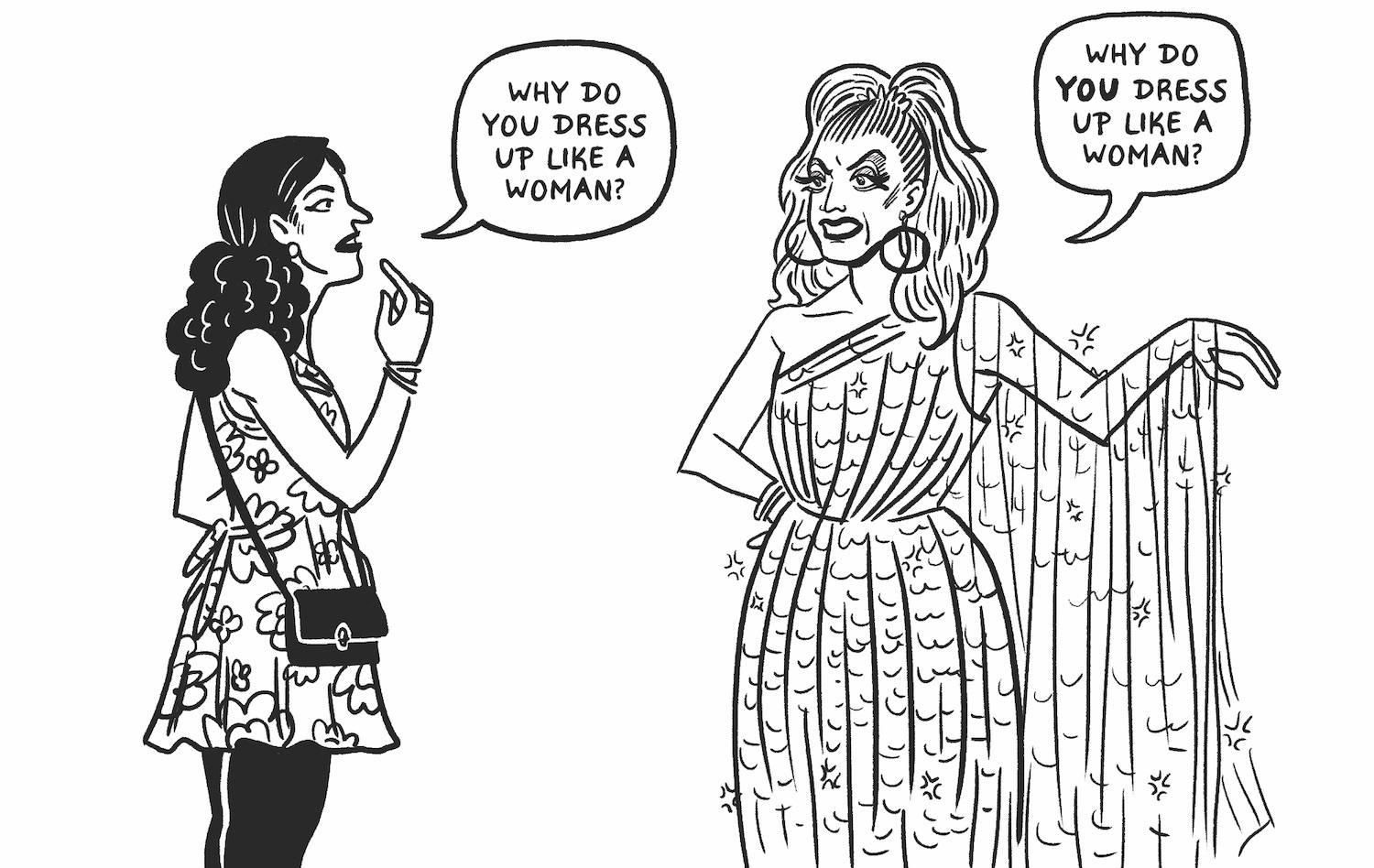
Queer: A Graphic History, by Meg-John Barker, illustrated by Julia Scheele
From Queer: A Graphic History, by Meg-John Barker, illustrated by Julia Scheele

Why?

Gender theory is not just about identifying problems, but seeking action and answers. So, how do these theories act in the real world? How do you apply notions of gender theory or feminism to cultural fields? How does gender theory manifest itself? The readings below illustrate answers to some of these questions. They also introduce queer theory, which uses early gender theory and feminism as a springboard into further questioning sex and gender.

Aside from the overt attention to sex and gender, queer theory posits some interesting ideas about looking beyond binaries. We often look at our world as one of absolutes. What if we approached more things not as polarities, but as spectrums? As always, it is up to you to discern the eternal from the temporal and cultural.

Required

Queer Theory, Cultural Theory and Popular Culture
Why Have There Been No Great Women Artists? (excerpt)

Supplementary Readings

Queer Theory and Queer Formalism
Notes on Queer Formalism, Big Red & Shiny
“Queer formalism is a paradox. Formalism requires the centrality of an object, whereas queer rejects authorship and universal concepts. Queer subverts singularity while the medium requires it. To find meaning in the internal factors of the medium is to invest in its selfhood, its ability to signify. But isn’t this what queer accomplishes? Is this not what we have fought for—the ability to express one’s self, to speak, to be legible to others as a unified agent? Queer rejects unification, however. It advocates for a ‘queer subject’ while attacking the notion of ‘subjecthood.’ Where is the balance?”
Taxi Ride to Gauguin: An Interview with Amy Sillman & Nicole Eisenman, Haunt
“One of the tenets of queer formalism, as I see it, is a complex interchange between identities and mediums, personal histories and aesthetic histories. There is an ongoing process of owning or disowning one’s chosen medium, just as one must wrestle constantly with one’s competing gendered, artistic, racial, and sexual, selves. When looking at your work, Nicole and Amy, I see a series of continuities and changes, such as Nicole’s move from ink to painting, and now sculpture, and Amy’s interest in digital techno logies. No matter the medium, however, your investment in it remains fiercely rigorous and investigative. How has your changing engagement with various materials mirrored an evolution in your personal and artistic identities?”
Judith Butler on the Culture Wars, JK Rowling and Living in “Anti-intellectual Times”, New Statesman
“In the three decades since Gender Trouble was published, the world has changed beyond recognition. In 2014, TIME declared a ‘Transgender Tipping Point.’ Butler herself has moved on from that earlier work, writing widely on culture and politics. But disagreements over biological essentialism remain, as evidenced by the tensions over trans rights within the feminist movement. How does Butler, who is Maxine Elliot Professor of Comparative Literature at Berkeley, see this debate today? And does she see a way to break the impasse? Butler recently exchanged emails with the New Statesman about this issue. The exchange has been edited.”
Feminism in Design
Art of Feminism: Images that Shaped the Fight for Equality, 1857–2017
“From highlighting the posters of the Suffrage Atelier, through the radical art of Judy Chicago and Carrie Mae Weems, to the cutting-edge work of Sethembile Msezane and Andrea Bowers, The Art of Feminism traces the way feminists have shaped visual arts and media throughout history. Featuring more than 350 works of art, illustration, photography, performance, and graphic design-along with essays examining the legacy of the radical canon-this rich volume showcases the vibrancy of the feminist aesthetic over the last 150 years.”
Women Design: Pioneers in Architecture, Industrial, Graphic and Digital Design from the Twentieth Century to the Present Day
“From architects and product designers to textile artists and digital innovators, Women Design profiles a selection of the most dynamic female designers from the modern era, showcasing their finest work and celebrating their enduring influence. Design throughout history has been profoundly shaped and enhanced by the creativity of women; as practitioners, commentators, educators and commissioners. But in a narrative that eagerly promotes their male counterparts, their contributions are all too often overlooked. Through 21 engaging profiles, Women Design rediscovers and revels in the work of pioneers such as Eileen Gray, Lora Lamm and Lella Vignelli, while shining a spotlight on modern-day trailblazers including Kazuyo Sejima, Hella Jongerius and Neri Oxman. Richly illustrated with archival imagery, this is a rare glimpse into the working worlds of some of the most influential forces in contemporary design.”
Women Who Draw
“Women Who Draw is an open directory of female* professional illustrators, artists and cartoonists. It was created by two women artists in an effort to increase the visibility of female illustrators, emphasizing female illustrators of color, LBTQ+, and other minority groups of female illustrators. *Women Who Draw is trans-inclusive and includes women, trans and gender non-conforming illustrators.”
The Role of Women in Design | 12 Designers – 12 Opinions, Graphicart News
“What role are women designers playing in today’s world? Are they taking a more leading role in the design field? Do women and their male counterparts differ in anyway? From a feminist aspect, women and men do not differ in any kind. However, the numbers speak the truth, as we do not find enough women designers in conferences, publications, or as jurors. Is this a reversing trend? Barbara Szaniecki from Brazil, Belen Mena from Ecuador, Benito Cabanas from Mexico, Chris Lozos from United States, Gitte Kath from Denmark, Jamila Varawala from India, Lygia Santiago from Brazil, Maria Mercedes Salgado from Ecuador, Marina Córdova Alvéstegui and Susana Machicao both from Bolivia, respectable designers , well known to our community and Veerle Poupeye from Jamaica, Executive Director of the National Gallery of Jamaica, were called to give the role of women in design as they experiences it in their respective countries or just global observations. They came with very interesting points and links for your references.”
Rebecca Wright on the Ratio of Girls with Design Degrees vs. Those in the Industry, It's Nice That
“We often find ourselves discussing the role, and lack of women in the world of graphic design. Rather than try and cackhandedly work it out for ourselves we decided to ask someone at the frontline of the issue to help explain it. Rebecca Wright is programme director of graphic communication design at Central Saint Martins, University of the Arts London.”
How One Design Agency is Fighting for Feminism, Creative Bloq
“Liam Fay-Fright explains why Mother London joined forces with fashion mag Elle to fight the patriarchy, in the design industry and beyond.”
Haus Proud: The Women of Bauhaus, The Guardian
“More women than men applied to the school in 1919, and Gropius insisted that there would be ‘no difference between the beautiful and the strong sex’—those very words betraying his real views. Those of the 'strong sex’ were, in fact, marked out for painting, carving and, from 1927, the school’s new architecture department. The 'beautiful sex’ had to be content, mostly, with weaving.”
Invisible Women, 99% Invisible

“Even when women are the focus of design, their actual needs are still sometimes ignored. Consider the three-stone stove, a traditional cooking mechanism used by 80% of people in the developing world. It is a simple device consisting of three stones with a fire underneath and a pot above. This stove not terribly efficient and is often placed in poorly ventilated rooms, exposing women in particular to the equivalent of multiple packs of cigarettes per day worth of harmful smoke. Alternatives have been developed by well-meaning groups, but adoption has been slow, in part because many designers have simply failed to consult the actual women for whom they are designing.”

Invisible Women

“Welcome to the Gender Data Gap. Our world is largely built for and by men, in a system that can ignore half the population. This book will tell you how and why this matters In her new book, Invisible Women, award-winning campaigner and writer Caroline Criado Perez shows us how, in a world largely built for and by men, we are systematically ignoring half the population. She exposes the gender data gap - a gap in our knowledge that is at the root of perpetual, systemic discrimination against women, and that has created a pervasive but invisible bias with a profound effect on women's lives. Caroline brings together for the first time an impressive range of case studies, stories and new research from across the world that illustrate the hidden ways in which women are excluded from the very building blocks of the world we live in, and the impact this has on their health and wellbeing. From government policy and medical research, to technology, workplaces, urban planning and the media - Invisible Women exposes the biased data that excludes women. In making the case for change, this powerful and provocative book will make you see the world anew.”

What Does a Feminist Graphic Design History in the United States Look Like?, Alphabettes

“It is my hope that this digital collection can be considered a humble contribution to the ongoing feminist effort in design. There are multiple limits in this collection. There is a disturbing lack of literature on women’s impact in the history of graphic design, independently of their background.”

This is part one of a four-part series.

Response Questions

  • How might you see gender playing a part in your professional field? How might it impact what you depict in your work?
  • How might looking at art through a queer theory lens, or queer formalist lens (not dealing with sex/gender, but looking outside of binary systems) impact your work?
  • Why have there been no great women artists (tongue in cheek)? What factors have kept them from the canon, and what do we do about that?
  • What is of eternal consequence here, and what is cultural and temporal? Support your arguments. (Only answer this if you didn’t answer it for the previous set of readings).

6.2: Gender as a Cultural Lens, part 1

How Ideas of Gender Shape Culture
Read by Sat Feb 13,
Reading Response due Wed Feb 17,
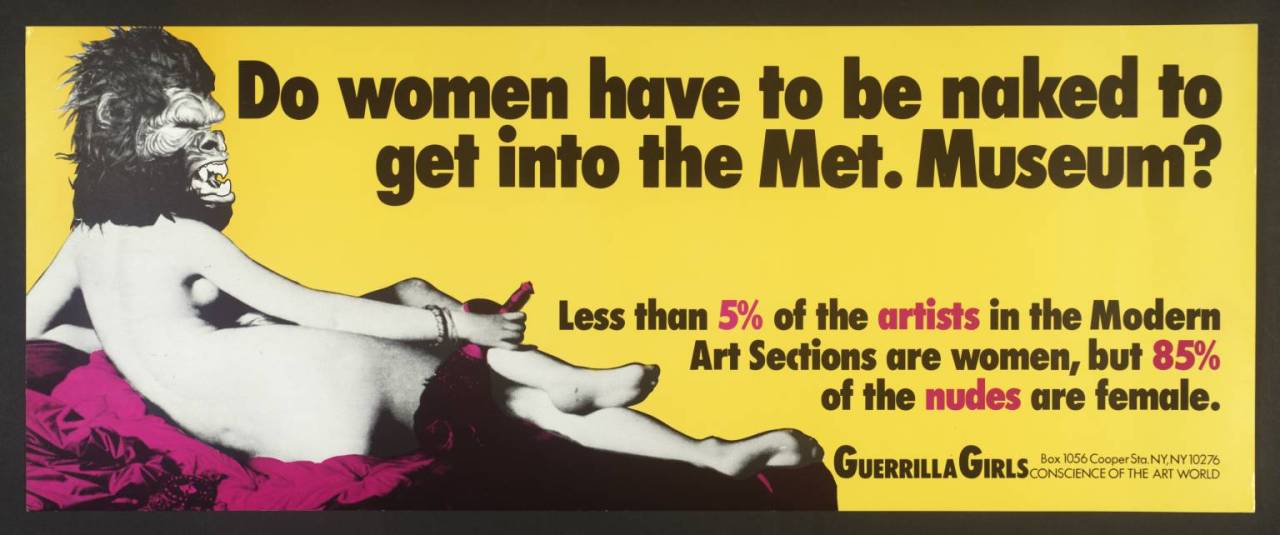
Guerrilla Girls, Do Women Have To Be Naked To Get Into the Met. Museum?, 1989
Guerrilla Girls (1985–)
Do Women Have To Be Naked To Get Into the Met. Museum?, 1989

Why?

Gender and sex have long been factors when editing culture. For centuries women were barred from markets, educational opportunities, voting, owning land, jobs, histories, voices, and more. Although strides have been made in recent decades, we are far from parity. It is important to look closer at not only the history of discrimination, but to dissect definitions of sex and gender to better understand other forms of discrimination and cultural editing.

Two main voices that you’ll see below belong to Simone de Beauvoir (1909–1986) and Judith Butler (1956–). De Beauvoir’s book The Second Sex (1949) helped spur the feminist movements of the 1950s forward. It outlined how the idea of woman is constructed socially, and that one becomes a woman through performing the roles, actions, and aesthetics that society dictates. Judith Butler built off of de Beauvoir’s ideas with her book Gender Trouble (1990) which posited that not only gender was socially contructed, but sex as well. Butler’s writings are foundational to queer theory and intersectionality.

Understandably, this can be a tricky topic considering how we see and address sex and gender in the Church. These readings are to help you understand world views of these topics. It is up to you to discern between what is of eternal consequence and what is temporal and cultural. It is also important to mention that the way the Church uses the term “gender” and the way that gender theorists use the term are very differently. Church leaders tend to use the terms “sex” and “gender” synonymously. Gender theorists differentiate between the two as you will find in your readings.

Required

Feminisms, Cultural Theory and Popular Culture
Introduction, The Second Sex

Supplementary Readings

Gender Theory
An Introduction to Judith Butler’s Gender Troubles
“Gender is ‘performative.’ It’s based on what we do. It is not part of our nature; we simply act it out. So definitions of masculinity and femininity are constructed, rather than something that comes from within us.”
Sexual Personae: Art and Decadence from Nefertiti to Emily Dickinson
“Paglia believes that ‘sexual physiology provides the pattern for our experience of the world.’ She follows Hobbes, Sade, Nietzsche, and Freud in her antifeminist view of (sexual) nature–not culture–as the ultimate determinant of human history and relationships. Society is needed to keep that potentially destructive nature in check; undefeated, however, pagan eroticism still flourishes in Western culture. This large, often aphoristic volume traces pagan, sometimes mythological, archetypes from antiquity through the 19th century. An introductory chapter expounds Paglia’s thesis that Western aesthetics has been Apollonian (sky god)–male, rational; and has repressed its Dionysian (earth god)–female, emotional polarity. Major chapters deal with Italian Renaissance art ("an explosion of sexual personae” in its rebirth of pagan forms), Spenser, Shakespeare, Rousseau, Goethe, Blake, Wordsworth, Coleridge, Byron, Shelley, Keats, Balzac, Gautier, Baudelaire, Huysmans, the Bronte sisters, Swinburne, Pater, late 19th-century decadent art, Wilde, Poe, Hawthorne, Melville, Emerson, Whitman, James, and Dickinson. Paglia’s perceptions are interdisciplinary; a large dose of psychological anthropology is mixed with her literary and cultural criticism.”
What Does ‘Hood Feminism’ Mean For A Pandemic?, Code Switch
“This week on the show, we're talking about race, feminism and COVID-19 with Mikki Kendall. She's the author of the new book Hood Feminism: Notes from the Women that a Movement Forgot, which is about all the ways in which feminists who are women of color—especially black feminists—have a wider agenda than the mainstream, largely white feminist movement.”
Key Issues in Postcolonial Feminism: A Western Perspective, Gender Forum
“Post-colonial feminists are still in the process of contesting the Eurocentric gaze that privileges Western notions of liberation and progress and portrays Third World women primarily as victims of ignorance and restrictive cultures and religions.”
How Pink Became a Color for Girls, Racked
“For most of history, pink was just another color. It was worn equally by men and women. A line in Little Women published in 1869 refers to Amy as tying pink and blue ribbons around two babies to tell the male from the female ‘in the French fashion.’ That’s often cited as a reason pink became affiliated with girls. However, ribbons aside, babies were generally dressed in white, and if you did have twins that needed to be color-coded you didn’t have to go with pink or blue ribbons. A catalogue from 1918 even recommended dressing female babies in blue as it had a ‘much more delicate and dainty tone.’”
Simone de Beauvoir
Dungeons & Dragons & Philosophers III: Ladies’ Night at the Dragon’s Den, Existential Comics
Read the comic, but also the blurbs underneath about each philosopher featured: Philippa Foot, Simone de Beauvoir, G.E.M. Anscombe, Judith Butler, and Hannah Arendt.
An Introduction to Simone de Beauvoir’s The Second Sex
“‘One is not born, but rather becomes, a woman.’ Male-dominated society deliberately constructs the idea of femininity to keep men in control.”
The Second Sex
“In 1946, Simone de Beauvoir began to outline what she thought would be an autobiographical essay explaining why, when she had tried to define herself, the first sentence that came to mind was ‘I am a woman.’ That October, my maiden aunt, Beauvoir’s contemporary, came to visit me in the hospital nursery. I was a day old, and she found a little tag on my bassinet that announced, ‘It’s a Girl!’ In the next bassinet was another newborn (‘a lot punier,’ she recalled), whose little tag announced, ‘I’m a Boy!’ There we lay, innocent of a distinction—between a female object and a male subject—that would shape our destinies. It would also shape Beauvoir’s great treatise on the subject. Beauvoir was then a thirty-eight-year-old public intellectual who had been enfranchised for only a year.”
What is Woman? (de Beauvoir + Metroid)
“Simone de Beauvoir, existentialist philosopher, feminist theorist, and author of The Second Sex, may not seem to be a good match for the 1986 Nintendo video game Metroid, but 8-Bit Philosophy, a web series that explains philosophical concepts by way of vintage video games, makes it make sense.”
Simone de Beauvoir: 1975 Interview
“In the 1975 interview with French journalist Jean-Louis Servan-Schreiber—‘Why I’m a Feminist’—De Beauvoir picks up the ideas of The Second Sex, which Servan-Schreiber calls as important an ‘ideological reference’ for feminists as Marx’s Capital is for communists. He asks De Beauvior about one of her most quoted lines: 'One is not born a woman, one becomes one.’ Her reply shows how far in advance she was of post-modern anti-essentialism, and how much of a debt later feminist thinkers owe to her ideas.” (Open Culture)
Feminisms
Feminism in the Light of the Gospel of Jesus Christ, BYU Studies Quarterly
“In its most basic basic form, feminism echoes eternal truths of the gospel, which affirms the equal worth of all people, the equal right to and capacity for spirituality, and the evils of abuse.”
It’s Not (All) the Second Wave’s Fault, Elle
“In 2010, during yet another of these intergenerational scraps, Katha Pollitt complained that the 'new wave’ talk was used ‘to describe each latest crop of feminists—loosely defined as any female with more political awareness than a Bratz doll—and to portray them in terms of their rejection of second wavers, who are supposedly starchy and censorious [. . .] The wave structure,’ she continued, ‘. . . looks historical, but actually it is used to misrepresent history by evoking ancient tropes about repressive mothers and rebellious daughters.’”
What Does ‘Hood Feminism’ Mean For A Pandemic?, Code Switch
“This week on the show, we're talking about race, feminism and COVID-19 with Mikki Kendall. She's the author of the new book Hood Feminism: Notes from the Women that a Movement Forgot, which is about all the ways in which feminists who are women of color—especially black feminists—have a wider agenda than the mainstream, largely white feminist movement.”
Key Issues in Postcolonial Feminism: A Western Perspective, Gender Forum
“Post-colonial feminists are still in the process of contesting the Eurocentric gaze that privileges Western notions of liberation and progress and portrays Third World women primarily as victims of ignorance and restrictive cultures and religions.”
Women Design: Pioneers in Architecture, Industrial, Graphic and Digital Design from the Twentieth Century to the Present Day
“From architects and product designers to textile artists and digital innovators, Women Design profiles a selection of the most dynamic female designers from the modern era, showcasing their finest work and celebrating their enduring influence. Design throughout history has been profoundly shaped and enhanced by the creativity of women; as practitioners, commentators, educators and commissioners. But in a narrative that eagerly promotes their male counterparts, their contributions are all too often overlooked. Through 21 engaging profiles, Women Design rediscovers and revels in the work of pioneers such as Eileen Gray, Lora Lamm and Lella Vignelli, while shining a spotlight on modern-day trailblazers including Kazuyo Sejima, Hella Jongerius and Neri Oxman. Richly illustrated with archival imagery, this is a rare glimpse into the working worlds of some of the most influential forces in contemporary design.”
Women Who Draw
“Women Who Draw is an open directory of female* professional illustrators, artists and cartoonists. It was created by two women artists in an effort to increase the visibility of female illustrators, emphasizing female illustrators of color, LBTQ+, and other minority groups of female illustrators. *Women Who Draw is trans-inclusive and includes women, trans and gender non-conforming illustrators.”
The Role of Women in Design | 12 Designers – 12 Opinions, Graphicart News
“What role are women designers playing in today’s world? Are they taking a more leading role in the design field? Do women and their male counterparts differ in anyway? From a feminist aspect, women and men do not differ in any kind. However, the numbers speak the truth, as we do not find enough women designers in conferences, publications, or as jurors. Is this a reversing trend? Barbara Szaniecki from Brazil, Belen Mena from Ecuador, Benito Cabanas from Mexico, Chris Lozos from United States, Gitte Kath from Denmark, Jamila Varawala from India, Lygia Santiago from Brazil, Maria Mercedes Salgado from Ecuador, Marina Córdova Alvéstegui and Susana Machicao both from Bolivia, respectable designers , well known to our community and Veerle Poupeye from Jamaica, Executive Director of the National Gallery of Jamaica, were called to give the role of women in design as they experiences it in their respective countries or just global observations. They came with very interesting points and links for your references.”
Rebecca Wright on the Ratio of Girls with Design Degrees vs. Those in the Industry, It's Nice That
“We often find ourselves discussing the role, and lack of women in the world of graphic design. Rather than try and cackhandedly work it out for ourselves we decided to ask someone at the frontline of the issue to help explain it. Rebecca Wright is programme director of graphic communication design at Central Saint Martins, University of the Arts London.”
How One Design Agency is Fighting for Feminism, Creative Bloq
“Liam Fay-Fright explains why Mother London joined forces with fashion mag Elle to fight the patriarchy, in the design industry and beyond.”
How Do Tech’s Biggest Companies Compare on Diversity?, The Verge
The Verge created a set of interactive charts that break down diversity at some of the biggest tech comapnies: Apple, Google, Twitter, Intel, Facebook, Microsoft, and Amazon.
Haus Proud: The Women of Bauhaus, The Guardian
“More women than men applied to the school in 1919, and Gropius insisted that there would be ‘no difference between the beautiful and the strong sex’—those very words betraying his real views. Those of the 'strong sex’ were, in fact, marked out for painting, carving and, from 1927, the school’s new architecture department. The 'beautiful sex’ had to be content, mostly, with weaving.”
Invisible Women, 99% Invisible

“Even when women are the focus of design, their actual needs are still sometimes ignored. Consider the three-stone stove, a traditional cooking mechanism used by 80% of people in the developing world. It is a simple device consisting of three stones with a fire underneath and a pot above. This stove not terribly efficient and is often placed in poorly ventilated rooms, exposing women in particular to the equivalent of multiple packs of cigarettes per day worth of harmful smoke. Alternatives have been developed by well-meaning groups, but adoption has been slow, in part because many designers have simply failed to consult the actual women for whom they are designing.”

Invisible Women

“Welcome to the Gender Data Gap. Our world is largely built for and by men, in a system that can ignore half the population. This book will tell you how and why this matters In her new book, Invisible Women, award-winning campaigner and writer Caroline Criado Perez shows us how, in a world largely built for and by men, we are systematically ignoring half the population. She exposes the gender data gap - a gap in our knowledge that is at the root of perpetual, systemic discrimination against women, and that has created a pervasive but invisible bias with a profound effect on women's lives. Caroline brings together for the first time an impressive range of case studies, stories and new research from across the world that illustrate the hidden ways in which women are excluded from the very building blocks of the world we live in, and the impact this has on their health and wellbeing. From government policy and medical research, to technology, workplaces, urban planning and the media - Invisible Women exposes the biased data that excludes women. In making the case for change, this powerful and provocative book will make you see the world anew.”

What Does a Feminist Graphic Design History in the United States Look Like?, Alphabettes

“It is my hope that this digital collection can be considered a humble contribution to the ongoing feminist effort in design. There are multiple limits in this collection. There is a disturbing lack of literature on women’s impact in the history of graphic design, independently of their background.”

This is part one of a four-part series.

Response Questions

Remember to cite specific instances from the text to support your views.

  • What are the issues around discussing only a singular feminism?
  • According to Butler, the question of “the subject” of feminism is crucial for politics, and for feminist politics in particular. How and why?
  • As with any issue of an “other” or a power struggle, would it be more advantageous to force the existing structures to accept the marginalized, or for the marginalized to create their own structures that are more inclusive? Why? Can you think of examples?
  • What is of eternal consequence here, and what is cultural and temporal? Support your views.

6.1: Platforms, Distribution, and Display As Cultural Lenses

How Reproductions, Photographs, Museums, Publications, Television and the Internet Shape Culture and Visual Literacy
Read by Thu Feb 11,
Reading Response due Wed Feb 17,
Joseph Kosuth (1945–), One and Three Chairs, 1965
Joseph Kosuth (1945–)
One and Three Chairs, 1965
Wood folding chair, mounted photograph of a chair, and mounted photographic enlargement of the dictionary definition of “chair”
Chair 32 3/8 x 14 7/8 × 20 7/8″ (82 x 37.8 × 53 cm), photographic panel 36 × 24 1/8″ (91.5 × 61.1 cm), text panel 24 × 30″ (61 × 76.2 cm)
Larry Aldrich Foundation Fund
© 2020 Joseph Kosuth / Artists Rights Society (ARS), New York, Courtesy of the artist and Sean Kelly Gallery, New York

Why?

One of the primary concern’s of Benjamin’s “The Work of Art in the Age of Mechanical Reproduction” (below) is how the nature of artwork and its place in society has changed when photographic reproductions have become more ubiquitous. What did it mean when you could see an image of an artwork, but never see the original work? Does the original serve a purpose at that point? He wrote this about 80 years ago, before broadcast television had taken a strong hold, well before the internet and social media, and before commercial printing did a good job of handling color images. While you are reading his essay, think about how these concepts have aged and how they might apply to contemporary life. Benjamin’s essay was the basis for John Berger’s Ways of Seeing that you will watch afterwards. Berger’s video updates some of Benjamin’s ideas and makes them a bit more accessible.

Along the lines of Benjamin’s and Berger’s thinking about reproductions, publications (magazines, books, websites), galleries, and museums all form distribution channels and contexts for images. Asking how those platforms that display and distribute images shape our understanding of art, determine what qualifies as art/design, and act as gatekeepers of “quality” is important. Consider the limitations of these platforms and the things that influence them—technology, money, politics, sexism, racism, and so on.

Required

The Work of Art in the Age of Mechanical Reproduction
Ways of Seeing, episode 1

Ways of Seeing (1972), 30:01, by John Berger

Supplementary Readings

Benjamin & Adorno

Walter Benjamin and Theodor Adorno were both part of the Frankfurt School, but their ideas were often at odds. They function as effective foils to each other to help understand the others’ strengths and limitations.

The Naysayers: Walter Benjamin, Theodor Adorno, and the Critique of Pop Culture, The New Yorker
“The worst that one Frankfurt School theorist could say of another was that his work was insufficiently dialectical. In 1938, Adorno said it of Benjamin, who fell into a months-long depression. The word ‘dialectic,’ as elaborated in the philosophy of Hegel, causes endless problems for people who are not German, and even for some who are. In a way, it is both a philosophical concept and a literary style. Derived from the ancient Greek term for the art of debate, it indicates an argument that maneuvers between contradictory points. It 'mediates,’ to use a favorite Frankfurt School word. And it gravitates toward doubt, demonstrating the 'power of negative thinking,’ as Herbert Marcuse once put it. Such twists and turns come naturally in the German language, whose sentences are themselves plotted in swerves, releasing their full meaning only with the final clinching action of the verb.”
ENGL 300: Introduction to Theory of Literature: Lecture 17 – The Frankfurt School of Critical Theory
“This first lecture on social theories of art and artistic production examines the Frankfurt School. The theoretical writings of Theodor Adorno and Walter Benjamin are explored in historical and political contexts, including Marxism, socialist realism, and late capitalism. The concept of mechanical reproduction, specifically the relationship between labor and art, is explained at some length. Adorno’s opposition to this argument, and his own position, are explained. The lecture concludes with a discussion of Benjamin’s perspective on the use of distraction and shock in the process of aesthetic revelation.”
The Culture Industry: Selected Essays on Mass Culture
“The creation of the Frankfurt School of critical theory in the 1920s saw the birth of some of the most exciting and challenging writings of the twentieth century. It is out of this background that the great critic Theodor Adorno emerged. His finest essays are collected here, offering the reader unparalleled insights into Adorno’s thoughts on culture. He argued that the culture industry commodified and standardized all art. In turn this suffocated individuality and destroyed critical thinking. At the time, Adorno was accused of everything from overreaction to deranged hysteria by his many detractors. In today’s world, where even the least cynical of consumers is aware of the influence of the media, Adorno’s work takes on a more immediate significance. The Culture Industry is an unrivalled indictment of the banality of mass culture.”
Aesthetic Theory
“Perhaps the most important aesthetics of the twentieth century appears here newly translated, in English that is for the first time faithful to the intricately demanding language of the original German. The culmination of a lifetime of aesthetic investigation, Aesthetic Theory is Theodor W. Adorno’s magnum opus, the clarifying lens through which the whole of his work is best viewed, providing a framework within which his other major writings cohere.”
The Work of Art in the Age of Its Technological Reproducibility, and Other Writings on Media
“Benjamin’s essay ‘Work of Art’ sets out his boldest thoughts on media and on culture in general. It is collected here with other essays, as he tackles film, radio, photography, and the modern transformations of literature and painting.”
Dialectic of Elightenment
“One of the core texts of Critical Theory, Dialectic of Enlightenment explores the socio-psychological status quo that had been responsible for what the Frankfurt School considered the failure of the Age of Enlightenment. Together with The Authoritarian Personality (1950; also co-authored by Adorno) and Frankfurt School member Herbert Marcuse’s One-Dimensional Man (1964), it has had a major effect on 20th-century philosophy, sociology, culture, and politics, inspiring especially the New Left of the 1960s and 1970s” (text from Wikipedia)
The Work of Art in the Age of the Internet, Hyperallergic
“In March of 2020, however, art displays everywhere suddenly changed. (Of course the entire culture has also been transformed, but I discuss only the art world.) This change had nothing to do with leftist politics or the development of novel art forms. Right now the only way to see art exhibitions in museums or in galleries is online. Without leaving my study I visit art shows anywhere in virtual displays.”
Walter Benjamin: The Work of Art in the Age of Mechanical Reproduction
“An introduction to the art critic Walter Benjamin and his most influential essay, the Work of Art in the Age of Mechanical Reproduction. Including David Douglas's the Work of Art in the Age of Digital Reproduction.”
Marxisms: The Frankfurt School, Althusserianism, Hegemony, and Post-Marxism, Cultural Theory and Popular Culture
I know this is a long slog for this one, but there is a really good and succinct (despite its length) overview of the different facets of Marxism. Stick with it and do your best to understand the different terms and ideas.
Reproduction/Copies
Who am I? A Philosophical Inquiry, TED-Ed
“Throughout the history of mankind, the subject of identity has sent poets to the blank page, philosophers to the agora and seekers to the oracles. These murky waters of abstract thinking are tricky to navigate, so it’s probably fitting that to demonstrate the complexity, the Greek historian Plutarch used the story of a ship. Amy Adkins illuminates Plutarch’s Ship of Theseus.”
Lascaux Paintings and the Taco Bell Breakfast Menu, The Anthropocene Reviewed
“John Green reviews a 17,000-year-old painting and the Taco Bell breakfast menu.” For our purposes, the section on the Lascaux paintings is the only applicable one and the time indicated is only for that section.
Display/Exhibition Theory
To Bear Witness: Real Talk About White Supremacy Culture in Art Museums Today
“We know very well that art museums are some of the strongest cultural bastions of western colonization. Through very deliberately racist and sexist practices of acquisition, deaccession, exhibition and art historical analysis, museums have decisively produced the very state of exclusion that publicly engaged art historians and curators like me are currently working hard to dismantle. Yet, what we do not speak honestly enough about are the very distinct ways in which racism and sexism are often times utilized to traumatize us and undermine our work — the very work that our respective institutions claim they want and often recruit us to do.”
Notes on the Gallery Space, Inside The White Cube: The Ideology of the Gallery Space
“The ideal gallery subtracts from the artwork all cues that interfere with the fact that it is ‘art.’ The work is isolated from everything that would detract from its own evaluation of itself. This gives the space a presence possessed by other spaces where conventions are preserved through the repetition of a closed system of values. Some of the sanctity of the church, the formality of the courtroom, the mystique of the experimental laboratory joins with chic design to produce a unique chamber of esthetics. So powerful are the perceptual fields of force within this chamber that, once outside it, art can lapse into secular status. Conversely, things become art in a space where powerful ideas about art focus on them.”
Almost One Third of Solo Shows in US Museums go to Artists Represented by Just Five Galleries
“Nearly one-third of the major solo exhibitions held in US museums between 2007 and 2013 featured artists represented by just five galleries, according to research conducted by The Art Newspaper. We analysed nearly 600 exhibitions submitted by 68 museums for our annual attendance-figures survey and found that 30% of prominent solo shows featured artists represented by Gagosian Gallery, Pace, Marian Goodman Gallery, David Zwirner and Hauser & Wirth.”
The Voices of Silence
Note: This books is 661 pages. Read as much of it as you like. I recommend the first chapter: “Museum Without Walls” which jibes nicely with John Berger’s Ways of Seeing—exemplifying how the visual reproduction of art impacts the popularity and how people experience it.
Editor’s Letter, ARTnews
“Global art history requires more than an expanded sense of cultural geography, as Christopher Green contends in an essay about recent exhibitions of Native American art. This fall, the Metropolitan Museum of Art in New York installed a collection of Native artwork, crafts, and ceremonial objects in the American Wing rather than in the galleries set aside for Indigenous cultures. The move could be interpreted as part of a broader process of decolonization within museums (wall texts acknowledged that the Met sits on Lenape land). But, as Green writes, the museum’s display conventions, geared toward highlighting aesthetic values, also obscure the context and purpose of the artworks.”
How Advocates of African-American Art Are Advancing Racial Equality in the Art World, Artsy
“Only a small group of African Americans occupy curatorial positions at mainstream museums, relatively few African-American artists have been given major solo museum shows, and works by 19th- and 20th-century African-American artists are undervalued by the art market relative to those by white artists of equal standing. Change doesn’t come organically, however. It takes individuals. And there is a contingent of curators, collectors, artists, dealers, and others who are working to advance racial diversity in the art world. We spoke to those with a history of activism around the representation of African-American art in the United States and a younger generation of artists and professionals who are reaping the rewards of their forebears and continuing the movement toward a fairer—and more culturally rich—art world.”
A Study Found That 85% of Artists in U.S. Museum Collections are White, and 87% are Male, Artsy
“The permanent collections of America’s museums are disproportionately male and overwhelmingly white, according to a study published by the Public Library of Science. The study, based on online data from 18 major U.S. museums—including the Metropolitan Museum of Art, the National Gallery of Art, the Philadelphia Museum of Art, the Art Institute of Chicago, the Los Angeles County Museum of Art, and the Museum of Fine Arts, Houston—had at its disposal more than 40,000 works by over 10,000 artists.”
Are U.S. Art Museums Finally Taking Latin American Art Seriously?, ARTnews
“It’s in New York, the center of the U.S. art world, where the topic of Latin American art seems to have been most overlooked. In the last decade, the New Museum has had only one solo installation by a Latin American artist (Carlos Motta’s ‘Museum as Hub’ piece in 2012). Over the last eight years, the Whitney Museum has had no surveys that deal with Latino themes and has done only one solo exhibition featuring an artist of Latin American origin … sort of. That’d be the 2007 Gordon Matta-Clark exhibition, ‘You Are the Measure.’ (The artist’s father was born in Chile.)”
To Fight Racism Within Museums, They Need to Stop Acting Like They’re Neutral, Vice
“In April, the Brooklyn Museum hired a white curator, Kristen Windmuller-Luna to oversee its collection of African art. The appointment outraged skeptics who felt that a black curator should oversee the institution’s African objects. Decolonize This Place, a New York activist group, staged a protest occupying the museum’s Beaux-Arts Court and penned a letter publicly accusing the museum of racism and aiding gentrification, demanding prompt change.”
Captivating Cultures: the Politics of Exhibiting, Representation: Cultural Representations and Signifying Practices
“The link between visibility and power is rendered most compelling when one considers human subjects and in particular the great spectacles of the colonial period—the national and international exhibitions that were mounted in Great Britain between 1850 and 1925. These exhibitions were notable for a great many things: their promotion of exploration, trade, business interests, commerce; their dependence on adequate rail links, colonial trading networks, and advertising; their launching of now familiar products: Colman’s mustard, Goodyear India rubber and ice cream; their notable effect on the institutionalization of collecting and internalization of commerce. Among these other notable distractions, they provided another type of spectacle: the display of peoples. In this section we will look, very briefly, at ethnographic displays which showed people, not objects.”
Where Does a Work of Art Belong?, Hyperallergic
“But this widening of the canons, so David Joselit argues in his new book, Heritage and Debt: Art in Globalization (MIT Press, 2020), was accompanied by a politically governed marginalization of these non-Western traditions. Only the West, it was claimed, had developed art capable of an ongoing expansion. Other cultures merely provided resources to be exploited. Told this way, the story of art was part and parcel with the rise of Western imperialism. Now, however, ‘art’s globalization,’ he writes, ‘has the potential to redress Western modernism’s cultural dispossession of the global South.’ If countries outside the West can reclaim their heritage, globalization could then become politically liberating.”
The Work of Art in the Age of the Internet, Hyperallergic
“In March of 2020, however, art displays everywhere suddenly changed. (Of course the entire culture has also been transformed, but I discuss only the art world.) This change had nothing to do with leftist politics or the development of novel art forms. Right now the only way to see art exhibitions in museums or in galleries is online. Without leaving my study I visit art shows anywhere in virtual displays.”

Response Questions

Remember to cite specific instances from the text to support your views.

  • What is the importance of the “original” when it comes to art and design? Is this always applicable? Are there areas where the idea of an “original” is not in play?
  • Would you say that the context, or mode of display of an image is as important, less important, or more important than the content of the image itself? How might an image’s context come into play in a magazine? On television? On the internet? In a gallery? In a museum/gallery?

5.2: Thinking and Writing Critically About Art and Design

Articulating Ideas About Art
Read by Sat Feb 06,
Reading Response due Wed Feb 10,
Eye and Hand

Why?

We have now spent some time understanding visual literacy and going even deeper to understand different layers of “texts” (think connotations and latent text). Most of this has been in service of better understanding the intricacies of the imagery you create. However, we can’t overlook the importance of the written word in stepping up to offer critique, and helping out when the imagery isn’t doing all of the conceptual lifting. An inarticulate designer will struggle with clients, have difficulty selling themselves, and will miss opportunities that are more obvious to keener designers. A designer who can express themselves, think critically, and competently verbalize their ideas will be head and shoulders above the pack.

Required

Why Writing Should Be Part of Your Design Portfolio, Inside Design

Read: Use your time this week to begin work on the Writing Exam. The resources below will help you find the answers you need to answer the questions. You can save, exit, and return to the exam as needed, so you can take it in stages.

NO SUPPLEMENTARY READINGS REQUIRED FOR THIS SET.
The required readings above and Writing Exam are extensive enough.

Supplementary Readings

Art/Design Criticism & Art/Design Journalism
Reflecting on the Mistakes I’ve Made as an Art Critic, Hyperallergic
“Art critic Seph Rodney considers on his reviews during the last few years and what he may have gotten wrong and why.”
Writing a Review of an Exhibition, A Short Guide to Writing About Art
“Writing a review requires analytic skill, but a review is not identical with an analysis. An analysis usually focuses on one work or at most a few, and often the work (let’s say Picasso’s Guemica) is familiar to the readers. On the other hand, a review of an exhibition normally is concerned with a fairly large number of works, many of which may be unfamiliar.” Note: I don’t agree with all of Sylvan’s views on what to include in a review, so read this with a grain of salt. There is some very useful information in here, though.
SuperScript, The Walker Art Center
Note: This site contains a number of essays and presentation videos. “In May 2015, the Walker Art Center and Mn Artists hosted Superscript: Arts Journalism and Criticism in a Digital Age, a three-day conference of panels, keynotes, and a blog mentorship program, all dedicated to pondering the present and possible futures for arts publishing online. To complement the proceedings, the Walker and MnArtists collaborated on a series of commissioned essays features thinking by some of the field’s most incisive voices on key topics not addressed within the live event, published in the months following the conference. This page documents the entirety of this inaugural experiment.”
Art Criticism in the Age of Yelp, Rhizome
“In a writing style that picks up on both the casualness and directness of reviews on Yelp, Droitcour manages to avoid many of the pitfalls of art reviewing, those traits (convoluted sentences, overly grand claims, reliance on jargon) that have led to the many essays putting art criticism to death. Could Yelp be the answer for some of the stylistic issues with criticism? It’s hard to ignore the prevailing tone in Yelp reviews. As they refer largely to experiences, they are highly subjective; every other sentence begins with ‘I,’ and they include a lot of storytelling and little information.”
Post-Internet Art Criticism Survey, Kunstkritikk
“So do we need a new generation of writers to do justice to a new range of subjects/crises? Yes, though all these new materialist, object-oriented, speculative, ecological, network ideas are spreading rapidly, they are still oddly invoked to reignite old ideas of critique, resistance, utopia and the like—invoked to save what’s lost. Not that I personally subscribe to all of these new ideas, but at least they should serve to challenge, if not debunk, the latter. The imperative of resistance, for instance, does not just hark back to ‘68, but even to World War II as pointed out by philosopher Michel Serres. So if you’re not into resistance, you’re a corrupt ‘collaborateur’.”
Art Criticism in the Networked Age, Kunstlicht
Note: This is a publication with numerous articles. “It is within this context that art criticism–which has professed itself to be in a crisis since Flusser’s time of writing at the very least–is to maintain itself. The current condition of art criticism is exemplary of these hybrid times: traditional art criticism seems like an anachronism, a relic of the enlightenment project. But at the same time, the need for art criticism is still urgent–perhaps more urgent than ever.”
Has the Internet Changed Art Criticism? On Service Criticism and A Possible Future, Rhizome
“Look at the title. I’m asking has, not 'how.’ Contemporary art is still in the early stages of the digital shift that other industries have already experienced. To better understand what might be happening to art criticism, we should look to other fields and assess the structures that have developed as a response to the internet’s effect.”
Hyperallergic, at Age 9, Rivals the Arts Journalism of Legacy Media, Nieman Reports
“More than a million people read Hyperallergic each month, says Gueyikian, who is publisher. The site’s revenue last year was $1.5 million, an increase from about $1.1 million in 2016, he says. The couple have invested personal savings into the business and have yet to pay themselves full salaries. Their first profitable year was 2014, and they have been primarily funded by ads since, breaking about even each year, Gueyikian says 'Essentially, they are one of the few, if not the only, commercially viable, native-to-online publishing institutions to emerge in the last decade,’ says Sky Goodden, editor and publisher of Momus, an online publication that emphasizes art criticism.”
ARTS.BLACK: An Editorial Note, Temporary Art Review
“Though we are in the age of ‘democratized media’, its facilitators and content are hardly reflective of the artists, and the individuals who consume it. The lack of Black writers in the critical arts realm influences an industry that is completely one dimensional.”
Structuralist/Post-Structuralist/New Criticism
The Intentional Fallacy, The Verbal Icon: Studies in the Meaning of Poetry
“The claim of the author’s 'intention’ upon the critic’s judgment has been challenged in a number of recent discussions, notably in the debate entitled The Personal Heresy, between Professors Lewis and Tillyard. But it seems doubtful if this claim and most of its romantic corollaries are as yet subject to any widespread questioning. The present writers, in a short article entitled ‘Intention’ for a Dictionary1 of literary criticism, raised the issue but were unable to pursue its implications at any length. We argued that the design or intention of the author is neither available nor desirable as a standard for judging the success of a work of literary art, and it seems to us that this is a principle which goes deep into some differences in the history of critical attitudes. It is a principle which accepted or rejected points to the polar opposites of classical 'imitation’ and romantic expression. It entails many specific truths about inspiration, authenticity, biography, literary history and scholarship, and about some trends of contemporary poetry, especially its allusiveness. There is hardly a problem of literary criticism in which the critic’s approach will not be qualified by his view of ‘intention.’”
Criticism and Truth
“Written in 1966 in response to an attack on Barthes’s Sur Racine, this polemic answers many of the charges brought against French New Criticism by conservative, academic, 19th-century-oriented critics: lack of ‘objectivity,’ fondness for ‘jargon,’ indifference to the author’s intention, etc. More positively, Barthes outlines some key concerns: plurality of meanings; analysis, based on linguistics, of the structures of possible meanings; the idea of a science of literature; and the dynamics of reading. Though some of the issues are specific to the French literary-academic situation, the bulk of this brief essay is a lively and accessible statement of an important modern critical position that is worth reading.“
The Death of the Author
"This conception perfectly suits criticism, which can then take as its major task the discovery of the Author (or his hypostases: society, history, the psyche, freedom) beneath the work: once the Author is discovered, the text is ‘explained:’ the critic has conquered; hence it is scarcely surprising not only that, historically, the reign of the Author should also have been that of the Critic, but that criticism (even “new criticism”) should be overthrown along with the Author.”
The Role of the Reader: Explorations in the Semiotics of Texts

“In this erudite and imaginative book, Umberto Eco sets forth a dialectic between ‘open’ and ‘closed’ texts.”

Writing About Your Own Work
No Longer Interested, A Blade of Grass
“I’ve worked to strike the phrase ‘I am interested in’ from my vocabulary. It is not easy. For years I have heard fellow artists explain their practice beginning with: ‘I am interested in notions of…’ ‘I am interested in the intersection between…’ ‘I am interested in questioning…’ I searched for the phrase ‘I am interested in’ in connection to ‘artist statement’ and was embarrassed at how far reaching this crutch phrase is among my peers.” You can follow up this reading with any of the other 15 essays from the same series, linked to at the bottom of Steve’s essay.
Writing an Artist Statement? First Ask Yourself These Four Questions, The Guardian
“Academia is only one part of the art world, says Daniel Blight. To reach wider audiences, let’s find an alternative to artspeak.”
“Don’t Quote Deleuze”: How to Write a Good Artist Statement, Artspace
“Writing about art is hard. Writing about art that you made can be even harder. We hear artists say, ‘If I knew how to describe my work in words, I’d be a writer, not an artist.’ While this may be true, what’s ‘truer’ is the fact that at some point, you as an artist will be asked to write an artist statement—and whether or not it is good, will matter. So, what makes an artist statement ‘good’? Whether you’re applying for a residency or grant, or you just want to perfect your elevator pitch, here are a handful of things not to include in your artist statement, plus a few tips to make the process a little less excruciating.”
The Anti-artist-statement Statement
“I hate artist statements. Really, I do. As an artist, they are almost always awkward and painful to write, and as a viewer they are similarly painful and uninformative to read. I also don’t know who decided that artists should be responsible for writing their own ‘artist statement.’ Maybe it was an understaffed gallery in the 1980s, or a control freak think-inside-my-box-or-get-out MFA program director, but regardless of how this standardized practice came to be, the artist’s statement as professional prerequisite (at least for artists who have yet to be validated by the established art world) has long overstayed its welcome. And I don’t think a new one should be required in its place.”
In Defense of the Artist Statement, Hyperallergic
“As a writer who works with visual artists, I was inspired to address Iris Jaffe’s recent post, ‘The Anti-artist-statement Statement.’ [. . .] Don’t get me wrong: I don’t need an artist’s manifesto or moral judgments or childhood stories. And I definitely don’t want to waste time reading clichés, artspeak, or cool-sounding phrases spit out by an arty robot. Someone else, like the gallery, can be responsible for informing me about historical or cultural context. All I want from an artist statement is a link between the work and the artist. When this is done honestly, the result is original and authentic. It’s simple, but there is so much resistance that the simplicity is overlooked.”

Response Questions

There is no reading response required for this set since you will be working on the Writing Exam.

4.2: Money, Patronage, and Class as Cultural Lenses

How Money and Economies Shape Art Worlds
Read by Sat Jan 30,
Reading Response due Wed Feb 03,
Guerilla Girls (1985–), Women In America Earn Only 2/3 Of What Men Do, 1985
Guerrilla Girls (1985–)
Women In America Earn Only 2/3 Of What Men Do, 1985
Screenprint on paper
Image: 430 × 560 mm

Why?

Economies are a shaping factor in culture. Markets dictate to artists and deseigners what sells (and therefore which creations would be beneficial to make). Are people buying large work or small work? Are they buying highly saturated imagery, black and white, or pastel color palettes? If the economy is struggling, do people buy from your field, or is it seen as a luxury? What ideologies are inherent in economic systems? What might the U.S.’s cultural landscape look like if it offered a base living wage to artists? Will your dream job even exist in ten years? These are all important considerations that function to focus attention on and away from different aspects of culture and cultural production.

Graphic designers, illustrators, and photographers often have clients who are footing the bill. As such, the clients have a large impact on the direction of projects—aesthetic/conceptual input, timelines, resources, etc. In animation, there is often either a client or a perceived audience. Pixar makes movies based on time-tested formulas for plot, character, humor, MPAA rating, color, and so on to appeal to a broad audience and therefore to make a larger profit. I’m not saying the profit is bad or client input taints your creative vision, but it is important to be honest and transparent about the factors that shape your work. When you know your parameters (and which parameters you can transgress), you don’t waste time and resources, and you can find the beauty in constraints.

We start with a dive into economic theory. Our introduction to Marxism is partly to understand alternative systems to capitalism (thereby better understanding capitalism), but mainly to lay a foundation for subsequent cultural theory we’ll be reading that employs a Marxist lens to examine literature, film, music, and art (and not necessarily calling for the violent overthrow of the capitalist system). If the hair on the back of your neck bristles at the mention of Marxism because it is often equated with “godless communists,” I just ask that you set bias aside and seek to understand the theory to better understand culture. I never ask that you tacitly agree with anything that we read in this class, only that you seek to understand it. If you disagree with it after understanding it, then you have a much more solid footing in your argument against it.

Required

How the Death of Mid-Budget Cinema Left a Generation of Iconic Filmmakers MIA, Flavorwire
Capitalism and Socialism: Crash Course World History #33
Marxisms: Classical Marxism, Cultural Theory and Popular Culture

Supplementary Readings

Design Economies
Economies of Design (excerpts)
“Economics and design have never been particularly good bedfellows. One suggests certainties and statistics or, at least, attempts to get a clear understanding of what is going on in the big picture of world events or the smaller one of firms and individuals. The other proposes sensations and aesthetics, opening up myriad ways of doing things, of living, of functioning in the world. One tries to demonstrate the knowable, the other is constantly pushing towards the unknowable. Putting these together creates a seemingly impossible nexus. This book is concerned with the various economies in contemporary capitalism that make design and the ways by which design contributes to the making of economies.”
The Design Economy: The Value of Design to the UK
“Design Council has championed the contribution and importance of design since 1944. Our research and evidence is a vital way we’re able to assess the value of design. The Design Economy is the most comprehensive account ever of design’s contribution to the UK economy.”
Cultural Pay
AIGA Survey of Design Salaries
“Periodically AIGA conducts an extensive compensation survey for the communication design profession—the largest of its kind. See the 2014 survey at designsalaries.aiga.org—and log in as an AIGA member to explore detailed results for job titles by company type, size or location. The AIGA Survey of Design Salaries 2014 draws on an extensive pool of designers and others allied to the profession, and includes responses from nearly 9,000 design professionals in the United States. The survey was conducted on AIGA’s behalf by Readex Research, an independent research company in Minnesota. The AIGA Survey of Design Salaries is commissioned by AIGA in cooperation with Communication Arts magazine. As the principal source of information on the design economy, AIGA produces this salary survey as part of a comprehensive program of activities developed to serve the professional designer with strategies for success.”
CREATIVZ
“CREATIVZ is a conversation about how artists in the United States live and work and what they need to sustain and strengthen their careers. It’s part of a research project from the Center for Cultural Innovation and the National Endowment for the Arts, with additional support from the Doris Duke Charitable Foundation and the Surdna Foundation.”
W.A.G.E.
“Founded in 2008, Working Artists and the Greater Economy (W.A.G.E.) is a New York-based activist organization focused on regulating the payment of artist fees by nonprofit art institutions and establishing a sustainable labor relation between artists and the institutions that contract their labor.”
Economies of Education
Why Get an MFA?, The New York Times
“Do you care about the oppressive lack of diversity in M.F.A. programs—what Junot Díaz calls ’M.F.A. vs. P.O.C.’ [People of Color]—that seems to translate into the astonishingly narrow range of contemporary writing? How is any of this relevant for you?”
An M.F.A. Degree Is Too Expensive, and That’s Only the Start of the Problem, Vulture
“What’s different now is that MFA programs are exorbitantly priced luxury items. At the top-shelf East Coast schools like Yale, RISD, SVA, and Columbia, the two-year cost can top $100,000. This doesn’t include room, board, materials, etc. Add all that in, and you’re hovering near a quarter-million dollars. No matter how wonderful the M.F.A. experience, that’s straight-up highway robbery.”
Debating an MFA? The Lowdown on Art School Risks and Returns, HuffPost
“So how will you know which program is right for you? Should the current metrical obsession with determining success in higher education by the rate of post-graduation employment be translated into art world terms? If sales are to serve as the marker, then tradition-bound programs stressing craft would win. If visibility is the barometer, then the interdisciplinary programs that turn out idiosyncratic hipsters who talk big and make quirky assemblages stand out. If eligibility for teaching is what you seek—cognizant that the field is overwhelmingly composed of poorly paid adjuncts—then the statistical dominance of introductory courses in drawing and design should suggest to you that cultivating technical skills will open more doors.”
Is Getting an MFA Worth the Price?, Artnet News
“We tracked down where each artist on the list went to graduate school, either from publicly available sources or by contacting the artists or their representatives. (For a very few, we were unable to find any information; we’ve left their fields blank in the attached table.) With that data in hand, we could then look for patterns as to how educational choices correlate with this measure of early-career success.”
Can You Make Your Own MFA?, Temporary Art Review
“Now like most young hopeful artists I was filled with the confidence and hubris pretty much required to embark on such a career in the first place, and felt pretty convinced that my decision was sound and I wouldn’t look back. Years later, while I have made the absolute most of my education, my move to the United States and the community I entered in Chicago, I would be happier without the debt that has hung around my neck like an albatross the last 14 years. The list of things I could’ve done, had it not been for the debt is long, so I do my best to not obsess over it – but my experience, and the knowledge that that debt is not easily alleviated by the teaching opportunities available at this point, leads me to think of some other solutions.”
Economic Marxism(s)
Are Marx’s ‘Capital’ and Althusser’s ‘Reading Capital’ Still Relevant Today?, Public Seminar
“As such, Capital necessarily remains immediately relevant into the present for understanding capitalism beyond its various contingent, superficial transformations, as a system possessing its proper logic, structures, and dynamics. […] In short, in the face of the massively disorienting and potentially catastrophic transformations of capitalism that we witness all around us today, transformations that have only accelerated since the turn of this century, if we wish to understand the forces currently driving globalization, general automation, and the corresponding immiseration of the better part of humanity as more and more humans are put to work in ever deteriorating conditions, Althusser and through him Marx tell us that we learn nothing from even the most erudite statistical compilations and neoliberal analyses of GDP, employment, profitability, growth and all the other real, but ultimately superficial and merely descriptive categories of economic calculation.”
Capital: Critique of Political Economy
Marx’s critique of capitalism sets it up as a necessary stepping stone toward the more logical and equitable communism. There are three volumes. The best place to start is probably volume 1, chapter 1.
The Communist Manifesto
This seminal work by Marx and Engels set out their thinking about politics, power, and revolution. You can also find it online.
Socialism/Communism and the Church
Socialism and the United Order
“Marion G. Romney compares and contrasts the theoretical underpinnings and practical implementation of socialism and the United Order.” Note: Romney uses his own definition of socialism that suits his purpose and against which he can argue, but it is just one definition of many. His points about secular vs. theocratic governments are salient.
United Orders
“‘United orders’ refers to the cooperative enterprises established in LDS communities of the Great Basin, Mexico, and Canada during the last quarter of the nineteenth century in an effort to better establish ideal Christian community and group economic self-sufficiency.”

Response Questions

Remember to cite specific instances from the text to support your views.

  • How might the market shape your field including technology, styles, mediums/platforms, subject matter, context, etc.?
  • What may be ways to influence, or control markets and economies rather than just be a passive participant in them?
  • What kinds of value can art and design have? For example, there is monetary value and there is personal value. What other kinds of value can they have? How is that value assigned, evaluated, and manipulated?

4.1: History as a Cultural Lens

We Come to Know Design Through History, but What Exactly is History?
Read by Thu Jan 28,
Reading Response due Wed Feb 03,
Indiana Jones and the Raiders of the Lost Ark (1981)
Indiana Jones and the Raiders of the Lost Ark, 1981
Directed by Steven Spielberg; written by Lawrence Kasdan, George Lucas, and Philip Kaufman

Why?

Experience governs how we understand our world. This experience can be gained empirically—through our senses—and logically—by learning from others and deducing from our experiences. Concepts, such as “design,” are primarily understood through witnesses. Practitioners and teachers define what design is by teaching your methods, materials, theories, and histories. Histories are generally what govern the others. What design has been defines what design is now. The materials and tools employed in the past (even the recent past), are what you are taught to use in the present. Aesthetics of the past are inherited and deployed in the here and now.

The past is what happened, history is how it is remembered. As such, it is important to look closely at what history is, how it is shaped and communicated, and how it molds our understanding of design and culture. We also need to differentiate between history—“A narration of incidents, esp. (in later use) professedly true ones; a narrative, a story”—and myth—“A popular conception of a person or thing which exaggerates or idealizes the truth.”1, 2 It also begs the questions, who is telling the stories, are we learning a true history or a mythology, can we understand design outside of history, and what might design look like that is void of history?

Required

Note: I am including the TED video, not so much for the life-coach, self-help aspect, but to consider what she is saying as a more personal way to contemplate how we tell the stories of history.

How Changing Your Story Can Change Your Life, TED
Design History and the History of Design

Supplementary Readings

Historiography
The Stories We Tell Ourselves, The New York Times
“If we reflect on the stories we tell about ourselves, both to others and to ourselves, we may well find out things about who we are that complicate the view we would prefer to be identified with.”
The Stories We Tell Ourselves, Psychology Today
“None of us wants to be seen as the villain of our own, or of other people’s, lives. Quite the opposite, we want to be regarded well. The stories we tell are attempts to maintain that respect. Even our confessions of failure are equally efforts to show that we are repentant, that we are good people at heart for whom the current malfeasance is mostly an irregularity.”
Myth and History, Encyclopædia Britannica
“Myth and history represent alternative ways of looking at the past. Defining history is hardly easier than defining myth, but a historical approach necessarily involves both establishing a chronological framework for events and comparing and contrasting rival traditions in order to produce a coherent account. The latter process, in particular, requires the presence of writing in order that conflicting versions of the past may be recorded and evaluated. Where writing is absent, or where literacy is restricted, traditions embedded in myths through oral transmission may constitute the principal sources of authority for the past.”
Why Design History? A Multi-National Perspective on the State and Purpose of the Field
“This article asks: what is the significance of design history within higher education? It reviews the practice and purpose of design history, in the education of historically aware and critically engaged designers, as an emerging independent discipline, and in terms of what the subject has to offer allied fields such as history, sociology, cultural studies, history of technology, area studies and anthropology. It considers the development and current state of design history as it is taught in the UK and non-Anglophone Europe (including France, Italy, Scandinavia, Spain, Turkey and Greece), in the US, Australia and East Asia. The argument that follows is grounded in recent design historical scholarship, combined with the views of design historians working in the abovementioned countries, in order to provide both a contemporary perspective on current practice and suggestions about possible futures.”
The Redundancy of Design History
“Of course, this failure of design history to affect practice may be explained by the fact that most designers, on the whole, don’t read. But some do, and particularly those engaged in postgraduate or paper is not another clarion call to practitioners to underpin their practice with more history and theory. We have had enough of such ill-defined, badly informed invocations. Read? Read what? appreciate your traditions? Whose traditions? So, the key problem is not more design history but better design history.”
What is History?, History Today
“Four historians consider the most fundamental question of all, one famously posed by E.H. Carr almost 60 years ago.”
Myth, History, and Theory, History and Theory
“Myth and history are generally considered antithetical modes of explanation. Writers of each tend to distrust the data of the other. Many historians of the modern period see their task as one of removing all trace of myth from the historical record. Many students of myth consider history to have less explanatory power than traditional narra- tives. Since the Greeks, logos (word as demonstrable truth) has been opposed to mythos (word as authoritative pronouncement). In more general terms myth may be defined as any set of unexamined assumptions. Some modern historians have become aware that much so-called factual history is interfused with such assumptions. What we call history is at best mythistory. Some even suggest that there can be no real distinction between the discourses of myth and history, between fact and fiction.”
Has The World Already Ended? Or Just History?, PBS Idea Channel
“Things are… tense…. It’s tough to deny that right now, the world can feel a bit like a standoffish middle school dance… with nukes. Foreign policy, geopolitics, international defense, and even long standing institutions like the European Union and, depending upon who you ask, democracy itself… have uncertain futures. Rather than indulging in our inner chicken little, it may be useful to know this isn’t, of course, the first time some people have felt like the end is nigh. As a matter of fact, depending upon who you ask–and we will… ask–it’s possible that either the world… OR HISTORY… has already ended; though at the end… of both of those things, and this episode, maybe we can find a beginning. Let’s talk some Francis Fukuyama and Jean Baudrillard.”
Unreliable Narrators
Every Marriage Is a Courthouse, This American Life
“The second cartoon Chris Ware and John Kuramoto made for our TV show, animating a story told by Radiolab host Robert Krulwich and his wife, Tamar.”
Who Can You Trust? Unreliable Narrators, It's Lit!, PBS Digital Studios
“Who is the most powerful character in fiction? Villains may doom the world, heroes may save it, but no one has more control over the plot than the narrator - expositing the who, what, where, when and how directly into the reader’s mind. But how can you tell that the person telling you the story is telling you the whole story?”
The Fix Is In, This American Life

“There are all sorts of situations in which we suspect the fix is in, but we almost never find out for certain. On today's show, for once, we find out. The whole program is devoted to one story, in which we go inside the back rooms of one multinational corporation and hear the intricate workings—recorded on tape—of how they put the fix in.”

Mythology
Myth and History, Encyclopædia Britannica
“Myth and history represent alternative ways of looking at the past. Defining history is hardly easier than defining myth, but a historical approach necessarily involves both establishing a chronological framework for events and comparing and contrasting rival traditions in order to produce a coherent account. The latter process, in particular, requires the presence of writing in order that conflicting versions of the past may be recorded and evaluated. Where writing is absent, or where literacy is restricted, traditions embedded in myths through oral transmission may constitute the principal sources of authority for the past.”
Myth, History, and Theory, History and Theory
“Myth and history are generally considered antithetical modes of explanation. Writers of each tend to distrust the data of the other. Many historians of the modern period see their task as one of removing all trace of myth from the historical record. Many students of myth consider history to have less explanatory power than traditional narra- tives. Since the Greeks, logos (word as demonstrable truth) has been opposed to mythos (word as authoritative pronouncement). In more general terms myth may be defined as any set of unexamined assumptions. Some modern historians have become aware that much so-called factual history is interfused with such assumptions. What we call history is at best mythistory. Some even suggest that there can be no real distinction between the discourses of myth and history, between fact and fiction.”
What Is Myth? Crash Course World Mythology #1
“Welcome to Crash Course World Mythology, our latest adventure (and this series may be literally adventurous) in education. Over the next 40 episodes or so, we and Mike Rugnetta are going to learn about the world by looking at the foundational stories of a bunch of different cultural traditions. We’re going to look at the ways that people’s stories define them, and the ways they shape their culture. We’re going to learn about gods, goddesses, heroes, and tricksters, and a lot more. We’re going to walk the blurry line between myth and religion, and we’re going to like it.”

Response Questions

Remember to cite specific instances from the text to support your views.

  • How much does history impact your view of design? Imagine that design did not exist as a concept—that animation, illustration, graphic design, and photography were never invented or developed. How might that alter the way that you work or the way that you talk about your work?
  • If our understanding of design is based on its past performance, how might the stories that are perpetuated about design impact how it is practiced?
  • Consider the sources of the histories you have been taught, particularly around art and design. How reliable are they? What biases might they hold? How might that shape your understanding of design?
  1. “History, n.,” Oxford English Dictionary, accessed January 2, 2021, https://www-oed-com.erl.lib.byu.edu/view/Entry/87324.
  2. “Myth, n.,” Oxford English Dictionary, accessed January 2, 2021, https://www-oed-com.erl.lib.byu.edu/view/Entry/124670.

3.2: Languages (Visual and Otherwise) as Cultural Lenses

Assigning, Communicating, and Understanding Meaning
Read by Sat Jan 23,
Reading Response due Wed Jan 27,
Kate Crawford and artist Trevor Paglen, ImageNet Roulette
Kate Crawford and artist Trevor Paglen
ImageNet Roulette, 2019

Why?

As communicators (visual and otherwise), you must understand how communication works. We all assume that because we can read, write, and interpret the visual, auditory, tactile, and olfactory world around us, that we understand how and why communication works. Communication is a complex world of signs, abstract concepts, experience, context, syntax, and so on. Meaning is assigned, understood, and informed on many different levels. These readings will help you better understand the basics of visual literacy (how we “read” our visual world) and semiotics (the study of signs and how meaning is created).

Required

An Introduction To Semiotics — Signifier And Signified
Icon, Index, and Symbol — Three Categories of Signs
Language: Crash Course Psychology #16

Language: Crash Course Psychology #16 (2014), 10:01

Language & Meaning: Crash Course Philosophy #26

Language & Meaning: Crash Course Philosophy #26 (2016), 09:31

How We’re Teaching Computers to Understand Pictures, TED

How We’re Teaching Computers to Understand Pictures (2015), by Fei-Fei Ji, 17:49

Supplementary Readings

Semiotics & Visual Literacy
How Pink Became a Color for Girls, Racked
“For most of history, pink was just another color. It was worn equally by men and women. A line in Little Women published in 1869 refers to Amy as tying pink and blue ribbons around two babies to tell the male from the female ‘in the French fashion.’ That’s often cited as a reason pink became affiliated with girls. However, ribbons aside, babies were generally dressed in white, and if you did have twins that needed to be color-coded you didn’t have to go with pink or blue ribbons. A catalogue from 1918 even recommended dressing female babies in blue as it had a ‘much more delicate and dainty tone.’”
What Makes a Truly Great Logo, Vox
“About once a month, there’s a new logo to fight about on the internet. The biggest one in recent memory was the highly controversial Hillary Clinton logo, which did not escape scrutiny from Vox.com either. But as a designer/filmmaker, something about these repeated discussions struck me as missing the point on what makes logos tick. It often has little to do with the subjective musings. So I called up Michael Bierut, the designer of that Hillary Clinton logo and countless others. He sat down with me and helped explain the elements of a great logo.”
Auditory Icons, 99% Invisible
The Auditory Icons portion starts at about 10:57 and ends about 19:43. “So instead of a generic and alarming alarm sound that could indicate anything, actual information about the problem is communicated. There’s something intuitive about it, and it illustrates a larger opportunity for alarm designers to rethink appropriate solutions.”
Vexillonaire, 99% Invisible
“Vexillologists—those who study flags—tend to fall into one of two schools of thought. The first is one that focuses on history, category, and usage, and maintains that vexillologists should be scholars and historians of all flags, regardless of their designs. The other school of vexillology, however, maintains that not all flags are created equal, and that flags can and should be redesigned, and improved. Ted Kaye of the Portland Flag Association—the largest subnational flag organization in the country—is one such vexillologist. Kaye has a word for these activist vexillologists of his ilk who go out into the world and lobby for more beautiful flags: ‘vexillonaires.’”
Icon for Access, 99% Invisible
“There is a beauty to a universal standard. The idea that people across the world can agree that when they interact with one specific thing, everyone will be on the same page — regardless of language or culture or geographic locale. If you’re in Belgrade or Shanghai or São Paulo, you can look at a sign and know instantly, without speaking a word of the local language, that this floor is slippery. That the emergency exit is over there. That that substance is poisonous, and you should not eat it. The group behind those internationally recognized logos is called the International Organization for Standardization.”
ENGL 300: Introduction to Theory of Literature: Lecture 8 – Semiotics and Structuralism, Yale University: Open Yale Courses
“In this lecture, Professor Paul Fry explores the semiotics movement through the work of its founding theorist, Ferdinand de Saussure. The relationship of semiotics to hermeneutics, New Criticism, and Russian formalism is considered. Key semiotic binaries–such as langue and parole, signifier and signified, and synchrony and diachrony–are explored. Considerable time is spent applying semiotics theory to the example of a “red light” in a variety of semiotic contexts.”
Semiotics of Sound
Golden Record: Sounds of Earth
Listen to the Golden Record sent into space with the Voyager spacecraft. Each sound is meant to convey life on earth.
Sounds Natural, 99% Invisible
“And then there’s the question of sound. In most wildlife films, the sounds you hear were not recorded while the cameras were rolling. Most filmmakers use long telephoto lenses to film animals, but there’s no sonic equivalent of a zoom lens. Good audio requires a microphone close to the source of the sound, which can be difficult and dangerous. And so many of the subtle movement sounds—a chimpanzee rustling through leaves, or a hippo squelching in the muck, or a lizard fleeing snakes—don’t come from animals at all. They’re made by Foley artists.”
Auditory Icons, 99% Invisible
The Auditory Icons portion starts at about 10:57 and ends about 19:43 “So instead of a generic and alarming alarm sound that could indicate anything, actual information about the problem is communicated. There’s something intuitive about it, and it illustrates a larger opportunity for alarm designers to rethink appropriate solutions.”
Creating Languages, Visual & Otherwise
Ten Thousand Years, 99% Invisible
“In 1990, the federal government invited a group of geologists, linguists, astrophysicists, architects, artists, and writers to the New Mexico desert, to visit the Waste Isolation Pilot Plant. [. . .] This WIPP site is going to be radioactive for hundreds of thousands of years, though this panel was only responsible for keeping this place sufficiently marked for humans for the next 10,000 years—thinking beyond that timeframe was thought to be impossible. [. . .] Who knows the world will look like 10,000 years from now? The panel began by thinking about language. But language, like radioactive materials, has a half life.”
Shaka, When the Walls Fell, The Atlantic
“In one fascinating episode, Star Trek: The Next Generation traced the limits of human communication as we know it—and suggested a new, truer way of talking about the universe.”
The Inevitable, Intergalactic Awkwardness of Time Capsules, Atlas Obscura
“It’s easy to make fun of time capsules, but [. . .] it’s much harder to fill them with the kind of material that will actually stand the test of time. Often, the things we tuck away for posterity are embarrassing or boring. Sometimes, they’re much worse—racist, bigoted, wrongheaded. Most take that old adage about the winners writing history to its logical conclusion. And they are always, by their very nature, exceedingly presumptuous.”
The 116 Images NASA Wants Aliens to See
“The Voyager team tapped famous astronomer and science popularizer Carl Sagan to compose that message. Sagan's committee chose a copper phonograph LP as their medium, and over the course of six weeks they produced the ‘Golden Record’: a collection of sounds and images that will probably outlast all human artifacts on Earth.”
Golden Record: Sounds of Earth
Listen to the Golden Record sent into space with the Voyager spacecraft. Each sound is meant to convey life on earth.
The Foundations of the Voyager Record, Murmurs of Earth: The Voyager Interstellar Record
“In 1977, two extraordinary spacecraft called Voyager were launched to the stars. Affixed to each Voyager craft was a gold-coated copped phonograph record as a message to possible extra-terrestrial civilizations that might encounter the spacecraft in some distant space and time. Each record contained 118 photographs of our planet; almost 90 minutes of the world's greatest music; an evolutionary audio essay on "The Sounds of Earth"; and greetings in almost sixty human languages (and one whale language). This book is an account, written by those chiefly responsible for the contents of the Voyager Record, of why they did it, how they selected the repertoire, and precisely what the record contains.”
Voyager: The Interstellar Mission: The Golden Record, Jet Propulsion Laboratory: California Institute of Technology
You could go down the rabbit hole with this site since there are sounds, images, and multiple texts to read. “NASA placed a more ambitious message aboard Voyager 1 and 2-a kind of time capsule, intended to communicate a story of our world to extraterrestrials. The Voyager message is carried by a phonograph record-a 12-inch gold-plated copper disk containing sounds and images selected to portray the diversity of life and culture on Earth.”
Perception
Perceiving is Believing: Crash Course Psychology #7
“So what does perception even mean? What’s the difference between seeing something and making sense of it? In today’s episode of Crash Course Psychology, Hank gives us some insight into the differences between sensing and perceiving.”
Sensation & Perception – Crash Course Psychology #5
“Just what is the difference between sensing and perceiving? And how does vision actually work? And what does this have to do with a Corgi? In this episode of Crash Course Psychology, Hank takes us on a journey through the brain to better explain these and other concepts.”

Response Questions

Remember to cite specific instances from the text to support your views.

  • How have these readings on semiotics and visual literacy made you think about how you communicate as an artist?
  • If you think of your work as a time capsule akin to the Golden Record or the 10,000 Years project, is it important to you that you work communicate through time? Why or why not? What about your work is specific to contemporary contexts and how much can have a longer life span?
  • How might these readings impact your thinking of representational vs. non-representational work? How might non-representational work communicate?

3.1: Education As Cultural Lens

How Schools, Curricula, and Textbooks Determine what we Consider Art and Design
Read by Thu Jan 21,
Reading Response due Wed Jan 27,
How Long Have You Been Photoshopping?
Team Detroit
Campaign for the College for Creative Studies, 2011

Why?

Educational frameworks and content have a very large impact on how culture is shaped. Educators and programs decide what is taught and what isn’t, what is considered worthy of notice and what should be ignored, what is good and what is bad. Just consider the language in which you are taught, and the limitations of and historical baggage associated with that language. It is a useful exercise to question the base assumption that all educational systems are for the good of all. I’m sure you’ve seen friends who don’t learn well in certain classes, or your interests are not addressed in your textbooks, or historical narratives that are given places of privilege ignore your or your friends’ cultures. How do you make sure that your education is yours and not something that caters to an imaginary average student?

Required

The Main Failing Of Design School: Kids Can’t Think For Themselves, Fast Company
The State of Design Education: A (Spirited) Discussion, Thought You Should See This

Supplementary Readings

Pedagogy
BBC Documentary – Bauhaus 100 – 100 Years of Bauhaus, BBC
“In 1919 an art school opened in Germany that would change the world forever. It was called the Bauhaus. A century later, its radical thinking still shapes our lives today. Bauhaus 100 is the story of Walter Gropius, architect and founder of the Bauhaus, and the teachers and students he gathered to form this influential school. Traumatised by his experiences during the Great War, and determined that technology should never again be used for destruction, Gropius decided to reinvent the way art and design were taught. At the Bauhaus, all the disciplines would come together to create the buildings of the future, and define a new way of living in the modern world.”
The MFA Question
Why Get an MFA?, The New York Times
“Do you care about the oppressive lack of diversity in M.F.A. programs—what Junot Díaz calls ’M.F.A. vs. P.O.C.’ [People of Color]—that seems to translate into the astonishingly narrow range of contemporary writing? How is any of this relevant for you?”
An M.F.A. Degree Is Too Expensive, and That’s Only the Start of the Problem, Vulture
“What’s different now is that MFA programs are exorbitantly priced luxury items. At the top-shelf East Coast schools like Yale, RISD, SVA, and Columbia, the two-year cost can top $100,000. This doesn’t include room, board, materials, etc. Add all that in, and you’re hovering near a quarter-million dollars. No matter how wonderful the M.F.A. experience, that’s straight-up highway robbery.”
Debating an MFA? The Lowdown on Art School Risks and Returns, HuffPost
“So how will you know which program is right for you? Should the current metrical obsession with determining success in higher education by the rate of post-graduation employment be translated into art world terms? If sales are to serve as the marker, then tradition-bound programs stressing craft would win. If visibility is the barometer, then the interdisciplinary programs that turn out idiosyncratic hipsters who talk big and make quirky assemblages stand out. If eligibility for teaching is what you seek—cognizant that the field is overwhelmingly composed of poorly paid adjuncts—then the statistical dominance of introductory courses in drawing and design should suggest to you that cultivating technical skills will open more doors.”
Is Getting an MFA Worth the Price?, Artnet News
“We tracked down where each artist on the list went to graduate school, either from publicly available sources or by contacting the artists or their representatives. (For a very few, we were unable to find any information; we’ve left their fields blank in the attached table.) With that data in hand, we could then look for patterns as to how educational choices correlate with this measure of early-career success.”
Can You Make Your Own MFA?, Temporary Art Review
“Now like most young hopeful artists I was filled with the confidence and hubris pretty much required to embark on such a career in the first place, and felt pretty convinced that my decision was sound and I wouldn’t look back. Years later, while I have made the absolute most of my education, my move to the United States and the community I entered in Chicago, I would be happier without the debt that has hung around my neck like an albatross the last 14 years. The list of things I could’ve done, had it not been for the debt is long, so I do my best to not obsess over it – but my experience, and the knowledge that that debt is not easily alleviated by the teaching opportunities available at this point, leads me to think of some other solutions.”

Response Questions

Remember to cite specific instances from the text to support your views.

  • What are you being taught at BYU? Why? Conversely, what are you not being taught at BYU? Why?
    • For example, why might the topics, histories, artists, styles, cultures that are covered at BYU be taught? Why might others be omitted? Why might they be taught the way that they are taught—set class times, types of classrooms, etc.?
  • What do you gain by being at a liberal arts university? What do you lose? What might you gain/lose if you were at an art school? What might you gain/lose if you didn’t go to school at all, but rather cobbled together your own education online and with job experience?
  • Think about your required curriculum. What do you think will be useful to your growth? What is missing from the curriculum that could help your growth? How might you get exposure to, or learn more about those missing pieces? How might you take ownership of your education rather than being a passive participant submitting to an existing system?
  • How might you take ownership of your education rather than being a passive participant who is just submitting to an existing system?