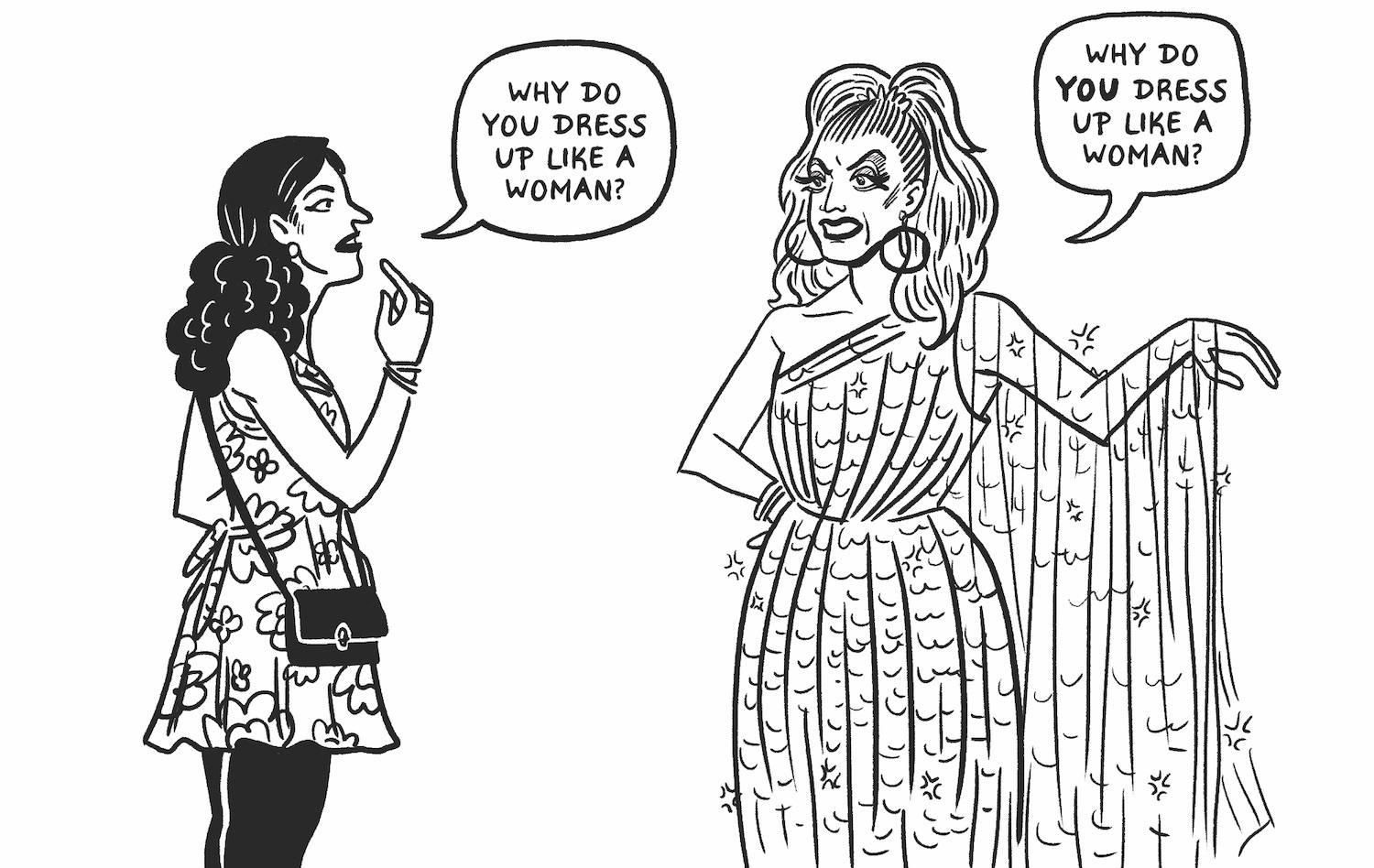
Why?
Gender theory is not just about identifying problems, but seeking action and answers. So, how do these theories act in the real world? How do you apply notions of gender theory or feminism to cultural fields? How does gender theory manifest itself? The readings below illustrate answers to some of these questions. They also introduce queer theory, which uses early gender theory and feminism as a springboard into further questioning sex and gender.
Aside from the overt attention to sex and gender, queer theory posits some interesting ideas about looking beyond binaries. We often look at our world as one of absolutes. What if we approached more things not as polarities, but as spectrums? As always, it is up to you to discern the eternal from the temporal and cultural.
Required
Supplementary Readings
- Queer Theory and Queer Formalism
-
Notes on Queer Formalism, Big Red & Shiny
“Queer formalism is a paradox. Formalism requires the centrality of an object, whereas queer rejects authorship and universal concepts. Queer subverts singularity while the medium requires it. To find meaning in the internal factors of the medium is to invest in its selfhood, its ability to signify. But isn’t this what queer accomplishes? Is this not what we have fought for—the ability to express one’s self, to speak, to be legible to others as a unified agent? Queer rejects unification, however. It advocates for a ‘queer subject’ while attacking the notion of ‘subjecthood.’ Where is the balance?”Taxi Ride to Gauguin: An Interview with Amy Sillman & Nicole Eisenman, Haunt
“One of the tenets of queer formalism, as I see it, is a complex interchange between identities and mediums, personal histories and aesthetic histories. There is an ongoing process of owning or disowning one’s chosen medium, just as one must wrestle constantly with one’s competing gendered, artistic, racial, and sexual, selves. When looking at your work, Nicole and Amy, I see a series of continuities and changes, such as Nicole’s move from ink to painting, and now sculpture, and Amy’s interest in digital techno logies. No matter the medium, however, your investment in it remains fiercely rigorous and investigative. How has your changing engagement with various materials mirrored an evolution in your personal and artistic identities?”Judith Butler on the Culture Wars, JK Rowling and Living in “Anti-intellectual Times”, New Statesman
“In the three decades since Gender Trouble was published, the world has changed beyond recognition. In 2014, TIME declared a ‘Transgender Tipping Point.’ Butler herself has moved on from that earlier work, writing widely on culture and politics. But disagreements over biological essentialism remain, as evidenced by the tensions over trans rights within the feminist movement. How does Butler, who is Maxine Elliot Professor of Comparative Literature at Berkeley, see this debate today? And does she see a way to break the impasse? Butler recently exchanged emails with the New Statesman about this issue. The exchange has been edited.” - Feminism in Design
-
Art of Feminism: Images that Shaped the Fight for Equality, 1857–2017
“From highlighting the posters of the Suffrage Atelier, through the radical art of Judy Chicago and Carrie Mae Weems, to the cutting-edge work of Sethembile Msezane and Andrea Bowers, The Art of Feminism traces the way feminists have shaped visual arts and media throughout history. Featuring more than 350 works of art, illustration, photography, performance, and graphic design-along with essays examining the legacy of the radical canon-this rich volume showcases the vibrancy of the feminist aesthetic over the last 150 years.”Women Design: Pioneers in Architecture, Industrial, Graphic and Digital Design from the Twentieth Century to the Present Day
“From architects and product designers to textile artists and digital innovators, Women Design profiles a selection of the most dynamic female designers from the modern era, showcasing their finest work and celebrating their enduring influence. Design throughout history has been profoundly shaped and enhanced by the creativity of women; as practitioners, commentators, educators and commissioners. But in a narrative that eagerly promotes their male counterparts, their contributions are all too often overlooked. Through 21 engaging profiles, Women Design rediscovers and revels in the work of pioneers such as Eileen Gray, Lora Lamm and Lella Vignelli, while shining a spotlight on modern-day trailblazers including Kazuyo Sejima, Hella Jongerius and Neri Oxman. Richly illustrated with archival imagery, this is a rare glimpse into the working worlds of some of the most influential forces in contemporary design.”Women Who Draw
“Women Who Draw is an open directory of female* professional illustrators, artists and cartoonists. It was created by two women artists in an effort to increase the visibility of female illustrators, emphasizing female illustrators of color, LBTQ+, and other minority groups of female illustrators. *Women Who Draw is trans-inclusive and includes women, trans and gender non-conforming illustrators.”The Role of Women in Design | 12 Designers – 12 Opinions, Graphicart News
“What role are women designers playing in today’s world? Are they taking a more leading role in the design field? Do women and their male counterparts differ in anyway? From a feminist aspect, women and men do not differ in any kind. However, the numbers speak the truth, as we do not find enough women designers in conferences, publications, or as jurors. Is this a reversing trend? Barbara Szaniecki from Brazil, Belen Mena from Ecuador, Benito Cabanas from Mexico, Chris Lozos from United States, Gitte Kath from Denmark, Jamila Varawala from India, Lygia Santiago from Brazil, Maria Mercedes Salgado from Ecuador, Marina Córdova Alvéstegui and Susana Machicao both from Bolivia, respectable designers , well known to our community and Veerle Poupeye from Jamaica, Executive Director of the National Gallery of Jamaica, were called to give the role of women in design as they experiences it in their respective countries or just global observations. They came with very interesting points and links for your references.”Rebecca Wright on the Ratio of Girls with Design Degrees vs. Those in the Industry, It's Nice That
“We often find ourselves discussing the role, and lack of women in the world of graphic design. Rather than try and cackhandedly work it out for ourselves we decided to ask someone at the frontline of the issue to help explain it. Rebecca Wright is programme director of graphic communication design at Central Saint Martins, University of the Arts London.”How One Design Agency is Fighting for Feminism, Creative Bloq
“Liam Fay-Fright explains why Mother London joined forces with fashion mag Elle to fight the patriarchy, in the design industry and beyond.”Haus Proud: The Women of Bauhaus, The Guardian
“More women than men applied to the school in 1919, and Gropius insisted that there would be ‘no difference between the beautiful and the strong sex’—those very words betraying his real views. Those of the 'strong sex’ were, in fact, marked out for painting, carving and, from 1927, the school’s new architecture department. The 'beautiful sex’ had to be content, mostly, with weaving.”Invisible Women, 99% Invisible
“Even when women are the focus of design, their actual needs are still sometimes ignored. Consider the three-stone stove, a traditional cooking mechanism used by 80% of people in the developing world. It is a simple device consisting of three stones with a fire underneath and a pot above. This stove not terribly efficient and is often placed in poorly ventilated rooms, exposing women in particular to the equivalent of multiple packs of cigarettes per day worth of harmful smoke. Alternatives have been developed by well-meaning groups, but adoption has been slow, in part because many designers have simply failed to consult the actual women for whom they are designing.”
Invisible Women
“Welcome to the Gender Data Gap. Our world is largely built for and by men, in a system that can ignore half the population. This book will tell you how and why this matters In her new book, Invisible Women, award-winning campaigner and writer Caroline Criado Perez shows us how, in a world largely built for and by men, we are systematically ignoring half the population. She exposes the gender data gap - a gap in our knowledge that is at the root of perpetual, systemic discrimination against women, and that has created a pervasive but invisible bias with a profound effect on women's lives. Caroline brings together for the first time an impressive range of case studies, stories and new research from across the world that illustrate the hidden ways in which women are excluded from the very building blocks of the world we live in, and the impact this has on their health and wellbeing. From government policy and medical research, to technology, workplaces, urban planning and the media - Invisible Women exposes the biased data that excludes women. In making the case for change, this powerful and provocative book will make you see the world anew.”
What Does a Feminist Graphic Design History in the United States Look Like?, Alphabettes
“It is my hope that this digital collection can be considered a humble contribution to the ongoing feminist effort in design. There are multiple limits in this collection. There is a disturbing lack of literature on women’s impact in the history of graphic design, independently of their background.”
This is part one of a four-part series.
Response Questions
- How might you see gender playing a part in your professional field? How might it impact what you depict in your work?
- How might looking at art through a queer theory lens, or queer formalist lens (not dealing with sex/gender, but looking outside of binary systems) impact your work?
- Why have there been no great women artists (tongue in cheek)? What factors have kept them from the canon, and what do we do about that?
- What is of eternal consequence here, and what is cultural and temporal? Support your arguments. (Only answer this if you didn’t answer it for the previous set of readings).