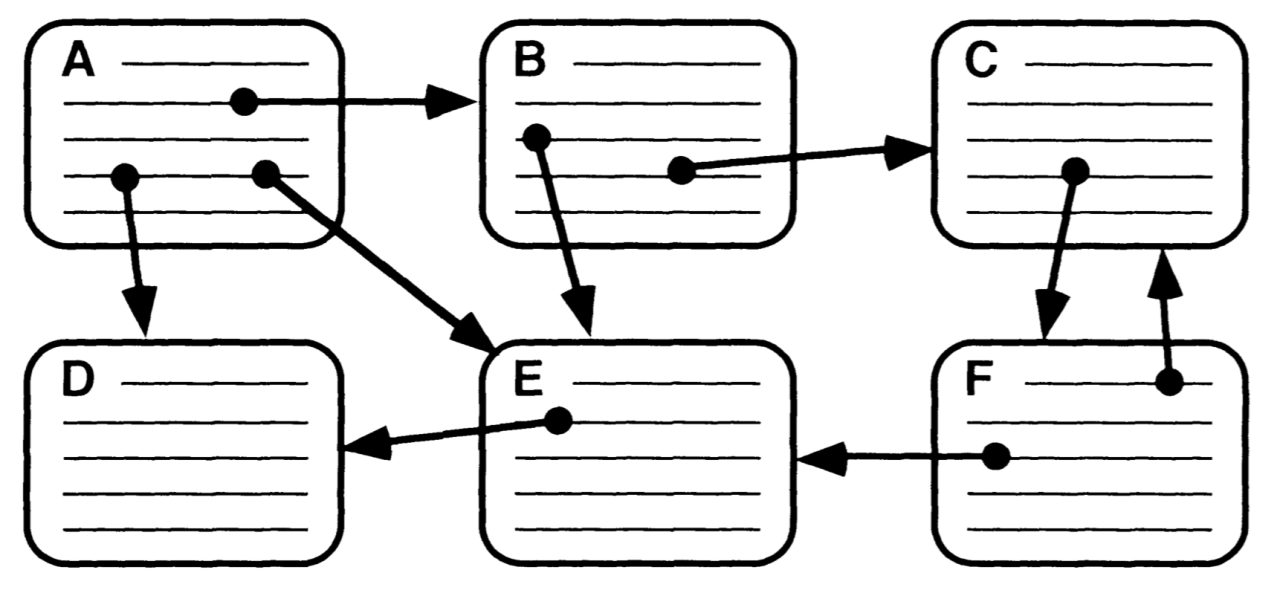
Simplified view of a small hypertext structure having six nodes and nine links.
Why?
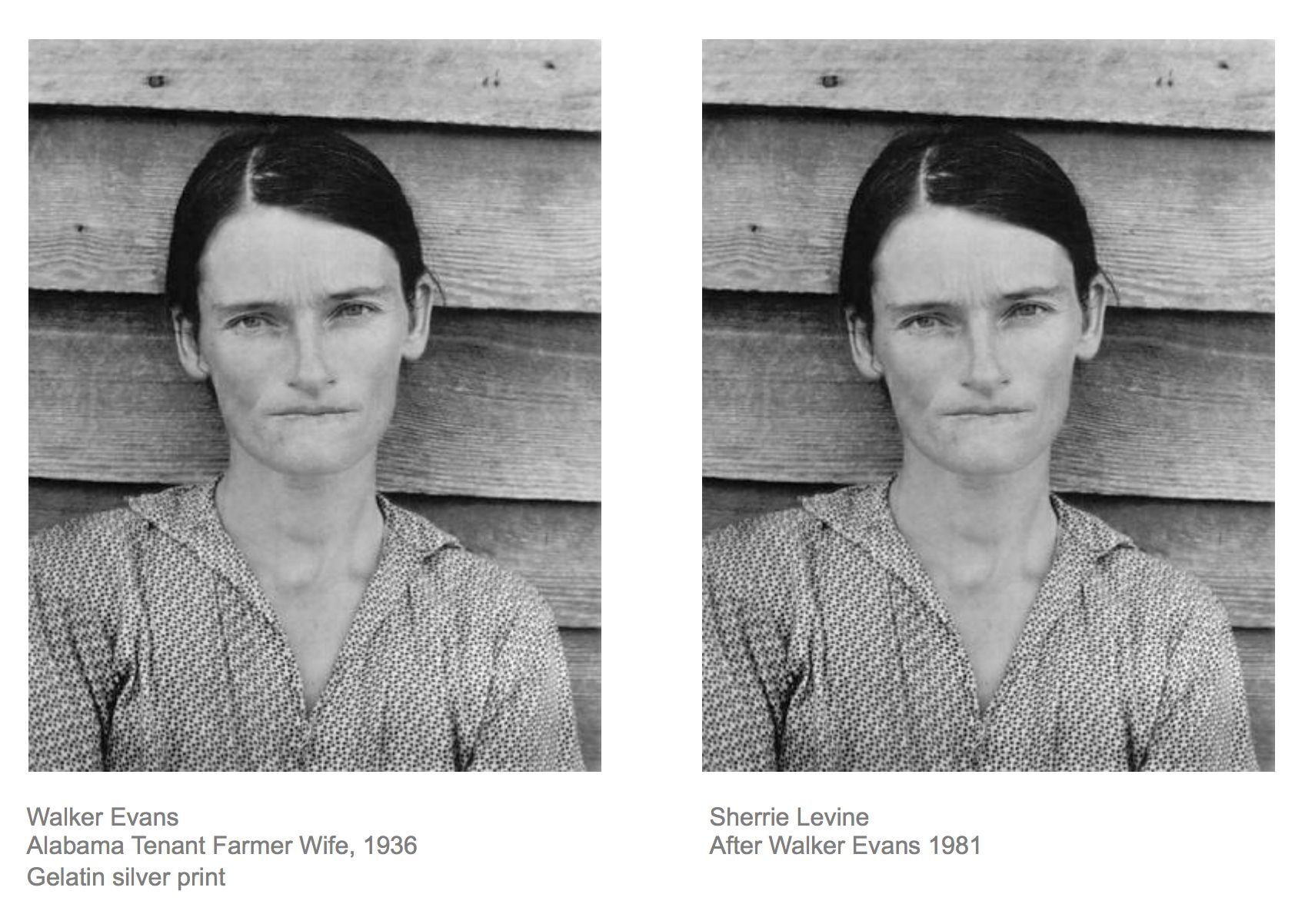
Early in the semester, when discussing semiotics and criticism, we spoke about open texts and closed texts—which Roland Barthes called writerly/scriptable texts and readerly/lisible texts, respectively. These indicated how amenable works were to interpretation and leaving room for the reader to act as a co-author of the work. Below is a brief recap:
open and closed texts A term deriving from the Italian semiotician and philosopher Umberto Eco (b. 1932). According to Eco, a “closed” text is one which encourages a particular interpretation, whereas an “open” text invites a diversity of readings. Such a distinction is also implied in Roland Barthes’s essay “From Work to Text” (1971), where he makes a distinction between “work,” which is more or less passively consumed, and “text,” which renders the process of reading active, productive and constitutive. The text requires of the reader a “practical collaboration.”1
Consider the following:
- Open text: the final product of design can be an open or closed text. The design process can also be open or closed.
- Hypertext: the basis of a hypertext is a series of dynamically linked texts. Design products and processes can also be thought of as hypertexts.
- Social aesthetics/social practice/relational aesthetics: this field considers the value of art, not in visual aesthetics, but in the social relations that are generated through the art—how people are dynamically linked through art objects or processes.
The required readings below dive into these three ideas. As you read them, recognize the areas of overlap and where they may open up possibilities withing design practices.
Required
Supplementary Readings
- Open Text
-
Open Text, Wikipedia
“In semiotic analysis (the studies of signs or symbols), an open text is a text that allows multiple or mediated interpretation by the readers. In contrast, a closed text leads the reader to one intended interpretation. The concept of the open text comes from Umberto Eco’s collection of essays The Role of the Reader, but it is also derivative of Roland Barthes’s distinction between ‘readerly’ (lisible) and ‘writerly’ (scriptible) texts as set out in his 1968 essay, ‘The Death of the Author.’”
Roland Barthes: Understanding Text
“After using this learning object, you will be able to describe Roland Barthes’s theory of the work and the Text, explain the difference between writerly and readerly texts, and identify Barthes’s Five Codes in a text.”
The Death of the Author
“The absence of the Author (with Brecht, we might speak here of a real ‘alienation:’ the Author diminishing like a tiny figure at the far end of the literary stage) is not only a historical fact or an act of writing: it utterly transforms the modern text (or — what is the same thing — the text is henceforth written and read so that in it, on every level, the Author absents himself). Time, first of all, is no longer the same. The Author, when we believe in him, is always conceived as the past of his own book: the book and the author take their places of their own accord on the same line, cast as a before and an after: the Author is supposed to feed the book — that is, he pre-exists it, thinks, suffers, lives for it.”
S/Z
“S/Z is the linguistic distillation of Barthes’s system of semiology, a science of signs and symbols, in which Balzac’s novella, Sarrasine, is dissected semantically to uncover layers of hidden meaning.”
The Role of the Reader: Explorations in the Semiotics of Texts
“In this erudite and imaginative book, Umberto Eco sets forth a dialectic between ‘open’ and ‘closed’ texts.”
- Hypertext
-
The Secret History of Hypertext, The Atlantic
“In the years leading up to World War II, a number of European thinkers were exploring markedly similar ideas about information storage and retrieval, and even imagining the possibility of a global network—a feature notably absent from the Memex. Yet their contributions have remained largely overlooked in the conventional, Anglo-American history of computing. Chief among them was Paul Otlet, a Belgian bibliographer and entrepreneur who, in 1934, laid out a plan for a global network of “electric telescopes” that would allow anyone in the world to access to a vast library of books, articles, photographs, audio recordings, and films.”
As We May Think, The Atlantic
“Consider a future device for individual use, which is a sort of mechanized private file and library. It needs a name, and, to coin one at random, ‘memex’ will do. A memex is a device in which an individual stores all his books, records, and communications, and which is mechanized so that it may be consulted with exceeding speed and flexibility. It is an enlarged intimate supplement to his memory. It consists of a desk, and while it can presumably be operated from a distance, it is primarily the piece of furniture at which he works. On the top are slanting translucent screens, on which material can be projected for convenient reading. There is a keyboard, and sets of buttons and levers. Otherwise it looks like an ordinary desk.”
The Godfather, Wired
"Vannevar Bush is a great name for playing six degrees of separation. Turn back the clock on any aspect of information technology - from the birth of Silicon Valley and the marriage of science and the military to the advent of the World Wide Web - and you find his footprints. As historian Michael Sherry says, ‘To understand the world of Bill Gates and Bill Clinton, start with understanding Vannevar Bush.’”
The History of Hypertext, Nielsen Norman Group
“Hypertext has a surprisingly rich history compared to most phenomena in the personal computer industry, especially considering that most people had not heard of it until a few years ago. I have been to talks at major conferences where the speakers were ignorant of any hypertext developments preceding the introduction of the WWW. Table 3.1 gives an overview of the history of hypertext; the major events are discussed in more detail in this chapter.”
The Curse of Xanadu, Wired
“It was the most radical computer dream of the hacker era. Ted Nelson’s Xanadu project was supposed to be the universal, democratic hypertext library that would help human life evolve into an entirely new form. Instead, it sucked Nelson and his intrepid band of true believers into what became the longest-running vaporware project in the history of computing—a 30-year saga of rabid prototyping and heart-slashing despair. The amazing epic tragedy.”
- Open Design
-
Designers Can Open Source Session Video, opendesign.foundation
“This is a video recording of Braithwaite’s presentation at Blend Conf in Charlotte, NC where he outlines the history and ethos of open-source design which is based on the idea of open-source software.”
Open Design Now
This is comprised of a number of essays, each of which could take between 5 to 30 minutes to read. “Open Design Now: Why Design Cannot Remain Exclusive surveys this emerging field for the first time. Insiders including John Thackara, Droog Design’s Renny Ramakers and Bre Pettis look at what’s driving open design and where it’s going. They examine new business models and issues of copyright, sustainability and social critique. Case studies show how projects ranging from the RepRap self-replicating 3D-printer to $50 prosthetic legs are changing the world. Open Design Now is essential reading for anyone concerned with the future of design and society.”
- Co-Design & Participatory Design
-
Participatory Design, Wicked Problems Worth Solving
“Participatory Design is a broad label for creative activities that are done with end users—where designers act as facilitators or visual translators for people who may not be skilled or confident in idea expression. The activities can take many forms, but the most common ones use visual and semantic tools—such as stickers, blocks of words, or ambiguous shapes—to offer expression to nondesigners.”
Participatory Design in Practice, UX Magazine
“As organizations embrace design-led innovation, they can struggle to reap the full value of human-centered design. A design team’s interactions with customers may often be limited to only the early research and late evaluation phases of the design process, while the work in between – when ideas are being generated – is left to the internal team alone. When this is the case, we miss the opportunity to discover some of the most valuable and customer-centered solutions.”
- Design for Remix
-
Patterns of Physical Design Remixing in Online Maker Communities, ACM’s SIGCHI (Association for Computing Machinery’s Special Interest Group on Computer-Human Interaction)
“Makers participate in remixing culture by drawing inspiration from, combining, and adapting designs for physical objects. To examine how makers remix each others’ designs on a community scale, we analyzed metadata from over 175,000 digital designs from Thingiverse, the largest online design community for digital fabrication. Remixed designs on Thingiverse are predominantly generated designs from Customizer a built-in web app for adjusting parametric designs. However, we find that these designs do not elicit subsequent user activity and the authors who generate them tend not to contribute additional content to Thingiverse. Outside of Customizer, influential sources of remixing include complex assemblies and design primitives, as well as non-physical resources posing as physical designs. Building on our findings, we discuss ways in which online maker communities could become more than just design repositories and better support collaborative remixing.” - Social Aesthetics and Social Practice
-
The Interventionists: Users’ Manual for the Creative Disruption of Everyday Life
“Art made to attach to buildings or to be given away? Wearable art for street demonstrations or art that sets up a booth at a trade show? This is the art of the interventionists, who trespass into the everyday world to raise our awareness of injustice and other social problems. These artists don’t preach or proselytize; they give us the tools to form our own opinions and create our own political actions. The Interventionists, which accompanies an exhibit at MASS MoCA, serves as a handbook to this new and varied work. It’s a user’s guide to art that is exciting”Living as Form
“'Living as Form’ grew out of a major exhibition at Creative Time in New York City. Like the exhibition, the book is a landmark survey of more than 100 projects selected by a 30-person curatorial advisory team; each project is documented by a selection of colour images.”Education for Socially Engaged Art: A Materials and Techniques Handbook
“For too long Social Practice has been the notoriously flimsy flipside of market-based contemporary art: a world of hand-wringing practitioners easily satisfied with the feeling of 'doing good’ in a community, and unaware that their quasi-activist, anti-formalist positions in fact have a long artistic heritage and can be critically dissected using the tools of art and theatre history. Helguera’s spunky primer promises to offer a much-needed critical compass for those adrift in the expanded social field.” –Claire Bishop, Professor of Contemporary Art and Exhibition History, CUNY, and author of Artificial Hells: Participatory Art and the Politics of SpectatorshipArtificial Hells: Participatory Art and the Politics of Spectatorship
“Since the 1990s, critics and curators have broadly accepted the notion that participatory art is the ultimate political art: that by encouraging an audience to take part an artist can promote new emancipatory social relations. Around the world, the champions of this form of expression are numerous, ranging from art historians such as Grant Kester, curators such as Nicolas Bourriaud and Nato Thompson, to performance theorists such as Shannon Jackson.”Seeing Power: Art and Activism in the Twenty-first Century
“Like an updated version of John Berger’s groundbreaking Ways of Seeing, Nato Thompson’s Seeing Power delivers a smart, accessible introduction to the prevailing artistic predicaments of our time. Written by one of our leading public intellectuals, it covers a wide range of key issues from the cultural politics of Occupy Wall Street; to the use and abuse of accumulated social capital; to the perennial antagonism between sophisticated cultural ambiguity and didactic, artistic impact. Seeing Power is a twenty-first-century user’s manual for the social responsible artist, critic, and curator.” —Gregory Sholette, author of Dark Matter: Art and Politics in the Age of Enterprise CultureDialogues in Public Art
“Interviews with the artists who create public art and the people whose lives are changed by it. By the 1990s, public art had evolved far beyond the lonely monument on an open plaza. Now public artists might design the entire plaza, create an event to alter the social dynamics of an urban environment, or help to reconstruct a neighborhood. Dialogues in Public Art presents a rich blend of interviews with the people who create and experience public art–from an artist who mounted three bronze sculptures in the South Bronx to the bureaucrat who led the fight to have them removed; from an artist who describes his work as a "cancer” on architecture to a pair of architects who might agree with him; from an artist who formed a coalition to convert twenty-two derelict row houses into an art center/community revitalization project to a young woman who got her life back on track while living in one of the converted houses.”Support Networks
“When artists break boundaries of traditional forms and work outside of institutionalized systems, they often must create new infrastructures to sustain their practices. Support Networks looks to Chicago’s deeply layered history of artists, scholars, and creative practitioners coming together to create, share, and maintain these alternative networks of exchange and collaboration.”Collectivism after Modernism: The Art of Social Imagination after 1945
“The desire to speak in a collective voice has long fueled social imagination and artistic production. Prior to the Second World War, artists understood collectivization as an expression of the promise or failure of industrial and political modernity envisioned as a mass phenomenon. After the war, artists moved beyond the old ideal of progress by tying the radicalism of their political dreams to the free play of differences.Organized around a series of case studies spanning the globe from Europe, Japan, and the United States to Africa, Cuba, and Mexico, Collectivism after Modernism covers such renowned collectives as the Guerrilla Girls and the Yes Men, as well as lesser-known groups. Contributors explore the ways in which collectives function within cultural norms, social conventions, and corporate or state-sanctioned art.”Introduction: What is Social Aesthetics?, Improvisation and Social Aesthetics
“While addressing the fundamental question, ‘What is social aesthetics?’ the introduction aims to situate the concept of social aesthetics within a number of distinct histories of art, musical, and cultural practices and theoretical paradigms. The editors demonstrate how the social and the aesthetic have come to be conceived and related (at times almost as opposed concepts; at other times as complementary notions) in a number of distinct intellectual and artistic traditions, themselves emerging out of particular histories concerning the theorization of both the social and the aesthetic. The introduction then gives a nuanced summary of the chapters in the volume, relating them to one another and showing in what ways they differ. It ends with a call for further inter- and transdisciplinary research to meet the challenges posed by the recognition, in the scholarship represented in this book, of the complex interpenetration and entanglement of aesthetic and social processes.” - Relational Aesthetics
-
Relational Aesthetics
“Where does our current obsession for interactivity stem from? After the consumer society and the communication era, does art still contribute to the emergence of a rational society? Bourriaud attempts to renew our approach toward contemporary art by getting as close as possible to the artists works, and by revealing the principles that structure their thoughts: an aesthetic of the inter-human, of the encounter; of proximity, of resisting social formatting.”Critique of Relational Aesthetics, Third Text
“Bourriaud’s fetishism of the social produces an inversion of his critical claims for relational aesthetics. His realised utopianism echoes with the commodified friendship of customer services. For all his claims to the novelty of the idea of relational aesthetics, it is a reapplication of Romanticism. Art is conceived as an immediate form of non-capitalist life. But without an account of what mediates relational art’s disengagement from capitalist life, it is helplessly reversible, obliviously occupying the other side of capitalism’s coin.”Antagonism and Relational Aesthetics, October
“But Bourriaud is at pains to distance contemporary work from that of previous generations. The main difference, as he sees it, is the shift in attitude toward social change: instead of a “utopian” agenda, today’s artists seek only to find provisional solutions in the here and now; instead of trying to change their environment, artists today are simply ‘learning to inhabit theworld in a better way’; instead of looking forward to a future utopia, this art sets up functioning 'microtopias’ in the present.Response to Claire Bishop’s Paper on Relational Aesthetics, Circa
“It is unfortunate (but strategic) that Bishop’s only example of a relational artwork at first hand is so far removed from any of the above. Jerry Saltz, describing his experience of a work by Rirkrit Tiravanija for Art in America, gives us an exercise in namedropping and nepotism that demonstrates how familiar types of social practice based on networks of influence and exclusivity can surface anywhere. But as Bishop points out, this actually tells us little, because if we were to base our judgement on individual testimony then every participant in the work would have to be taken into account (suggesting a wildly democratic if untenable form of art criticism).”Meet the Artist: Rirkrit Tiravanija
“Thai artist Rirkrit Tiravanija (b. Buenos Aires, Argentina, 1961; raised in Thailand, Ethiopia, and Canada) has developed a long and varied career that defies classification. For nearly thirty years, his artistic production has focused on real-time experience and exchange, breaking down the barriers between object and spectator. On the opening of our first exhibition of his work, Tiravanija joined Mark Beasley, Robert and Arlene Kogod Secretarial Scholar, Curator of Media and Performance Art, for a discussion about his performative practice, which changes how people connect with art. The interactive installation includes a large-scale mural, drawn on the walls over the course of the exhibition, which references Thai anti-government demonstrations that occurred in 2009–2010. The title of the work, (who’s afraid of red, yellow, and green), refers to the colors worn by the opposing factions in those protests as well as to the three curries that will be served to visitors in the gallery on select days throughout the run exhibition.”Gabriel Orozco in “Loss & Desire”, Art21
“‘I don’t have a studio, so I don’t have a specific place of production,’ remarks Gabriel Orozco. ‘What happens when you don’t have a studio is that you have to be confronted with reality all the time.’ The segment follows Orozco as he creates situations with objects on the street and photographs them. Orozco’s interest in logic, systems, and physics is revealed in his series of games and in the dramatic La D.S.—a Citroën car split down the center and reassembled to elongate its shape.”Felix Gonzalez-Torres: Specific Objects Without Specific Form
“Including both rarely seen and more known paintings, sculptures, photographic works, and public projects, reflecting the full scope of Gonzalez-Torres' short but prolific career and drawn from the Estate of Felix Gonzalez-Torres as well as public and private collections throughout the United States and Europe, this groundbreaking publication proposes an experimental form that is indebted to the artist's own radical conception of the artwork.”
Response Questions
Remember to cite specific instances from the text to support your views.
- Do you see your current practice as creating open, closed, or hypertexts? Why?
- How might you monetize open-source design work or is it inherently non-profit?
- How might you employ participatory design within your own practice (graphic design, illustration, photography, animation, etc.)? What would be the potential benefits and pitfalls?
- After reading in Helguera’s chapters that address symbolic and actual practice, where would you like to locate your practice? Is it possible to be a photographer, graphic designer, or illustrator whose practice has direct impact rather than just acting symbolically? Why or why not? Could your practice be a hybrid of the two? What might that look like?
- If a work’s primary concern is not with visual aesthetics, but with social interaction, what are the evaluative criteria for such a work? If visual “aesthetics” are the rules/principles that govern the visual appeal of a work (shape and proportion, balance, harmony, negative space, color, contrast, etc.), what would you consider principles of “social aesthetics” or socially engaged art that would make it socially “beautiful?”
- J. A. Cuddon, “Open and Closed Texts,” A Dictionary of Literary Terms and Literary Theory (Oxford: Wiley-Blackwell, 2013), 494, https://onlinelibrary-wiley-com.erl.lib.byu.edu/doi/pdf/10.1002/9781118325988.ch15.