6.2: Gender as a Cultural Lens, part 1

How Ideas of Gender Shape Culture
Read by Sat Feb 13,
Reading Response due Wed Feb 17,
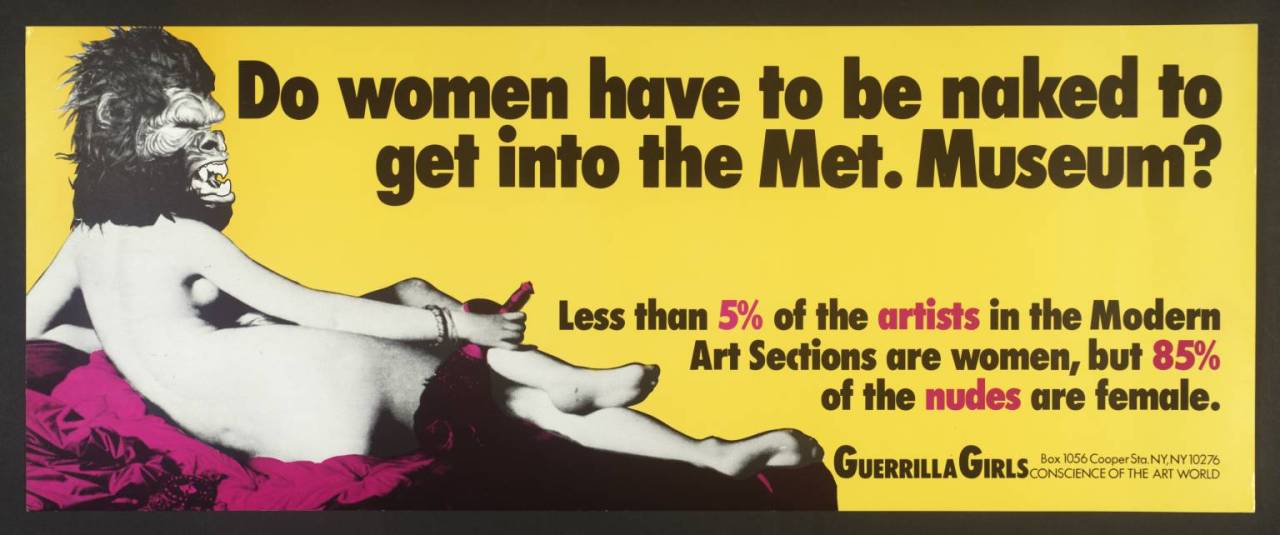
Guerrilla Girls, Do Women Have To Be Naked To Get Into the Met. Museum?, 1989
Guerrilla Girls (1985–)
Do Women Have To Be Naked To Get Into the Met. Museum?, 1989

Why?

Gender and sex have long been factors when editing culture. For centuries women were barred from markets, educational opportunities, voting, owning land, jobs, histories, voices, and more. Although strides have been made in recent decades, we are far from parity. It is important to look closer at not only the history of discrimination, but to dissect definitions of sex and gender to better understand other forms of discrimination and cultural editing.

Two main voices that you’ll see below belong to Simone de Beauvoir (1909–1986) and Judith Butler (1956–). De Beauvoir’s book The Second Sex (1949) helped spur the feminist movements of the 1950s forward. It outlined how the idea of woman is constructed socially, and that one becomes a woman through performing the roles, actions, and aesthetics that society dictates. Judith Butler built off of de Beauvoir’s ideas with her book Gender Trouble (1990) which posited that not only gender was socially contructed, but sex as well. Butler’s writings are foundational to queer theory and intersectionality.

Understandably, this can be a tricky topic considering how we see and address sex and gender in the Church. These readings are to help you understand world views of these topics. It is up to you to discern between what is of eternal consequence and what is temporal and cultural. It is also important to mention that the way the Church uses the term “gender” and the way that gender theorists use the term are very differently. Church leaders tend to use the terms “sex” and “gender” synonymously. Gender theorists differentiate between the two as you will find in your readings.

Required

Feminisms, Cultural Theory and Popular Culture
Introduction, The Second Sex

Supplementary Readings

Gender Theory
An Introduction to Judith Butler’s Gender Troubles
“Gender is ‘performative.’ It’s based on what we do. It is not part of our nature; we simply act it out. So definitions of masculinity and femininity are constructed, rather than something that comes from within us.”
Sexual Personae: Art and Decadence from Nefertiti to Emily Dickinson
“Paglia believes that ‘sexual physiology provides the pattern for our experience of the world.’ She follows Hobbes, Sade, Nietzsche, and Freud in her antifeminist view of (sexual) nature–not culture–as the ultimate determinant of human history and relationships. Society is needed to keep that potentially destructive nature in check; undefeated, however, pagan eroticism still flourishes in Western culture. This large, often aphoristic volume traces pagan, sometimes mythological, archetypes from antiquity through the 19th century. An introductory chapter expounds Paglia’s thesis that Western aesthetics has been Apollonian (sky god)–male, rational; and has repressed its Dionysian (earth god)–female, emotional polarity. Major chapters deal with Italian Renaissance art ("an explosion of sexual personae” in its rebirth of pagan forms), Spenser, Shakespeare, Rousseau, Goethe, Blake, Wordsworth, Coleridge, Byron, Shelley, Keats, Balzac, Gautier, Baudelaire, Huysmans, the Bronte sisters, Swinburne, Pater, late 19th-century decadent art, Wilde, Poe, Hawthorne, Melville, Emerson, Whitman, James, and Dickinson. Paglia’s perceptions are interdisciplinary; a large dose of psychological anthropology is mixed with her literary and cultural criticism.”
What Does ‘Hood Feminism’ Mean For A Pandemic?, Code Switch
“This week on the show, we're talking about race, feminism and COVID-19 with Mikki Kendall. She's the author of the new book Hood Feminism: Notes from the Women that a Movement Forgot, which is about all the ways in which feminists who are women of color—especially black feminists—have a wider agenda than the mainstream, largely white feminist movement.”
Key Issues in Postcolonial Feminism: A Western Perspective, Gender Forum
“Post-colonial feminists are still in the process of contesting the Eurocentric gaze that privileges Western notions of liberation and progress and portrays Third World women primarily as victims of ignorance and restrictive cultures and religions.”
How Pink Became a Color for Girls, Racked
“For most of history, pink was just another color. It was worn equally by men and women. A line in Little Women published in 1869 refers to Amy as tying pink and blue ribbons around two babies to tell the male from the female ‘in the French fashion.’ That’s often cited as a reason pink became affiliated with girls. However, ribbons aside, babies were generally dressed in white, and if you did have twins that needed to be color-coded you didn’t have to go with pink or blue ribbons. A catalogue from 1918 even recommended dressing female babies in blue as it had a ‘much more delicate and dainty tone.’”
Simone de Beauvoir
Dungeons & Dragons & Philosophers III: Ladies’ Night at the Dragon’s Den, Existential Comics
Read the comic, but also the blurbs underneath about each philosopher featured: Philippa Foot, Simone de Beauvoir, G.E.M. Anscombe, Judith Butler, and Hannah Arendt.
An Introduction to Simone de Beauvoir’s The Second Sex
“‘One is not born, but rather becomes, a woman.’ Male-dominated society deliberately constructs the idea of femininity to keep men in control.”
The Second Sex
“In 1946, Simone de Beauvoir began to outline what she thought would be an autobiographical essay explaining why, when she had tried to define herself, the first sentence that came to mind was ‘I am a woman.’ That October, my maiden aunt, Beauvoir’s contemporary, came to visit me in the hospital nursery. I was a day old, and she found a little tag on my bassinet that announced, ‘It’s a Girl!’ In the next bassinet was another newborn (‘a lot punier,’ she recalled), whose little tag announced, ‘I’m a Boy!’ There we lay, innocent of a distinction—between a female object and a male subject—that would shape our destinies. It would also shape Beauvoir’s great treatise on the subject. Beauvoir was then a thirty-eight-year-old public intellectual who had been enfranchised for only a year.”
What is Woman? (de Beauvoir + Metroid)
“Simone de Beauvoir, existentialist philosopher, feminist theorist, and author of The Second Sex, may not seem to be a good match for the 1986 Nintendo video game Metroid, but 8-Bit Philosophy, a web series that explains philosophical concepts by way of vintage video games, makes it make sense.”
Simone de Beauvoir: 1975 Interview
“In the 1975 interview with French journalist Jean-Louis Servan-Schreiber—‘Why I’m a Feminist’—De Beauvoir picks up the ideas of The Second Sex, which Servan-Schreiber calls as important an ‘ideological reference’ for feminists as Marx’s Capital is for communists. He asks De Beauvior about one of her most quoted lines: 'One is not born a woman, one becomes one.’ Her reply shows how far in advance she was of post-modern anti-essentialism, and how much of a debt later feminist thinkers owe to her ideas.” (Open Culture)
Feminisms
Feminism in the Light of the Gospel of Jesus Christ, BYU Studies Quarterly
“In its most basic basic form, feminism echoes eternal truths of the gospel, which affirms the equal worth of all people, the equal right to and capacity for spirituality, and the evils of abuse.”
It’s Not (All) the Second Wave’s Fault, Elle
“In 2010, during yet another of these intergenerational scraps, Katha Pollitt complained that the 'new wave’ talk was used ‘to describe each latest crop of feminists—loosely defined as any female with more political awareness than a Bratz doll—and to portray them in terms of their rejection of second wavers, who are supposedly starchy and censorious [. . .] The wave structure,’ she continued, ‘. . . looks historical, but actually it is used to misrepresent history by evoking ancient tropes about repressive mothers and rebellious daughters.’”
What Does ‘Hood Feminism’ Mean For A Pandemic?, Code Switch
“This week on the show, we're talking about race, feminism and COVID-19 with Mikki Kendall. She's the author of the new book Hood Feminism: Notes from the Women that a Movement Forgot, which is about all the ways in which feminists who are women of color—especially black feminists—have a wider agenda than the mainstream, largely white feminist movement.”
Key Issues in Postcolonial Feminism: A Western Perspective, Gender Forum
“Post-colonial feminists are still in the process of contesting the Eurocentric gaze that privileges Western notions of liberation and progress and portrays Third World women primarily as victims of ignorance and restrictive cultures and religions.”
Women Design: Pioneers in Architecture, Industrial, Graphic and Digital Design from the Twentieth Century to the Present Day
“From architects and product designers to textile artists and digital innovators, Women Design profiles a selection of the most dynamic female designers from the modern era, showcasing their finest work and celebrating their enduring influence. Design throughout history has been profoundly shaped and enhanced by the creativity of women; as practitioners, commentators, educators and commissioners. But in a narrative that eagerly promotes their male counterparts, their contributions are all too often overlooked. Through 21 engaging profiles, Women Design rediscovers and revels in the work of pioneers such as Eileen Gray, Lora Lamm and Lella Vignelli, while shining a spotlight on modern-day trailblazers including Kazuyo Sejima, Hella Jongerius and Neri Oxman. Richly illustrated with archival imagery, this is a rare glimpse into the working worlds of some of the most influential forces in contemporary design.”
Women Who Draw
“Women Who Draw is an open directory of female* professional illustrators, artists and cartoonists. It was created by two women artists in an effort to increase the visibility of female illustrators, emphasizing female illustrators of color, LBTQ+, and other minority groups of female illustrators. *Women Who Draw is trans-inclusive and includes women, trans and gender non-conforming illustrators.”
The Role of Women in Design | 12 Designers – 12 Opinions, Graphicart News
“What role are women designers playing in today’s world? Are they taking a more leading role in the design field? Do women and their male counterparts differ in anyway? From a feminist aspect, women and men do not differ in any kind. However, the numbers speak the truth, as we do not find enough women designers in conferences, publications, or as jurors. Is this a reversing trend? Barbara Szaniecki from Brazil, Belen Mena from Ecuador, Benito Cabanas from Mexico, Chris Lozos from United States, Gitte Kath from Denmark, Jamila Varawala from India, Lygia Santiago from Brazil, Maria Mercedes Salgado from Ecuador, Marina Córdova Alvéstegui and Susana Machicao both from Bolivia, respectable designers , well known to our community and Veerle Poupeye from Jamaica, Executive Director of the National Gallery of Jamaica, were called to give the role of women in design as they experiences it in their respective countries or just global observations. They came with very interesting points and links for your references.”
Rebecca Wright on the Ratio of Girls with Design Degrees vs. Those in the Industry, It's Nice That
“We often find ourselves discussing the role, and lack of women in the world of graphic design. Rather than try and cackhandedly work it out for ourselves we decided to ask someone at the frontline of the issue to help explain it. Rebecca Wright is programme director of graphic communication design at Central Saint Martins, University of the Arts London.”
How One Design Agency is Fighting for Feminism, Creative Bloq
“Liam Fay-Fright explains why Mother London joined forces with fashion mag Elle to fight the patriarchy, in the design industry and beyond.”
How Do Tech’s Biggest Companies Compare on Diversity?, The Verge
The Verge created a set of interactive charts that break down diversity at some of the biggest tech comapnies: Apple, Google, Twitter, Intel, Facebook, Microsoft, and Amazon.
Haus Proud: The Women of Bauhaus, The Guardian
“More women than men applied to the school in 1919, and Gropius insisted that there would be ‘no difference between the beautiful and the strong sex’—those very words betraying his real views. Those of the 'strong sex’ were, in fact, marked out for painting, carving and, from 1927, the school’s new architecture department. The 'beautiful sex’ had to be content, mostly, with weaving.”
Invisible Women, 99% Invisible

“Even when women are the focus of design, their actual needs are still sometimes ignored. Consider the three-stone stove, a traditional cooking mechanism used by 80% of people in the developing world. It is a simple device consisting of three stones with a fire underneath and a pot above. This stove not terribly efficient and is often placed in poorly ventilated rooms, exposing women in particular to the equivalent of multiple packs of cigarettes per day worth of harmful smoke. Alternatives have been developed by well-meaning groups, but adoption has been slow, in part because many designers have simply failed to consult the actual women for whom they are designing.”

Invisible Women

“Welcome to the Gender Data Gap. Our world is largely built for and by men, in a system that can ignore half the population. This book will tell you how and why this matters In her new book, Invisible Women, award-winning campaigner and writer Caroline Criado Perez shows us how, in a world largely built for and by men, we are systematically ignoring half the population. She exposes the gender data gap - a gap in our knowledge that is at the root of perpetual, systemic discrimination against women, and that has created a pervasive but invisible bias with a profound effect on women's lives. Caroline brings together for the first time an impressive range of case studies, stories and new research from across the world that illustrate the hidden ways in which women are excluded from the very building blocks of the world we live in, and the impact this has on their health and wellbeing. From government policy and medical research, to technology, workplaces, urban planning and the media - Invisible Women exposes the biased data that excludes women. In making the case for change, this powerful and provocative book will make you see the world anew.”

What Does a Feminist Graphic Design History in the United States Look Like?, Alphabettes

“It is my hope that this digital collection can be considered a humble contribution to the ongoing feminist effort in design. There are multiple limits in this collection. There is a disturbing lack of literature on women’s impact in the history of graphic design, independently of their background.”

This is part one of a four-part series.

Response Questions

Remember to cite specific instances from the text to support your views.

  • What are the issues around discussing only a singular feminism?
  • According to Butler, the question of “the subject” of feminism is crucial for politics, and for feminist politics in particular. How and why?
  • As with any issue of an “other” or a power struggle, would it be more advantageous to force the existing structures to accept the marginalized, or for the marginalized to create their own structures that are more inclusive? Why? Can you think of examples?
  • What is of eternal consequence here, and what is cultural and temporal? Support your views.
5.2: Thinking and Writing Critically About Art and Design

Articulating Ideas About Art
Read by Sat Feb 06,
Reading Response due Wed Feb 10,
Eye and Hand

Why?

We have now spent some time understanding visual literacy and going even deeper to understand different layers of “texts” (think connotations and latent text). Most of this has been in service of better understanding the intricacies of the imagery you create. However, we can’t overlook the importance of the written word in stepping up to offer critique, and helping out when the imagery isn’t doing all of the conceptual lifting. An inarticulate designer will struggle with clients, have difficulty selling themselves, and will miss opportunities that are more obvious to keener designers. A designer who can express themselves, think critically, and competently verbalize their ideas will be head and shoulders above the pack.

Required

Why Writing Should Be Part of Your Design Portfolio, Inside Design

Read: Use your time this week to begin work on the Writing Exam. The resources below will help you find the answers you need to answer the questions. You can save, exit, and return to the exam as needed, so you can take it in stages.

NO SUPPLEMENTARY READINGS REQUIRED FOR THIS SET.
The required readings above and Writing Exam are extensive enough.

Supplementary Readings

Art/Design Criticism & Art/Design Journalism
Reflecting on the Mistakes I’ve Made as an Art Critic, Hyperallergic
“Art critic Seph Rodney considers on his reviews during the last few years and what he may have gotten wrong and why.”
Writing a Review of an Exhibition, A Short Guide to Writing About Art
“Writing a review requires analytic skill, but a review is not identical with an analysis. An analysis usually focuses on one work or at most a few, and often the work (let’s say Picasso’s Guemica) is familiar to the readers. On the other hand, a review of an exhibition normally is concerned with a fairly large number of works, many of which may be unfamiliar.” Note: I don’t agree with all of Sylvan’s views on what to include in a review, so read this with a grain of salt. There is some very useful information in here, though.
SuperScript, The Walker Art Center
Note: This site contains a number of essays and presentation videos. “In May 2015, the Walker Art Center and Mn Artists hosted Superscript: Arts Journalism and Criticism in a Digital Age, a three-day conference of panels, keynotes, and a blog mentorship program, all dedicated to pondering the present and possible futures for arts publishing online. To complement the proceedings, the Walker and MnArtists collaborated on a series of commissioned essays features thinking by some of the field’s most incisive voices on key topics not addressed within the live event, published in the months following the conference. This page documents the entirety of this inaugural experiment.”
Art Criticism in the Age of Yelp, Rhizome
“In a writing style that picks up on both the casualness and directness of reviews on Yelp, Droitcour manages to avoid many of the pitfalls of art reviewing, those traits (convoluted sentences, overly grand claims, reliance on jargon) that have led to the many essays putting art criticism to death. Could Yelp be the answer for some of the stylistic issues with criticism? It’s hard to ignore the prevailing tone in Yelp reviews. As they refer largely to experiences, they are highly subjective; every other sentence begins with ‘I,’ and they include a lot of storytelling and little information.”
Post-Internet Art Criticism Survey, Kunstkritikk
“So do we need a new generation of writers to do justice to a new range of subjects/crises? Yes, though all these new materialist, object-oriented, speculative, ecological, network ideas are spreading rapidly, they are still oddly invoked to reignite old ideas of critique, resistance, utopia and the like—invoked to save what’s lost. Not that I personally subscribe to all of these new ideas, but at least they should serve to challenge, if not debunk, the latter. The imperative of resistance, for instance, does not just hark back to ‘68, but even to World War II as pointed out by philosopher Michel Serres. So if you’re not into resistance, you’re a corrupt ‘collaborateur’.”
Art Criticism in the Networked Age, Kunstlicht
Note: This is a publication with numerous articles. “It is within this context that art criticism–which has professed itself to be in a crisis since Flusser’s time of writing at the very least–is to maintain itself. The current condition of art criticism is exemplary of these hybrid times: traditional art criticism seems like an anachronism, a relic of the enlightenment project. But at the same time, the need for art criticism is still urgent–perhaps more urgent than ever.”
Has the Internet Changed Art Criticism? On Service Criticism and A Possible Future, Rhizome
“Look at the title. I’m asking has, not 'how.’ Contemporary art is still in the early stages of the digital shift that other industries have already experienced. To better understand what might be happening to art criticism, we should look to other fields and assess the structures that have developed as a response to the internet’s effect.”
Hyperallergic, at Age 9, Rivals the Arts Journalism of Legacy Media, Nieman Reports
“More than a million people read Hyperallergic each month, says Gueyikian, who is publisher. The site’s revenue last year was $1.5 million, an increase from about $1.1 million in 2016, he says. The couple have invested personal savings into the business and have yet to pay themselves full salaries. Their first profitable year was 2014, and they have been primarily funded by ads since, breaking about even each year, Gueyikian says 'Essentially, they are one of the few, if not the only, commercially viable, native-to-online publishing institutions to emerge in the last decade,’ says Sky Goodden, editor and publisher of Momus, an online publication that emphasizes art criticism.”
ARTS.BLACK: An Editorial Note, Temporary Art Review
“Though we are in the age of ‘democratized media’, its facilitators and content are hardly reflective of the artists, and the individuals who consume it. The lack of Black writers in the critical arts realm influences an industry that is completely one dimensional.”
Structuralist/Post-Structuralist/New Criticism
The Intentional Fallacy, The Verbal Icon: Studies in the Meaning of Poetry
“The claim of the author’s 'intention’ upon the critic’s judgment has been challenged in a number of recent discussions, notably in the debate entitled The Personal Heresy, between Professors Lewis and Tillyard. But it seems doubtful if this claim and most of its romantic corollaries are as yet subject to any widespread questioning. The present writers, in a short article entitled ‘Intention’ for a Dictionary1 of literary criticism, raised the issue but were unable to pursue its implications at any length. We argued that the design or intention of the author is neither available nor desirable as a standard for judging the success of a work of literary art, and it seems to us that this is a principle which goes deep into some differences in the history of critical attitudes. It is a principle which accepted or rejected points to the polar opposites of classical 'imitation’ and romantic expression. It entails many specific truths about inspiration, authenticity, biography, literary history and scholarship, and about some trends of contemporary poetry, especially its allusiveness. There is hardly a problem of literary criticism in which the critic’s approach will not be qualified by his view of ‘intention.’”
Criticism and Truth
“Written in 1966 in response to an attack on Barthes’s Sur Racine, this polemic answers many of the charges brought against French New Criticism by conservative, academic, 19th-century-oriented critics: lack of ‘objectivity,’ fondness for ‘jargon,’ indifference to the author’s intention, etc. More positively, Barthes outlines some key concerns: plurality of meanings; analysis, based on linguistics, of the structures of possible meanings; the idea of a science of literature; and the dynamics of reading. Though some of the issues are specific to the French literary-academic situation, the bulk of this brief essay is a lively and accessible statement of an important modern critical position that is worth reading.“
The Death of the Author
"This conception perfectly suits criticism, which can then take as its major task the discovery of the Author (or his hypostases: society, history, the psyche, freedom) beneath the work: once the Author is discovered, the text is ‘explained:’ the critic has conquered; hence it is scarcely surprising not only that, historically, the reign of the Author should also have been that of the Critic, but that criticism (even “new criticism”) should be overthrown along with the Author.”
The Role of the Reader: Explorations in the Semiotics of Texts

“In this erudite and imaginative book, Umberto Eco sets forth a dialectic between ‘open’ and ‘closed’ texts.”

Writing About Your Own Work
No Longer Interested, A Blade of Grass
“I’ve worked to strike the phrase ‘I am interested in’ from my vocabulary. It is not easy. For years I have heard fellow artists explain their practice beginning with: ‘I am interested in notions of…’ ‘I am interested in the intersection between…’ ‘I am interested in questioning…’ I searched for the phrase ‘I am interested in’ in connection to ‘artist statement’ and was embarrassed at how far reaching this crutch phrase is among my peers.” You can follow up this reading with any of the other 15 essays from the same series, linked to at the bottom of Steve’s essay.
Writing an Artist Statement? First Ask Yourself These Four Questions, The Guardian
“Academia is only one part of the art world, says Daniel Blight. To reach wider audiences, let’s find an alternative to artspeak.”
“Don’t Quote Deleuze”: How to Write a Good Artist Statement, Artspace
“Writing about art is hard. Writing about art that you made can be even harder. We hear artists say, ‘If I knew how to describe my work in words, I’d be a writer, not an artist.’ While this may be true, what’s ‘truer’ is the fact that at some point, you as an artist will be asked to write an artist statement—and whether or not it is good, will matter. So, what makes an artist statement ‘good’? Whether you’re applying for a residency or grant, or you just want to perfect your elevator pitch, here are a handful of things not to include in your artist statement, plus a few tips to make the process a little less excruciating.”
The Anti-artist-statement Statement
“I hate artist statements. Really, I do. As an artist, they are almost always awkward and painful to write, and as a viewer they are similarly painful and uninformative to read. I also don’t know who decided that artists should be responsible for writing their own ‘artist statement.’ Maybe it was an understaffed gallery in the 1980s, or a control freak think-inside-my-box-or-get-out MFA program director, but regardless of how this standardized practice came to be, the artist’s statement as professional prerequisite (at least for artists who have yet to be validated by the established art world) has long overstayed its welcome. And I don’t think a new one should be required in its place.”
In Defense of the Artist Statement, Hyperallergic
“As a writer who works with visual artists, I was inspired to address Iris Jaffe’s recent post, ‘The Anti-artist-statement Statement.’ [. . .] Don’t get me wrong: I don’t need an artist’s manifesto or moral judgments or childhood stories. And I definitely don’t want to waste time reading clichés, artspeak, or cool-sounding phrases spit out by an arty robot. Someone else, like the gallery, can be responsible for informing me about historical or cultural context. All I want from an artist statement is a link between the work and the artist. When this is done honestly, the result is original and authentic. It’s simple, but there is so much resistance that the simplicity is overlooked.”

Response Questions

There is no reading response required for this set since you will be working on the Writing Exam.

5.1: Critical Theory as a Cultural Lens

Looking at Modes of Production and Modes of Reception
Read by Thu Feb 04,
Reading Response due Wed Feb 10,
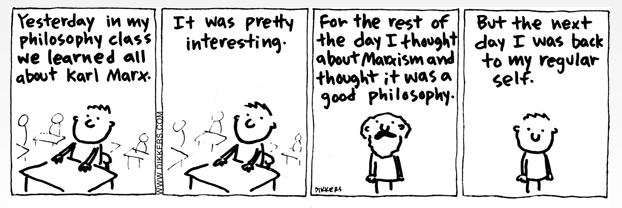
Jim's Journal
Scott Dikkers
Jim’s Journal

Why?

Critical Theory, as outlined and practiced by members of the Frankfurt School, has proven to be widely influential in modern and contemporary thinking of popular culture and the “culture industry.” Contemporary linguistics, structuralism, post-structuralism, postmodernism, and many other forms of current thought can trace portions of their DNA back to Critical Theory. Please make sure you grasp the concepts in the readings, lecture, and discussions because this will help you understand much of what comes later in this course.

Required

Marxisms: The Frankfurt School, Althusserianism, Hegemony, and Post-Marxism, Cultural Theory and Popular Culture
I know this is a long slog for this one, but there is a really good and succinct (despite its length) overview of the different facets of Marxism. Stick with it and do your best to understand the different terms and ideas.

Supplementary Readings

The Frankfurt School & Critical Theory
The Naysayers: Walter Benjamin, Theodor Adorno, and the Critique of Pop Culture, The New Yorker
“The worst that one Frankfurt School theorist could say of another was that his work was insufficiently dialectical. In 1938, Adorno said it of Benjamin, who fell into a months-long depression. The word ‘dialectic,’ as elaborated in the philosophy of Hegel, causes endless problems for people who are not German, and even for some who are. In a way, it is both a philosophical concept and a literary style. Derived from the ancient Greek term for the art of debate, it indicates an argument that maneuvers between contradictory points. It 'mediates,’ to use a favorite Frankfurt School word. And it gravitates toward doubt, demonstrating the 'power of negative thinking,’ as Herbert Marcuse once put it. Such twists and turns come naturally in the German language, whose sentences are themselves plotted in swerves, releasing their full meaning only with the final clinching action of the verb.”
ENGL 300: Introduction to Theory of Literature: Lecture 17 – The Frankfurt School of Critical Theory
“This first lecture on social theories of art and artistic production examines the Frankfurt School. The theoretical writings of Theodor Adorno and Walter Benjamin are explored in historical and political contexts, including Marxism, socialist realism, and late capitalism. The concept of mechanical reproduction, specifically the relationship between labor and art, is explained at some length. Adorno’s opposition to this argument, and his own position, are explained. The lecture concludes with a discussion of Benjamin’s perspective on the use of distraction and shock in the process of aesthetic revelation.”
Theodor Adorno
The Culture Industry: Selected Essays on Mass Culture
“The creation of the Frankfurt School of critical theory in the 1920s saw the birth of some of the most exciting and challenging writings of the twentieth century. It is out of this background that the great critic Theodor Adorno emerged. His finest essays are collected here, offering the reader unparalleled insights into Adorno’s thoughts on culture. He argued that the culture industry commodified and standardized all art. In turn this suffocated individuality and destroyed critical thinking. At the time, Adorno was accused of everything from overreaction to deranged hysteria by his many detractors. In today’s world, where even the least cynical of consumers is aware of the influence of the media, Adorno’s work takes on a more immediate significance. The Culture Industry is an unrivalled indictment of the banality of mass culture.”
Aesthetic Theory
“Perhaps the most important aesthetics of the twentieth century appears here newly translated, in English that is for the first time faithful to the intricately demanding language of the original German. The culmination of a lifetime of aesthetic investigation, Aesthetic Theory is Theodor W. Adorno’s magnum opus, the clarifying lens through which the whole of his work is best viewed, providing a framework within which his other major writings cohere.”
Walter Benjamin
ENGL 300: Introduction to Theory of Literature: Lecture 17 – The Frankfurt School of Critical Theory
“This first lecture on social theories of art and artistic production examines the Frankfurt School. The theoretical writings of Theodor Adorno and Walter Benjamin are explored in historical and political contexts, including Marxism, socialist realism, and late capitalism. The concept of mechanical reproduction, specifically the relationship between labor and art, is explained at some length. Adorno’s opposition to this argument, and his own position, are explained. The lecture concludes with a discussion of Benjamin’s perspective on the use of distraction and shock in the process of aesthetic revelation.”
The Work of Art in the Age of Its Technological Reproducibility, and Other Writings on Media
“Benjamin’s essay ‘Work of Art’ sets out his boldest thoughts on media and on culture in general. It is collected here with other essays, as he tackles film, radio, photography, and the modern transformations of literature and painting.”
Max Horkheimer
Dialectic of Elightenment
“One of the core texts of Critical Theory, Dialectic of Enlightenment explores the socio-psychological status quo that had been responsible for what the Frankfurt School considered the failure of the Age of Enlightenment. Together with The Authoritarian Personality (1950; also co-authored by Adorno) and Frankfurt School member Herbert Marcuse’s One-Dimensional Man (1964), it has had a major effect on 20th-century philosophy, sociology, culture, and politics, inspiring especially the New Left of the 1960s and 1970s” (text from Wikipedia)
Herbert Marcuse
One Dimensional Man: Studies in the Ideology of Advanced Industrial Society
One-Dimensional Man: Studies in the Ideology of Advanced Industrial Society is a 1964 book by the philosopher Herbert Marcuse, in which the author offers a wide-ranging critique of both contemporary capitalism and the Communist society of the Soviet Union, documenting the parallel rise of new forms of social repression in both these societies, as well as the decline of revolutionary potential in the West. He argues that 'advanced industrial society’ created false needs, which integrated individuals into the existing system of production and consumption via mass media, advertising, industrial management, and contemporary modes of thought.” (text from Wikipedia)

Response Questions

Remember to cite specific instances from the text to support your views.

  • How does Critical Theory play into the visual culture and visual literacy?
  • Marcuse fought against the domestication of authentic culture by re-contextualizing it as advertising or as pop culture (think “Bach as background music in the kitchen, [. . .] Plato and Hegel, Shelley and Baudelaire, Marx and Freud in the drugstore”). Do you agree with him? Why or why not?
  • Althusser addresses “symptomatic readings” of works. The example given in the text is a symptomatic reading of the film Taxi Driver. Do you see this as a valid way to understand cultural works? Why or why not?

4.1: History as a Cultural Lens

We Come to Know Design Through History, but What Exactly is History?
Read by Thu Jan 28,
Reading Response due Wed Feb 03,
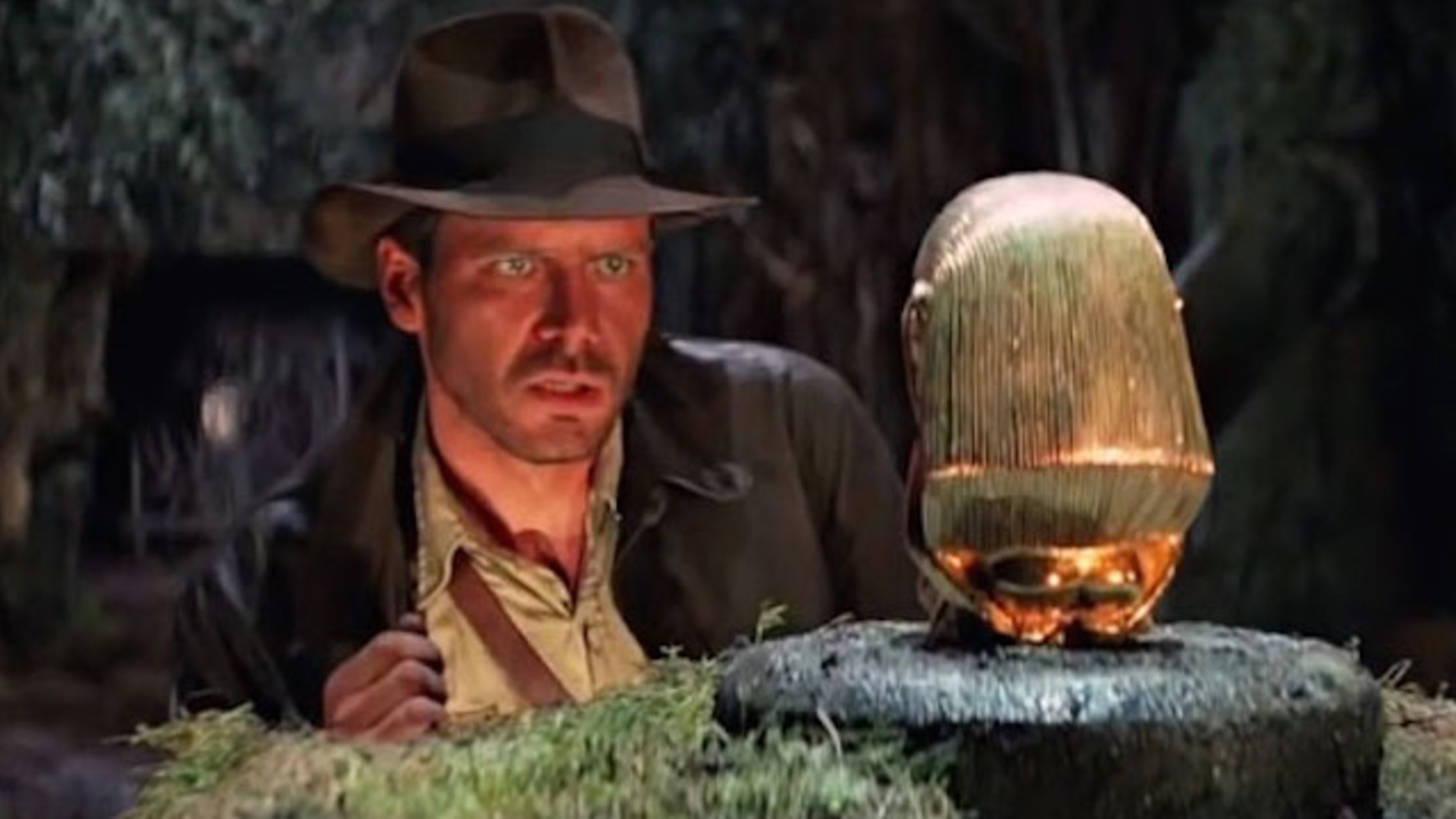
Indiana Jones and the Raiders of the Lost Ark (1981)
Indiana Jones and the Raiders of the Lost Ark, 1981
Directed by Steven Spielberg; written by Lawrence Kasdan, George Lucas, and Philip Kaufman

Why?

Experience governs how we understand our world. This experience can be gained empirically—through our senses—and logically—by learning from others and deducing from our experiences. Concepts, such as “design,” are primarily understood through witnesses. Practitioners and teachers define what design is by teaching your methods, materials, theories, and histories. Histories are generally what govern the others. What design has been defines what design is now. The materials and tools employed in the past (even the recent past), are what you are taught to use in the present. Aesthetics of the past are inherited and deployed in the here and now.

The past is what happened, history is how it is remembered. As such, it is important to look closely at what history is, how it is shaped and communicated, and how it molds our understanding of design and culture. We also need to differentiate between history—“A narration of incidents, esp. (in later use) professedly true ones; a narrative, a story”—and myth—“A popular conception of a person or thing which exaggerates or idealizes the truth.”1, 2 It also begs the questions, who is telling the stories, are we learning a true history or a mythology, can we understand design outside of history, and what might design look like that is void of history?

Required

Note: I am including the TED video, not so much for the life-coach, self-help aspect, but to consider what she is saying as a more personal way to contemplate how we tell the stories of history.

How Changing Your Story Can Change Your Life, TED
Design History and the History of Design

Supplementary Readings

Historiography
The Stories We Tell Ourselves, The New York Times
“If we reflect on the stories we tell about ourselves, both to others and to ourselves, we may well find out things about who we are that complicate the view we would prefer to be identified with.”
The Stories We Tell Ourselves, Psychology Today
“None of us wants to be seen as the villain of our own, or of other people’s, lives. Quite the opposite, we want to be regarded well. The stories we tell are attempts to maintain that respect. Even our confessions of failure are equally efforts to show that we are repentant, that we are good people at heart for whom the current malfeasance is mostly an irregularity.”
Myth and History, Encyclopædia Britannica
“Myth and history represent alternative ways of looking at the past. Defining history is hardly easier than defining myth, but a historical approach necessarily involves both establishing a chronological framework for events and comparing and contrasting rival traditions in order to produce a coherent account. The latter process, in particular, requires the presence of writing in order that conflicting versions of the past may be recorded and evaluated. Where writing is absent, or where literacy is restricted, traditions embedded in myths through oral transmission may constitute the principal sources of authority for the past.”
Why Design History? A Multi-National Perspective on the State and Purpose of the Field
“This article asks: what is the significance of design history within higher education? It reviews the practice and purpose of design history, in the education of historically aware and critically engaged designers, as an emerging independent discipline, and in terms of what the subject has to offer allied fields such as history, sociology, cultural studies, history of technology, area studies and anthropology. It considers the development and current state of design history as it is taught in the UK and non-Anglophone Europe (including France, Italy, Scandinavia, Spain, Turkey and Greece), in the US, Australia and East Asia. The argument that follows is grounded in recent design historical scholarship, combined with the views of design historians working in the abovementioned countries, in order to provide both a contemporary perspective on current practice and suggestions about possible futures.”
The Redundancy of Design History
“Of course, this failure of design history to affect practice may be explained by the fact that most designers, on the whole, don’t read. But some do, and particularly those engaged in postgraduate or paper is not another clarion call to practitioners to underpin their practice with more history and theory. We have had enough of such ill-defined, badly informed invocations. Read? Read what? appreciate your traditions? Whose traditions? So, the key problem is not more design history but better design history.”
What is History?, History Today
“Four historians consider the most fundamental question of all, one famously posed by E.H. Carr almost 60 years ago.”
Myth, History, and Theory, History and Theory
“Myth and history are generally considered antithetical modes of explanation. Writers of each tend to distrust the data of the other. Many historians of the modern period see their task as one of removing all trace of myth from the historical record. Many students of myth consider history to have less explanatory power than traditional narra- tives. Since the Greeks, logos (word as demonstrable truth) has been opposed to mythos (word as authoritative pronouncement). In more general terms myth may be defined as any set of unexamined assumptions. Some modern historians have become aware that much so-called factual history is interfused with such assumptions. What we call history is at best mythistory. Some even suggest that there can be no real distinction between the discourses of myth and history, between fact and fiction.”
Has The World Already Ended? Or Just History?, PBS Idea Channel
“Things are… tense…. It’s tough to deny that right now, the world can feel a bit like a standoffish middle school dance… with nukes. Foreign policy, geopolitics, international defense, and even long standing institutions like the European Union and, depending upon who you ask, democracy itself… have uncertain futures. Rather than indulging in our inner chicken little, it may be useful to know this isn’t, of course, the first time some people have felt like the end is nigh. As a matter of fact, depending upon who you ask–and we will… ask–it’s possible that either the world… OR HISTORY… has already ended; though at the end… of both of those things, and this episode, maybe we can find a beginning. Let’s talk some Francis Fukuyama and Jean Baudrillard.”
Unreliable Narrators
Every Marriage Is a Courthouse, This American Life
“The second cartoon Chris Ware and John Kuramoto made for our TV show, animating a story told by Radiolab host Robert Krulwich and his wife, Tamar.”
Who Can You Trust? Unreliable Narrators, It's Lit!, PBS Digital Studios
“Who is the most powerful character in fiction? Villains may doom the world, heroes may save it, but no one has more control over the plot than the narrator - expositing the who, what, where, when and how directly into the reader’s mind. But how can you tell that the person telling you the story is telling you the whole story?”
The Fix Is In, This American Life

“There are all sorts of situations in which we suspect the fix is in, but we almost never find out for certain. On today's show, for once, we find out. The whole program is devoted to one story, in which we go inside the back rooms of one multinational corporation and hear the intricate workings—recorded on tape—of how they put the fix in.”

Mythology
Myth and History, Encyclopædia Britannica
“Myth and history represent alternative ways of looking at the past. Defining history is hardly easier than defining myth, but a historical approach necessarily involves both establishing a chronological framework for events and comparing and contrasting rival traditions in order to produce a coherent account. The latter process, in particular, requires the presence of writing in order that conflicting versions of the past may be recorded and evaluated. Where writing is absent, or where literacy is restricted, traditions embedded in myths through oral transmission may constitute the principal sources of authority for the past.”
Myth, History, and Theory, History and Theory
“Myth and history are generally considered antithetical modes of explanation. Writers of each tend to distrust the data of the other. Many historians of the modern period see their task as one of removing all trace of myth from the historical record. Many students of myth consider history to have less explanatory power than traditional narra- tives. Since the Greeks, logos (word as demonstrable truth) has been opposed to mythos (word as authoritative pronouncement). In more general terms myth may be defined as any set of unexamined assumptions. Some modern historians have become aware that much so-called factual history is interfused with such assumptions. What we call history is at best mythistory. Some even suggest that there can be no real distinction between the discourses of myth and history, between fact and fiction.”
What Is Myth? Crash Course World Mythology #1
“Welcome to Crash Course World Mythology, our latest adventure (and this series may be literally adventurous) in education. Over the next 40 episodes or so, we and Mike Rugnetta are going to learn about the world by looking at the foundational stories of a bunch of different cultural traditions. We’re going to look at the ways that people’s stories define them, and the ways they shape their culture. We’re going to learn about gods, goddesses, heroes, and tricksters, and a lot more. We’re going to walk the blurry line between myth and religion, and we’re going to like it.”

Response Questions

Remember to cite specific instances from the text to support your views.

  • How much does history impact your view of design? Imagine that design did not exist as a concept—that animation, illustration, graphic design, and photography were never invented or developed. How might that alter the way that you work or the way that you talk about your work?
  • If our understanding of design is based on its past performance, how might the stories that are perpetuated about design impact how it is practiced?
  • Consider the sources of the histories you have been taught, particularly around art and design. How reliable are they? What biases might they hold? How might that shape your understanding of design?
  1. “History, n.,” Oxford English Dictionary, accessed January 2, 2021, https://www-oed-com.erl.lib.byu.edu/view/Entry/87324.
  2. “Myth, n.,” Oxford English Dictionary, accessed January 2, 2021, https://www-oed-com.erl.lib.byu.edu/view/Entry/124670.

3.2: Languages (Visual and Otherwise) as Cultural Lenses

Assigning, Communicating, and Understanding Meaning
Read by Sat Jan 23,
Reading Response due Wed Jan 27,
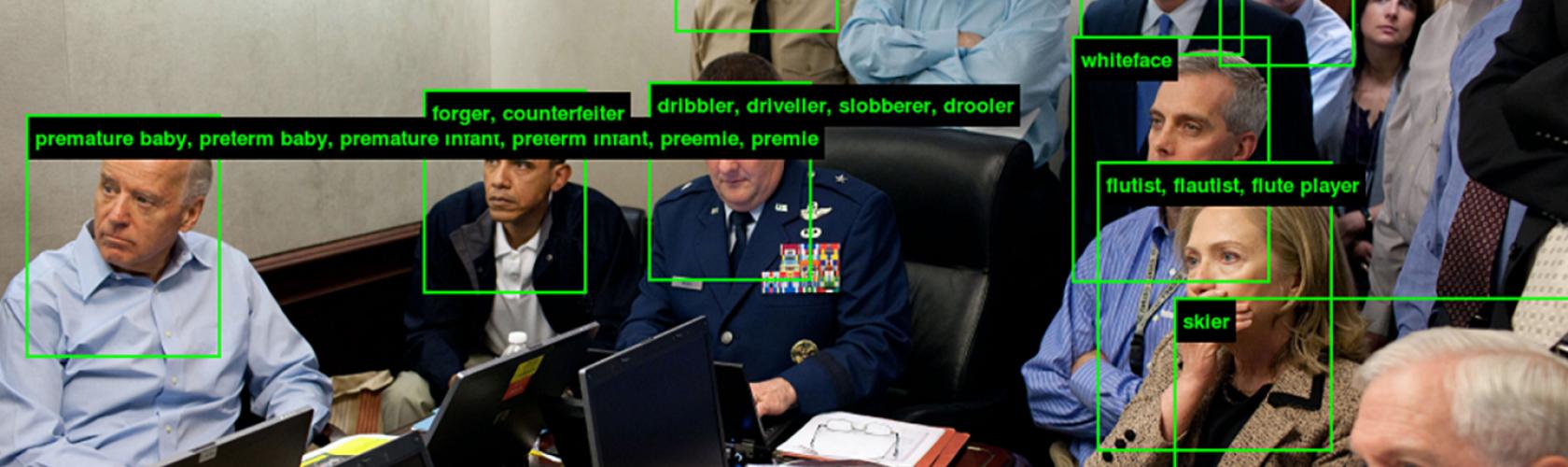
Kate Crawford and artist Trevor Paglen, ImageNet Roulette
Kate Crawford and artist Trevor Paglen
ImageNet Roulette, 2019

Why?

As communicators (visual and otherwise), you must understand how communication works. We all assume that because we can read, write, and interpret the visual, auditory, tactile, and olfactory world around us, that we understand how and why communication works. Communication is a complex world of signs, abstract concepts, experience, context, syntax, and so on. Meaning is assigned, understood, and informed on many different levels. These readings will help you better understand the basics of visual literacy (how we “read” our visual world) and semiotics (the study of signs and how meaning is created).

Required

An Introduction To Semiotics — Signifier And Signified
Icon, Index, and Symbol — Three Categories of Signs
Language: Crash Course Psychology #16

Language: Crash Course Psychology #16 (2014), 10:01

Language & Meaning: Crash Course Philosophy #26

Language & Meaning: Crash Course Philosophy #26 (2016), 09:31

How We’re Teaching Computers to Understand Pictures, TED

How We’re Teaching Computers to Understand Pictures (2015), by Fei-Fei Ji, 17:49

Supplementary Readings

Semiotics & Visual Literacy
How Pink Became a Color for Girls, Racked
“For most of history, pink was just another color. It was worn equally by men and women. A line in Little Women published in 1869 refers to Amy as tying pink and blue ribbons around two babies to tell the male from the female ‘in the French fashion.’ That’s often cited as a reason pink became affiliated with girls. However, ribbons aside, babies were generally dressed in white, and if you did have twins that needed to be color-coded you didn’t have to go with pink or blue ribbons. A catalogue from 1918 even recommended dressing female babies in blue as it had a ‘much more delicate and dainty tone.’”
What Makes a Truly Great Logo, Vox
“About once a month, there’s a new logo to fight about on the internet. The biggest one in recent memory was the highly controversial Hillary Clinton logo, which did not escape scrutiny from Vox.com either. But as a designer/filmmaker, something about these repeated discussions struck me as missing the point on what makes logos tick. It often has little to do with the subjective musings. So I called up Michael Bierut, the designer of that Hillary Clinton logo and countless others. He sat down with me and helped explain the elements of a great logo.”
Auditory Icons, 99% Invisible
The Auditory Icons portion starts at about 10:57 and ends about 19:43. “So instead of a generic and alarming alarm sound that could indicate anything, actual information about the problem is communicated. There’s something intuitive about it, and it illustrates a larger opportunity for alarm designers to rethink appropriate solutions.”
Vexillonaire, 99% Invisible
“Vexillologists—those who study flags—tend to fall into one of two schools of thought. The first is one that focuses on history, category, and usage, and maintains that vexillologists should be scholars and historians of all flags, regardless of their designs. The other school of vexillology, however, maintains that not all flags are created equal, and that flags can and should be redesigned, and improved. Ted Kaye of the Portland Flag Association—the largest subnational flag organization in the country—is one such vexillologist. Kaye has a word for these activist vexillologists of his ilk who go out into the world and lobby for more beautiful flags: ‘vexillonaires.’”
Icon for Access, 99% Invisible
“There is a beauty to a universal standard. The idea that people across the world can agree that when they interact with one specific thing, everyone will be on the same page — regardless of language or culture or geographic locale. If you’re in Belgrade or Shanghai or São Paulo, you can look at a sign and know instantly, without speaking a word of the local language, that this floor is slippery. That the emergency exit is over there. That that substance is poisonous, and you should not eat it. The group behind those internationally recognized logos is called the International Organization for Standardization.”
ENGL 300: Introduction to Theory of Literature: Lecture 8 – Semiotics and Structuralism, Yale University: Open Yale Courses
“In this lecture, Professor Paul Fry explores the semiotics movement through the work of its founding theorist, Ferdinand de Saussure. The relationship of semiotics to hermeneutics, New Criticism, and Russian formalism is considered. Key semiotic binaries–such as langue and parole, signifier and signified, and synchrony and diachrony–are explored. Considerable time is spent applying semiotics theory to the example of a “red light” in a variety of semiotic contexts.”
Semiotics of Sound
Golden Record: Sounds of Earth
Listen to the Golden Record sent into space with the Voyager spacecraft. Each sound is meant to convey life on earth.
Sounds Natural, 99% Invisible
“And then there’s the question of sound. In most wildlife films, the sounds you hear were not recorded while the cameras were rolling. Most filmmakers use long telephoto lenses to film animals, but there’s no sonic equivalent of a zoom lens. Good audio requires a microphone close to the source of the sound, which can be difficult and dangerous. And so many of the subtle movement sounds—a chimpanzee rustling through leaves, or a hippo squelching in the muck, or a lizard fleeing snakes—don’t come from animals at all. They’re made by Foley artists.”
Auditory Icons, 99% Invisible
The Auditory Icons portion starts at about 10:57 and ends about 19:43 “So instead of a generic and alarming alarm sound that could indicate anything, actual information about the problem is communicated. There’s something intuitive about it, and it illustrates a larger opportunity for alarm designers to rethink appropriate solutions.”
Creating Languages, Visual & Otherwise
Ten Thousand Years, 99% Invisible
“In 1990, the federal government invited a group of geologists, linguists, astrophysicists, architects, artists, and writers to the New Mexico desert, to visit the Waste Isolation Pilot Plant. [. . .] This WIPP site is going to be radioactive for hundreds of thousands of years, though this panel was only responsible for keeping this place sufficiently marked for humans for the next 10,000 years—thinking beyond that timeframe was thought to be impossible. [. . .] Who knows the world will look like 10,000 years from now? The panel began by thinking about language. But language, like radioactive materials, has a half life.”
Shaka, When the Walls Fell, The Atlantic
“In one fascinating episode, Star Trek: The Next Generation traced the limits of human communication as we know it—and suggested a new, truer way of talking about the universe.”
The Inevitable, Intergalactic Awkwardness of Time Capsules, Atlas Obscura
“It’s easy to make fun of time capsules, but [. . .] it’s much harder to fill them with the kind of material that will actually stand the test of time. Often, the things we tuck away for posterity are embarrassing or boring. Sometimes, they’re much worse—racist, bigoted, wrongheaded. Most take that old adage about the winners writing history to its logical conclusion. And they are always, by their very nature, exceedingly presumptuous.”
The 116 Images NASA Wants Aliens to See
“The Voyager team tapped famous astronomer and science popularizer Carl Sagan to compose that message. Sagan's committee chose a copper phonograph LP as their medium, and over the course of six weeks they produced the ‘Golden Record’: a collection of sounds and images that will probably outlast all human artifacts on Earth.”
Golden Record: Sounds of Earth
Listen to the Golden Record sent into space with the Voyager spacecraft. Each sound is meant to convey life on earth.
The Foundations of the Voyager Record, Murmurs of Earth: The Voyager Interstellar Record
“In 1977, two extraordinary spacecraft called Voyager were launched to the stars. Affixed to each Voyager craft was a gold-coated copped phonograph record as a message to possible extra-terrestrial civilizations that might encounter the spacecraft in some distant space and time. Each record contained 118 photographs of our planet; almost 90 minutes of the world's greatest music; an evolutionary audio essay on "The Sounds of Earth"; and greetings in almost sixty human languages (and one whale language). This book is an account, written by those chiefly responsible for the contents of the Voyager Record, of why they did it, how they selected the repertoire, and precisely what the record contains.”
Voyager: The Interstellar Mission: The Golden Record, Jet Propulsion Laboratory: California Institute of Technology
You could go down the rabbit hole with this site since there are sounds, images, and multiple texts to read. “NASA placed a more ambitious message aboard Voyager 1 and 2-a kind of time capsule, intended to communicate a story of our world to extraterrestrials. The Voyager message is carried by a phonograph record-a 12-inch gold-plated copper disk containing sounds and images selected to portray the diversity of life and culture on Earth.”
Perception
Perceiving is Believing: Crash Course Psychology #7
“So what does perception even mean? What’s the difference between seeing something and making sense of it? In today’s episode of Crash Course Psychology, Hank gives us some insight into the differences between sensing and perceiving.”
Sensation & Perception – Crash Course Psychology #5
“Just what is the difference between sensing and perceiving? And how does vision actually work? And what does this have to do with a Corgi? In this episode of Crash Course Psychology, Hank takes us on a journey through the brain to better explain these and other concepts.”

Response Questions

Remember to cite specific instances from the text to support your views.

  • How have these readings on semiotics and visual literacy made you think about how you communicate as an artist?
  • If you think of your work as a time capsule akin to the Golden Record or the 10,000 Years project, is it important to you that you work communicate through time? Why or why not? What about your work is specific to contemporary contexts and how much can have a longer life span?
  • How might these readings impact your thinking of representational vs. non-representational work? How might non-representational work communicate?

2.2: Truth in the modern age and beyond, part 1

Oh, Say, What is Truth?
Read by Sat Jan 16,
Reading Response due Wed Jan 20,
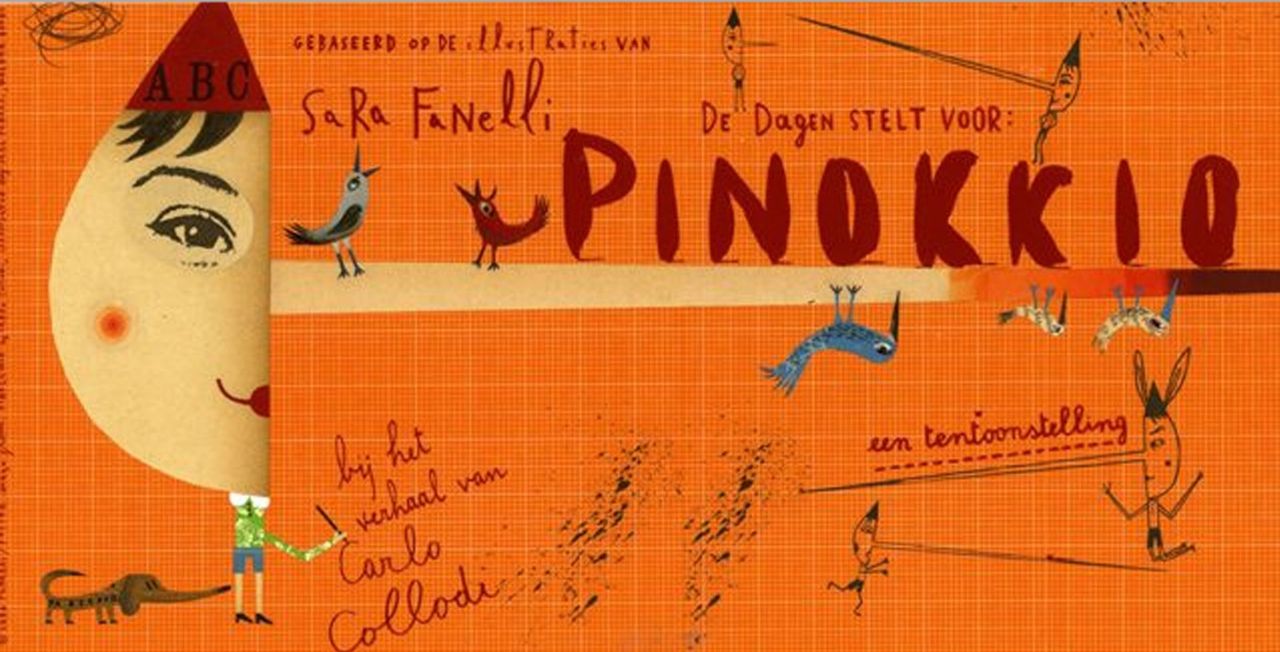
Sara Finelli ,Pinokkio (Pinocchio), 2003
Sara Finelli
Pinokkio (Pinocchio), 2003

Why?

President Kimball stated: “There are relative truths, and there are also absolute truths which are the same yesterday, today, and forever—never changing. These absolute truths are not altered by the opinions of men. As science has expanded our understanding of the physical world, certain accepted ideas of science have had to be abandoned in the interest of truth.” The ideas we discuss in class are our best attempts at understanding our world and how we can operate in it. But some of these ideas may prove to be less useful or productive in the future. That is the nature of the game.d

So far in class, we have discussed a number of theories—abstracted, conceptual bases of our fields. At times we have even considered examples and illustrations of these theories as they are put into practice, or seen in the wild. Some may even seem very compelling and logical. These are important ideas to know and understand, but truth is only discovered through the Spirit, not philosophical machinations. Our ultimate goal should be obtaining and understanding absolute truths. This does not mean that all relative truths are useless and should not be considered, but some are more useful than others for our time on earth. The readings below range from the religious to the philosophical, to understand how the world has looked at truth, facts, honesty, and reality.

There is some terminology that may come up that will be important to understand:

  • Ontology: “As a first approximation, ontology is the study of what there is. Some contest this formulation of what ontology is, so it’s only a first approximation. Many classical philosophical problems are problems in ontology: the question whether or not there is a god, or the problem of the existence of universals, etc.. These are all problems in ontology in the sense that they deal with whether or not a certain thing, or more broadly entity, exists.”1 In short, ontology is concerned with truth as an abstract.
  • Epistemology: “Plato’s epistemology was an attempt to understand what it was to know, and how knowledge (unlike mere true opinion) is good for the knower. Locke’s epistemology was an attempt to understand the operations of human understanding, Kant’s epistemology was an attempt to understand the conditions of the possibility of human understanding, and Russell’s epistemology was an attempt to understand how modern science could be justified by appeal to sensory experience.”2 In short, epistemology is concerned in how humans come to know or understand truth.

Required

What is Truth?, The Great Courses
Absolute Truth, ChurchofJesusChrist.org

Supplementary Readings

Truth and Knowledge (Philosophy)
What is Philosophy?: Crash Course Philosophy #1, PBS Digital Studios
“Today Hank begins to teach you about Philosophy by discussing the historical origins of philosophy in ancient Greece, and its three main divisions: metaphysics, epistemology, and value theory. He will also introduce logic, and how you’re going to use it to understand and critically evaluate a whole host of different worldviews throughout this course. And also, hopefully, the rest of your life.”
Cartesian Skepticism – Neo, Meet Rene: Crash Course Philosophy #5, PBS Digital Studios
“This week Hank introduces skepticism, exploring everything from the nature of reality through the eyes of a 17th century philosopher and, of course, The Matrix.”
Locke, Berkeley, & Empiricism: Crash Course Philosophy #6, PBS Digital Studios
“This week we answer skeptics like Descartes with empiricism. Hank explains John Locke’s primary and secondary qualities and why George Berkeley doesn’t think that distinction works – leaving us with literally nothing but our minds, ideas, and perceptions.”
The Meaning of Knowledge: Crash Course Philosophy #7, PBS Digital Studios
“On today’s episode… CATS. Also: Hank talks about some philosophy stuff, like a few of the key concepts philosophers use when discussing belief and knowledge, such as what defines an assertion and a proposition, and that belief is a kind of propositional attitude. Hank also discusses forms of justification and the traditional definition of knowledge, which Edmund Gettier just totally messed with, using his Gettier cases.”
PHILOSOPHY – Kant: On Metaphysical Knowledge, Wireless Philosophy
“Kant famously claims that we have synthetic apriori knowledge. Indeed, this claim is absolutely central to all of his philosophy. But what is synthetic apriori knowledge? Scott Edgar helpfully breaks-down this category of knowledge by first walking through Kant’s distinction between empirical and apriori knowledge and then his distinction between analytic and synthetic judgments. The interaction between these distinctions is then illustrated with numerous examples, making it clear why Kant, unlike Hume, thought that there is knowledge that is both apriori and synthetic and that this is the type of knowledge philosophers seek.”
PHILOSOPHY – Epistemology: Introduction to Theory of Knowledge, Wireless Philosophy
“In this Wireless Philosophy video, Jennifer Nagel (University of Toronto) launches our Theory of Knowledge series. We look at the line between knowing and just believing something, focusing on factors like truth and confidence.”
PHILOSOPHY – Epistemology: Analyzing Knowledge #1 (The Gettier Problem), Wireless Philosophy
“Is knowledge the same as justified true belief? In this Wireless Philosophy video, Jennifer Nagel (University of Toronto) discusses a Gettier case, a scenario in which someone has justified true belief but not knowledge. We’ll look at a Gettier case from Edmund Gettier’s famous 1963 paper on this topic, and a structurally similar case from 8th century Classical Indian philosophy.”
PHILOSOPHY – Epistemology: Analyzing Knowledge #2 (No-False-Lemma and No-Defeater Approaches), Wireless Philosophy
“If we can’t analyze knowledge simply as justified true belief, can we add one more ingredient to produce a successful analysis? In this Wireless Philosophy video, Jennifer Nagel examines two ‘extra ingredient’ analyses of knowledge: Michael Clark’s ‘no false lemma’ analysis, and the fancier ‘no undefeated defeaters’ analysis of Keith Lehrer and Thomas Paxson.”
PHILOSOPHY – Epistemology: Analyzing Knowledge #3 (Causal and Reliabilist Theories), Wireless Philosophy
“Is knowledge a matter of being causally connected to the world in the right way? In this Wireless Philosophy video, Jennifer Nagel (University of Toronto) examines the causal theory of knowledge proposed by Alvin Goldman in 1967, and then discusses the problems with the causal theory that led Goldman to formulate his influential reliabilist theory of knowledge.”
PHILOSOPHY – Epistemology: Analyzing Knowledge #4 (Tracking Theories), Wireless Philosophy
“Problems for the causal theory of knowledge led epistemologists to propose that knowledge is a matter of tracking the truth. Fred Dretske and Robert Nozick developed this idea using counterfactual conditions. In this Wireless Philosophy video, Geoff Pynn (Northern Illinois University) examines the tracking idea, consider how it improves on the causal theory, and then discuss some well known objections to the theories advanced by Dretske and Nozick.”
Art and Epistemology, Internet Encyclopedia of Philosophy

“The relationship between art and epistemology has been forever tenuous and fraught with much debate. It seems fairly obvious that we gain something meaningful from experiences and interactions with works of art. It does not seem so obvious whether or not the experiences we have with art can produce propositional knowledge that is constituted by true justified belief. In what follows I will give some historical background on the debate and flesh out some of the important issues surrounding the question ‘(What) can we learn from art?’”

The Cave : A Parable Told by Orson Welles

An animated version of Plato's allegory of the cave. “In the allegory, Socrates describes a group of people who have lived chained to the wall of a cave all their lives, facing a blank wall. The people watch shadows projected on the wall from objects passing in front of a fire behind them and give names to these shadows. The shadows are the prisoners' reality but are not accurate representations of the real world. Three higher levels exist: the natural sciences; mathematics, geometry, and deductive logic; and the theory of forms. Socrates explains how the philosopher is like a prisoner who is freed from the cave and comes to understand that the shadows on the wall are not reality at all. A philosopher aims to understand and perceive the higher levels of reality. However, the other inmates of the cave do not even desire to leave their prison, for they know no better life.”1

  1. “Allegory of the Cave,” Wikipedia, accessed February 4, 2021, https://www.wikiwand.com/en/Allegory_of_the_cave
Truth and Knowledge in the Gospel
Absolute Truth, Churchofjesuschrist.org
“This true way of life is not a matter of opinion. There are absolute truths and relative truths. The rules of dietetics have changed many times in my lifetime. Many scientific findings have changed from year to year. The scientists taught for decades that the world was once a nebulous, molten mass cast off from the sun, and later many scientists said it once was a whirl of dust which solidified. There are many ideas advanced to the world that have been changed to meet the needs of the truth as it has been discovered. There are relative truths, and there are also absolute truths which are the same yesterday, today, and forever—never changing.”
The Truth of All Things, Churchofjesuschrist.org
“Mom put the responsibility of developing faith and finding answers on me. She knew that the important answers would come from my seeking truth the way that Heavenly Father has prescribed. She knew that I needed to find the truth. She knew that I needed to be sincere in my questions and be willing to act on what I already knew to be true. She knew that I needed to study and pray and that I needed to develop greater patience as I sought answers from the Lord. Willingness to be patient is part of our search for truth and part of the Lord’s pattern of revealing truth.”
He Hath Filled the Hungry with Good Things, Churchofjesuschrist.org
“As the world slouches toward the 21st century, many long for something, sometimes cry out for something, but too often scarcely know for what. The economic condition in the world, speaking generally and certainly not specifically, is probably better than it has ever been in history, but the human heart is still anxious and often filled with great stress. We live in an “information age” that has a world of data available literally at our fingertips, yet the meaning of that information and the satisfaction of using knowledge in some moral context seems farther away for many than ever before.”
What is Truth?, Churchofjesuschrist.org
“Part of the reason for poor judgment comes from the tendency of mankind to blur the line between belief and truth. We too often confuse belief with truth, thinking that because something makes sense or is convenient, it must be true. Conversely, we sometimes don’t believe truth or reject it—because it would require us to change or admit that we were wrong. Often, truth is rejected because it doesn’t appear to be consistent with previous experiences. When the opinions or ‘truths’ of others contradict our own, instead of considering the possibility that there could be information that might be helpful and augment or complement what we know, we often jump to conclusions or make assumptions that the other person is misinformed, mentally challenged, or even intentionally trying to deceive. Unfortunately, this tendency can spread to all areas of our lives—from sports to family relationships and from religion to politics.”
On Being Genuine, ChurchofJesusChrist.org
“Although modern historians have questioned the truthfulness of this story, the term ‘Potemkin village’ has entered the world’s vocabulary. It now refers to any attempt to make others believe we are better than we really are.”
Honesty
And Nothing but the Truth, This American Life
“Reporter Nazanin Rafsanjani brings us the story of Brad Blanton, a psychologist who founded a philosophy called "Radical Honesty.” Brad believes that the way to be happy is to tell the truth all the time. This philosophy helped him help a lot of people as a therapist. But it got in the way a little when, in 2006, he left his practice, ran for a seat in the US Congress, and became that rarest of things: a political candidate who never lies.”
Why Be Honest?, Psychology Today
"We all lie. Admittedly, most of do so only occasionally. But we still all do. Yet most of us also consider ourselves honest. In his book, The (Honest) Truth about Dishonesty, Dan Ariely offers evidence that we’re able to believe we’re honest even though we lie or cheat by doing so only in little ways. We’re therefore able to tell ourselves we’re mostly honest—that is, we’re only dishonest in ways that we think don’t matter. Apparently this strategy works: most of us don’t suffer serious cognitive dissonance over our integrity.”
How Honesty Could Make You Happier, The New York Times
“I’ve been keeping an honesty journal for the past several months. With honesty much in the news lately — you might even say honesty is having a cultural moment — I wanted to reflect on my own. My 6-year-old daughter once told me that telling the truth made her feel “gold in her brain.” Could upping my personal honesty light up a pleasure center in my own brain?”

Response Questions

Remember to cite specific instances from the text to support your views.

  • Compare an LDS view of truth with some of the philosophical views of truth. Where do they overlap and where do they differ?
  • Based on your readings, how might you define “truth?” How might that definition shape your life and your work in your field?
  • What might be the cases for dishonesty, or is it always wrong in every situation?
  • Do you consider your field to be an inherently truthful or dishonest field? Why or why not?
  1. “Logic and Ontology,” Stanford Encyclopedia of Philosophy, October 11, 2017, https://plato.stanford.edu/entries/logic-ontology/#Ont.
  2. “Epistemology,” Stanford Encyclopedia of Philosophy, April 11, 2020, https://plato.stanford.edu/entries/epistemology/.

1.0: Spirituality, Ethics, and Morality as Cultural Lenses

How notions of God, spirituality, true, false, right, and wrong impact what we choose to consider or dismiss in our culture
Read by Thu Jan 01,
Reading Response due Wed Jan 13,
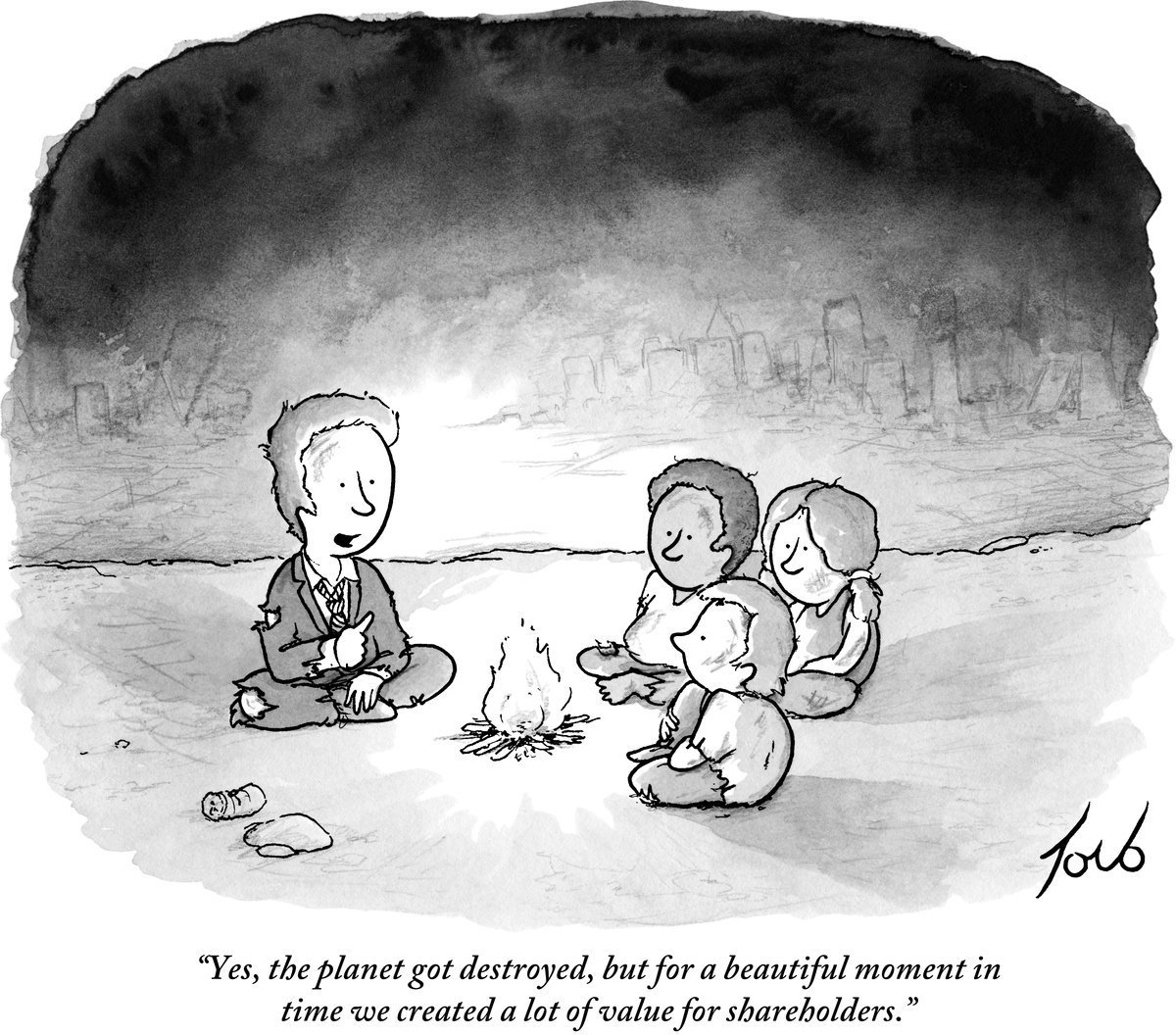
Tom Toro for the New Yorker
Tom Toro
For the New Yorker

Why?

Since we are beginning the semester by introducing various theoretical lenses through which cultural production can be viewed and scrutinized, I thought it best to start with the most overarching consideration: “We are not human beings having a spiritual experience; we are spiritual beings having a human experience” (President Thomas S. Monson quoting Pierre Teilhard de Chardin). And, as spiritual beings, how do we deal with the ethical and moral ramifications of moving through this world?

Keep our discussions and readings about spirituality, ethics, and morality in mind as we talk about gender studies, postcolonialism, Marxism, postmodernism, and other topics since your POV as a moral being colors all other factors.

Required

The Gospel Vision of the Arts, ChurchofJesusChrist.org

If the Church’s website is causing you problems, you can also access a PDF of the piece by clicking here.

The State of Ethics in Design, Muzli
Ambiguity & Truth, Brand Identity Conference, AIGA, NYC

Supplementary Readings

Religion/Spirituality and the Arts
The Arts and the Spirit of the Lord, BYU Speeches
“It is sad but true that, almost as a rule, our most gifted members are drawn to the world. They who are most capable to preserve our cultural heritage and to extend it, because of the enticements of the world, seek rather to replace it. That is so easy to do because for the most part they do not have that intent. They think that what they do is to improve it. Unfortunately many of them will live to learn that indeed, ‘Many men struggle to climb to reach the top of the ladder, only to find that it is leaning against the wrong wall.’”
The Words Religion and Art, A Very Brief History of Religion and Art, Some Words to Describe Spiritual Art, Conclusions, On the Strange Place of Religion in Contemporary Art
“It seems that art has been basically religious or ritual in nature, even in times and places where there was no word for what we call religion or art. In the 20th century, some writers still told the history of art that way, as if art and religion were essentially a unity. André Malraux may have been one of the last; his picture-book called La Musée imaginaire de la sculpture mondial (1952–54) doesn’t say much, but when it’s leafed through it seems to propose a strange and dramatic religious purpose for the world’s art.”
Spirituality, Art21
“‘Spirituality is such a vibrant and integral part of our lives that even our changing times and all the apparent obstacles have not stifled the powerful partnership of spirituality and art in the modern era,’ writes Lynn M. Herbert in her essay for the Companion Book to the Art in the Twenty-First Century series. ‘The realm of the spiritual is mysterious and inviting,’ writes Herbert, ‘It is a place where we are encouraged to explore the unknown.’”
Ethics in Graphic Design
How to Practice Ethical Design, Muzli
This is part 2 of the required reading above. “Although we might consider ourselves to be ethical people, many of us aren’t thinking of ethics intentionally in our work. The objective here is to help designers reframe their design goal to be more reflective of human values. Adapted from various experts and ethicists at the University of Washington, IDEO, Google, and Artefact, Ethical Design Thinking encourages designers to think inclusively and consider the social impact of their design goal.”
Should Designers Take Responsibility for the Ethics of Their Clients?, AIGIA Eye of Design
“Broadly speaking, my beef is that designers often like to speak of a higher purpose and the seemingly limitless possibility of design for the greater good, but how do they go about fulfilling those ideals on the payroll of a company that flouts them at every turn? Worse, some of the companies designers are so keen to serve are masking a lack of ethics behind a beautifully polished veneer; a selection of morally questionable actions perpetrated by companies on that wish list include the dissemination of fake news, manufacturing products in factories with non-existent rights and high suicide rates among its workers, and driving up the cost of property rental in cities across the world.”
Infographics Lie. Here’s How To Spot The B.S., Fast Company
“Time and time again we have seen that data visualizations can easily be manipulated to lie. By misrepresenting, altering, or faking the data they visualize, data scientists can twist public opinion to their benefit and even profit at our expense.”
Ethics According to Mike Monteiro

Caveat emptor: be aware that Mike is a hyperbolic speaker/writer who liberally peppers his speech with profanity. There is some good information in here, but there are also a lot of rough edges. Take him with a large grain of salt (more like a giant salt lick).

Ethics Can’t Be a Side Hustle, Dear Design Student
“If you want to do good work, and I really hope you do, start doing it at your day job. Start asking questions about what you’re building. Start asking questions about who benefits from what you’re building. Start asking questions about who gets hurt by what you’re building. And take a look at your team. Does it look like the audience you’re trying to reach? Especially if you’re building something in the social sphere, where trust and safety is paramount. Ask your managers these questions as well. And if you’re not satisfied with their answers stop working. Designing something without understanding the ramifications of what it does is as unethical as designing something you know to be harmful.”
Ethics and Paying Rent, Dear Design Student
“Throughout your career, you’ll find yourself in spots where your only options might be doing a little work for one of the Travis Kalanicks of the world, or starving. By all means, don’t starve! Just be honest with yourself about what you’re doing, why you’re doing it, and for how long you’re going to do it. Because once you lose sight of that, the justifications start. (“I’m going to change things from the inside.” ) And realize if you keep making those decisions, they end up defining your career. The idea that you can work unethically, build up a reputation, and then swing that ship around into ethical waters is also a fallacy. By that point, you do indeed have a reputation, but not the one you wanted. You’ll find a bad reputation is the hardest thing in the world to change.”
A Designer’s Code of Ethics, Dear Design Student
“Design does not exist in a vacuum. Society is the biggest system we can impact and everything you do is a part of that system, good and bad. Ultimately we must judge the value of our work based on that impact, rather than any aesthetic considerations. An object that is designed to harm people cannot be said to be well-designed, no matter how aesthetically pleasing it might be, because to design it well is to design it to harm others. Nothing a totalitarian regime designs is well-designed because it has been designed by a totalitarian regime.”
Doing the Right Thing the Wrong Way, Dear Design Student
“So how do ideas, which start out helpful and by all measure ethically sound, turn into companies with the ethical charm of a decapitated horse head bleeding out onto your silk sheets? Easy. You introduce people. Even easier, you introduce people with a very narrow set of life experiences. […] Especially when those designers have the same life experiences. Celebrate the same holidays. Went to the same school. Look like each other. In other words, white boys solving problems for white boys. They’ve never been harassed, so they don’t think of solving for that problem. And even if they do, they don’t solve that problem from a place of experience. They’ve never had a cab refuse to stop for them, so they don’t solve for that problem. They’ve never had a host refuse to rent them a room based on race, so they don’t solve for that problem. They’ve never had a host be a little too eager to rent them a room, so they don’t solve for that problem. And it’s too easy to think that terrible things don’t actually happen as often as they happen. But they do.”
Ethics in Photography
Posing Questions of Photographic Ethics, The New York Times
“During this year’s World Press photo contest, about 20 percent of the entrants that reached the second-to-last round of judging were disqualified for significantly altering images in post processing and Giovanni Troilo was stripped of a first prize in the face of charges of misrepresentation and posing images (the photographer said he had ‘made a mistake,’ but had not intended to deceive). In the vigorous debate that followed, some ridiculed the concept of 'objective photojournalism’ as philosophically tenuous in a postmodern world.”
Staging, Manipulation and Truth in Photography, The New York Times
“A staged photo is not acceptable in news pictures that are thought to depict real-world situations and events. Portraiture, fashion and still lifes are, of course, produced and directed, which should be obvious to the viewer. That said, no publication is immune to getting burned. For example, one of our photojournalists covering conflict in Lebanon once gave me a heads-up that I wasn’t going to see a dramatic image of a dead baby being paraded through the streets. That’s because the crowd saw the photographers and actually dug the baby’s corpse from its grave, held it aloft and paraded it. He refused to take that picture.”
The Ethics of Photojournalism, PetaPixel
“If this picture would be posted online in any discussion forum, there would be a lot of voices that would support this claim of, ‘how could he take a picture in this situation without providing any sort of help?’ The same arguments could be heard during the migration crisis in Europe or the conflict zones in the Middle East. In my opinion this shows the dilemma of the ethics of photojournalism. On the one hand these kinds of people seek out dangerous situations where they document people that obviously need help; on the other hand, it is impossible for a single photographer to help all these people. So what is the actual solution to this conflict? Should Photojournalism cease to exist, and human suffering go undocumented? Should we all sit in our comforting homes and turn a willfully blind eye to critical areas of the world, while we are in a perfectly safe environment?”
Untitled (Cowboy): Behind Richard Prince’s Photographs & Appropriation | 100 Photos | TIME
“His luminous 1989 photographs of Marlboro ads, minus the text, made Richard Prince a deeply controversial—and eventually very wealthy—artist of appropriation.”
Ethics in Illustration
(Why) Do illustrators need to talk about ethics ?, Julien Posture
“I’ve recently been asked by the Québec association of illustrators (Illustration Québec) to coordinate an ethical committee that would come up with recommendations about a vast array of topics, from inclusive communication to the stance regarding free labor through the power of representations in our work as illustrators. Before even saying yes, I had to ask myself (and the internet), what does it mean and why is it important to care about ethics as an illustrator?”
The True Power of Story, RandyBishopArt.com

This four-part essay outlines Bishop's views on narrative as a powerful force in shaping morality.

“Morality is a philosophical issue that has been pondered on and argued for thousands of years. The purpose of this post is not to weigh in on what I believe to be right or wrong, but to discuss how narrative entertainment can reaffirm or alter one's moral beliefs. I believe there are two separate issues to discuss when it comes to the effect of stories on audiences: content and narrative.”

Design and Ethics – Can You Stick to Your Beliefs?, Digital Arts

“Unlike doctors, lawyers or the police, designers are not often forced to make life-and-death ethical decisions. But the messages designers choose to impart and how they communicate them may have the power to influence many lives. What, then, are a designer’s ethical responsibilities in the creative process?”

Honesty
And Nothing but the Truth, This American Life
“Reporter Nazanin Rafsanjani brings us the story of Brad Blanton, a psychologist who founded a philosophy called "Radical Honesty.” Brad believes that the way to be happy is to tell the truth all the time. This philosophy helped him help a lot of people as a therapist. But it got in the way a little when, in 2006, he left his practice, ran for a seat in the US Congress, and became that rarest of things: a political candidate who never lies.”
Why Be Honest?, Psychology Today
"We all lie. Admittedly, most of do so only occasionally. But we still all do. Yet most of us also consider ourselves honest. In his book, The (Honest) Truth about Dishonesty, Dan Ariely offers evidence that we’re able to believe we’re honest even though we lie or cheat by doing so only in little ways. We’re therefore able to tell ourselves we’re mostly honest—that is, we’re only dishonest in ways that we think don’t matter. Apparently this strategy works: most of us don’t suffer serious cognitive dissonance over our integrity.”
How Honesty Could Make You Happier, The New York Times
“I’ve been keeping an honesty journal for the past several months. With honesty much in the news lately — you might even say honesty is having a cultural moment — I wanted to reflect on my own. My 6-year-old daughter once told me that telling the truth made her feel “gold in her brain.” Could upping my personal honesty light up a pleasure center in my own brain?”

Response Questions

Respond to one question below in your weekly Reading Response. Remember to cite specific instances from the text to support your views.

  • Preseident Kimball’s examples are largely from male artist, from hundreds of years ago, and involve very traditional mediums. How might you reconcile his non-professional, classical view of creative fields with contemporary applications?
  • How might religion, spirituality, morality, and/or ethics impact what you choose to do within your creative practice? Be clear and specific about what those aspects encourage you to do and what they might direct you to avoid.
  • In Glaser’s twelve-question Road to Hell, where do you find your limit and why? Why were the previous questions OK, but the remaining out of bounds? Now consider these jobs come to you when you have a spouse and children depending on you, and these jobs come after a couple of years of employment. Do you find yourself more willing to bend your morals or less? Why?