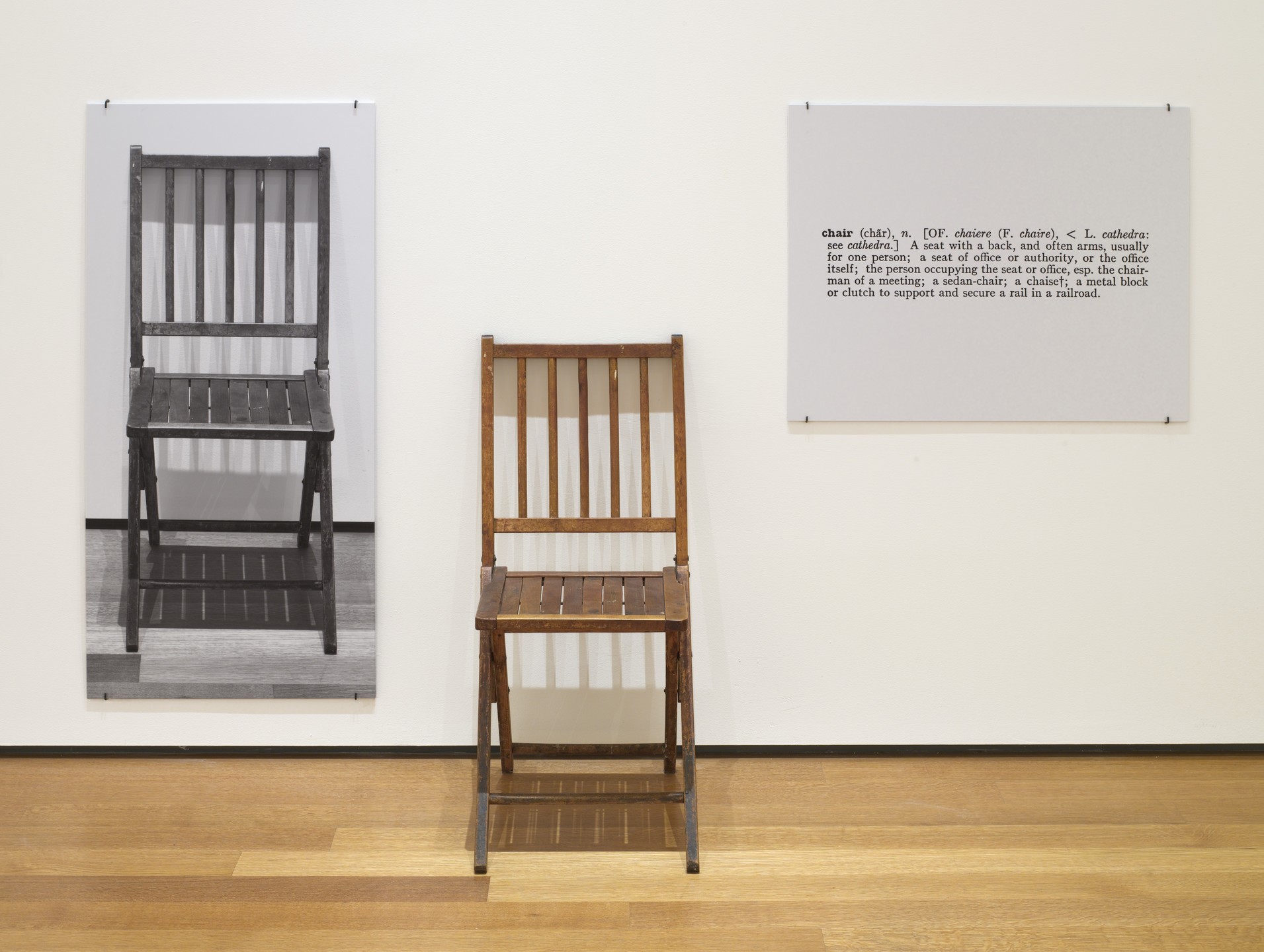
One and Three Chairs, 1965
Wood folding chair, mounted photograph of a chair, and mounted photographic enlargement of the dictionary definition of “chair”
Chair 32 3/8 x 14 7/8 × 20 7/8″ (82 x 37.8 × 53 cm), photographic panel 36 × 24 1/8″ (91.5 × 61.1 cm), text panel 24 × 30″ (61 × 76.2 cm)
Larry Aldrich Foundation Fund
© 2020 Joseph Kosuth / Artists Rights Society (ARS), New York, Courtesy of the artist and Sean Kelly Gallery, New York
Why?
One of the primary concern’s of Benjamin’s “The Work of Art in the Age of Mechanical Reproduction” (below) is how the nature of artwork and its place in society has changed when photographic reproductions have become more ubiquitous. What did it mean when you could see an image of an artwork, but never see the original work? Does the original serve a purpose at that point? He wrote this about 80 years ago, before broadcast television had taken a strong hold, well before the internet and social media, and before commercial printing did a good job of handling color images. While you are reading his essay, think about how these concepts have aged and how they might apply to contemporary life. Benjamin’s essay was the basis for John Berger’s Ways of Seeing that you will watch afterwards. Berger’s video updates some of Benjamin’s ideas and makes them a bit more accessible.
Along the lines of Benjamin’s and Berger’s thinking about reproductions, publications (magazines, books, websites), galleries, and museums all form distribution channels and contexts for images. Asking how those platforms that display and distribute images shape our understanding of art, determine what qualifies as art/design, and act as gatekeepers of “quality” is important. Consider the limitations of these platforms and the things that influence them—technology, money, politics, sexism, racism, and so on.
Required
Ways of Seeing, episode 1
Ways of Seeing (1972), 30:01, by John Berger
Supplementary Readings
- Benjamin & Adorno
-
Walter Benjamin and Theodor Adorno were both part of the Frankfurt School, but their ideas were often at odds. They function as effective foils to each other to help understand the others’ strengths and limitations.
The Naysayers: Walter Benjamin, Theodor Adorno, and the Critique of Pop Culture, The New Yorker
“The worst that one Frankfurt School theorist could say of another was that his work was insufficiently dialectical. In 1938, Adorno said it of Benjamin, who fell into a months-long depression. The word ‘dialectic,’ as elaborated in the philosophy of Hegel, causes endless problems for people who are not German, and even for some who are. In a way, it is both a philosophical concept and a literary style. Derived from the ancient Greek term for the art of debate, it indicates an argument that maneuvers between contradictory points. It 'mediates,’ to use a favorite Frankfurt School word. And it gravitates toward doubt, demonstrating the 'power of negative thinking,’ as Herbert Marcuse once put it. Such twists and turns come naturally in the German language, whose sentences are themselves plotted in swerves, releasing their full meaning only with the final clinching action of the verb.”ENGL 300: Introduction to Theory of Literature: Lecture 17 – The Frankfurt School of Critical Theory
“This first lecture on social theories of art and artistic production examines the Frankfurt School. The theoretical writings of Theodor Adorno and Walter Benjamin are explored in historical and political contexts, including Marxism, socialist realism, and late capitalism. The concept of mechanical reproduction, specifically the relationship between labor and art, is explained at some length. Adorno’s opposition to this argument, and his own position, are explained. The lecture concludes with a discussion of Benjamin’s perspective on the use of distraction and shock in the process of aesthetic revelation.”The Culture Industry: Selected Essays on Mass Culture
“The creation of the Frankfurt School of critical theory in the 1920s saw the birth of some of the most exciting and challenging writings of the twentieth century. It is out of this background that the great critic Theodor Adorno emerged. His finest essays are collected here, offering the reader unparalleled insights into Adorno’s thoughts on culture. He argued that the culture industry commodified and standardized all art. In turn this suffocated individuality and destroyed critical thinking. At the time, Adorno was accused of everything from overreaction to deranged hysteria by his many detractors. In today’s world, where even the least cynical of consumers is aware of the influence of the media, Adorno’s work takes on a more immediate significance. The Culture Industry is an unrivalled indictment of the banality of mass culture.”Aesthetic Theory
“Perhaps the most important aesthetics of the twentieth century appears here newly translated, in English that is for the first time faithful to the intricately demanding language of the original German. The culmination of a lifetime of aesthetic investigation, Aesthetic Theory is Theodor W. Adorno’s magnum opus, the clarifying lens through which the whole of his work is best viewed, providing a framework within which his other major writings cohere.”The Work of Art in the Age of Its Technological Reproducibility, and Other Writings on Media
“Benjamin’s essay ‘Work of Art’ sets out his boldest thoughts on media and on culture in general. It is collected here with other essays, as he tackles film, radio, photography, and the modern transformations of literature and painting.”Dialectic of Elightenment
“One of the core texts of Critical Theory, Dialectic of Enlightenment explores the socio-psychological status quo that had been responsible for what the Frankfurt School considered the failure of the Age of Enlightenment. Together with The Authoritarian Personality (1950; also co-authored by Adorno) and Frankfurt School member Herbert Marcuse’s One-Dimensional Man (1964), it has had a major effect on 20th-century philosophy, sociology, culture, and politics, inspiring especially the New Left of the 1960s and 1970s” (text from Wikipedia)The Work of Art in the Age of the Internet, Hyperallergic
“In March of 2020, however, art displays everywhere suddenly changed. (Of course the entire culture has also been transformed, but I discuss only the art world.) This change had nothing to do with leftist politics or the development of novel art forms. Right now the only way to see art exhibitions in museums or in galleries is online. Without leaving my study I visit art shows anywhere in virtual displays.”Walter Benjamin: The Work of Art in the Age of Mechanical Reproduction
“An introduction to the art critic Walter Benjamin and his most influential essay, the Work of Art in the Age of Mechanical Reproduction. Including David Douglas's the Work of Art in the Age of Digital Reproduction.”Marxisms: The Frankfurt School, Althusserianism, Hegemony, and Post-Marxism, Cultural Theory and Popular Culture
I know this is a long slog for this one, but there is a really good and succinct (despite its length) overview of the different facets of Marxism. Stick with it and do your best to understand the different terms and ideas. - Reproduction/Copies
-
Who am I? A Philosophical Inquiry, TED-Ed
“Throughout the history of mankind, the subject of identity has sent poets to the blank page, philosophers to the agora and seekers to the oracles. These murky waters of abstract thinking are tricky to navigate, so it’s probably fitting that to demonstrate the complexity, the Greek historian Plutarch used the story of a ship. Amy Adkins illuminates Plutarch’s Ship of Theseus.”Lascaux Paintings and the Taco Bell Breakfast Menu, The Anthropocene Reviewed
“John Green reviews a 17,000-year-old painting and the Taco Bell breakfast menu.” For our purposes, the section on the Lascaux paintings is the only applicable one and the time indicated is only for that section. - Display/Exhibition Theory
-
To Bear Witness: Real Talk About White Supremacy Culture in Art Museums Today
“We know very well that art museums are some of the strongest cultural bastions of western colonization. Through very deliberately racist and sexist practices of acquisition, deaccession, exhibition and art historical analysis, museums have decisively produced the very state of exclusion that publicly engaged art historians and curators like me are currently working hard to dismantle. Yet, what we do not speak honestly enough about are the very distinct ways in which racism and sexism are often times utilized to traumatize us and undermine our work — the very work that our respective institutions claim they want and often recruit us to do.”Notes on the Gallery Space, Inside The White Cube: The Ideology of the Gallery Space
“The ideal gallery subtracts from the artwork all cues that interfere with the fact that it is ‘art.’ The work is isolated from everything that would detract from its own evaluation of itself. This gives the space a presence possessed by other spaces where conventions are preserved through the repetition of a closed system of values. Some of the sanctity of the church, the formality of the courtroom, the mystique of the experimental laboratory joins with chic design to produce a unique chamber of esthetics. So powerful are the perceptual fields of force within this chamber that, once outside it, art can lapse into secular status. Conversely, things become art in a space where powerful ideas about art focus on them.”Almost One Third of Solo Shows in US Museums go to Artists Represented by Just Five Galleries
“Nearly one-third of the major solo exhibitions held in US museums between 2007 and 2013 featured artists represented by just five galleries, according to research conducted by The Art Newspaper. We analysed nearly 600 exhibitions submitted by 68 museums for our annual attendance-figures survey and found that 30% of prominent solo shows featured artists represented by Gagosian Gallery, Pace, Marian Goodman Gallery, David Zwirner and Hauser & Wirth.”The Voices of Silence
Note: This books is 661 pages. Read as much of it as you like. I recommend the first chapter: “Museum Without Walls” which jibes nicely with John Berger’s Ways of Seeing—exemplifying how the visual reproduction of art impacts the popularity and how people experience it.Editor’s Letter, ARTnews
“Global art history requires more than an expanded sense of cultural geography, as Christopher Green contends in an essay about recent exhibitions of Native American art. This fall, the Metropolitan Museum of Art in New York installed a collection of Native artwork, crafts, and ceremonial objects in the American Wing rather than in the galleries set aside for Indigenous cultures. The move could be interpreted as part of a broader process of decolonization within museums (wall texts acknowledged that the Met sits on Lenape land). But, as Green writes, the museum’s display conventions, geared toward highlighting aesthetic values, also obscure the context and purpose of the artworks.”How Advocates of African-American Art Are Advancing Racial Equality in the Art World, Artsy
“Only a small group of African Americans occupy curatorial positions at mainstream museums, relatively few African-American artists have been given major solo museum shows, and works by 19th- and 20th-century African-American artists are undervalued by the art market relative to those by white artists of equal standing. Change doesn’t come organically, however. It takes individuals. And there is a contingent of curators, collectors, artists, dealers, and others who are working to advance racial diversity in the art world. We spoke to those with a history of activism around the representation of African-American art in the United States and a younger generation of artists and professionals who are reaping the rewards of their forebears and continuing the movement toward a fairer—and more culturally rich—art world.”A Study Found That 85% of Artists in U.S. Museum Collections are White, and 87% are Male, Artsy
“The permanent collections of America’s museums are disproportionately male and overwhelmingly white, according to a study published by the Public Library of Science. The study, based on online data from 18 major U.S. museums—including the Metropolitan Museum of Art, the National Gallery of Art, the Philadelphia Museum of Art, the Art Institute of Chicago, the Los Angeles County Museum of Art, and the Museum of Fine Arts, Houston—had at its disposal more than 40,000 works by over 10,000 artists.”Are U.S. Art Museums Finally Taking Latin American Art Seriously?, ARTnews
“It’s in New York, the center of the U.S. art world, where the topic of Latin American art seems to have been most overlooked. In the last decade, the New Museum has had only one solo installation by a Latin American artist (Carlos Motta’s ‘Museum as Hub’ piece in 2012). Over the last eight years, the Whitney Museum has had no surveys that deal with Latino themes and has done only one solo exhibition featuring an artist of Latin American origin … sort of. That’d be the 2007 Gordon Matta-Clark exhibition, ‘You Are the Measure.’ (The artist’s father was born in Chile.)”To Fight Racism Within Museums, They Need to Stop Acting Like They’re Neutral, Vice
“In April, the Brooklyn Museum hired a white curator, Kristen Windmuller-Luna to oversee its collection of African art. The appointment outraged skeptics who felt that a black curator should oversee the institution’s African objects. Decolonize This Place, a New York activist group, staged a protest occupying the museum’s Beaux-Arts Court and penned a letter publicly accusing the museum of racism and aiding gentrification, demanding prompt change.”Captivating Cultures: the Politics of Exhibiting, Representation: Cultural Representations and Signifying Practices
“The link between visibility and power is rendered most compelling when one considers human subjects and in particular the great spectacles of the colonial period—the national and international exhibitions that were mounted in Great Britain between 1850 and 1925. These exhibitions were notable for a great many things: their promotion of exploration, trade, business interests, commerce; their dependence on adequate rail links, colonial trading networks, and advertising; their launching of now familiar products: Colman’s mustard, Goodyear India rubber and ice cream; their notable effect on the institutionalization of collecting and internalization of commerce. Among these other notable distractions, they provided another type of spectacle: the display of peoples. In this section we will look, very briefly, at ethnographic displays which showed people, not objects.”Where Does a Work of Art Belong?, Hyperallergic
“But this widening of the canons, so David Joselit argues in his new book, Heritage and Debt: Art in Globalization (MIT Press, 2020), was accompanied by a politically governed marginalization of these non-Western traditions. Only the West, it was claimed, had developed art capable of an ongoing expansion. Other cultures merely provided resources to be exploited. Told this way, the story of art was part and parcel with the rise of Western imperialism. Now, however, ‘art’s globalization,’ he writes, ‘has the potential to redress Western modernism’s cultural dispossession of the global South.’ If countries outside the West can reclaim their heritage, globalization could then become politically liberating.”The Work of Art in the Age of the Internet, Hyperallergic
“In March of 2020, however, art displays everywhere suddenly changed. (Of course the entire culture has also been transformed, but I discuss only the art world.) This change had nothing to do with leftist politics or the development of novel art forms. Right now the only way to see art exhibitions in museums or in galleries is online. Without leaving my study I visit art shows anywhere in virtual displays.”
Response Questions
Remember to cite specific instances from the text to support your views.
- What is the importance of the “original” when it comes to art and design? Is this always applicable? Are there areas where the idea of an “original” is not in play?
- Would you say that the context, or mode of display of an image is as important, less important, or more important than the content of the image itself? How might an image’s context come into play in a magazine? On television? On the internet? In a gallery? In a museum/gallery?