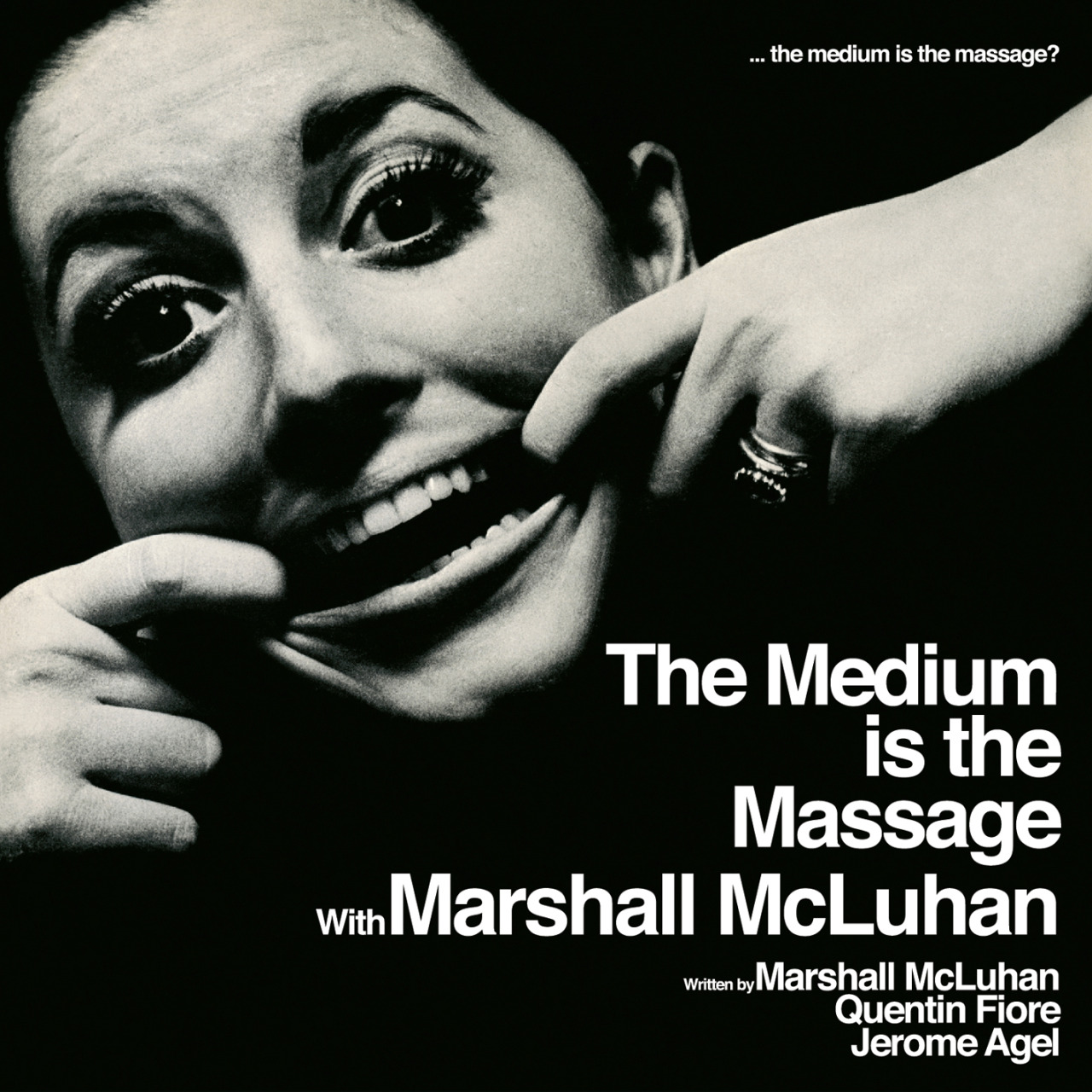
The Medium is the Massage, 1967
With Marshall McLuhan and Jerome Agel
Why?
One of the largest shifts in the latter-half of the 20th century was technological. Computers, telecommunications, air travel, television, and the internet completely destabilized standard thinking and communication. The required readings from Marshall McLuhan (noted Canadian media theorist) and Guy Debord (French philosopher of the Situationist International movement) were both published in 1967 and were prophetic in nature. Both tackled how life was becoming increasingly mediated—we were experiencing things less directly, and more through technology and images. McLuhan’s main point in “The Medium is the Message” is that the mediums that are created are more important and influential than the messages carried by those mediums. For example, the telephone systems shape culture much more than the individual conversations that take place within that system. Debord focuses on capital and images and that as a society, we are moving from being, to having, to appearing (think of the shift from just experiencing the world directly, like a farmer, to constantly giving the appearance of living a full life through Instagram). McLuhan took a more neutral, academic tone in his writings whereas Debord—a neo-Marxist—was critical of these shifts. See if you can notice these tones within their texts, and what societal changes they saw as coming about through these changes in technology.
Required
This is Marshall McLuhan: The Medium is the Message
Separation Perfected, Society of the Spectacle
Supplementary Readings
- Timeline
- Marshall McLuhan
-
The Medium is the Massage
Note; Don't let the page count scare you, it's mostly pictures. “Marshall McLuhan argues that technologies—from clothing to the wheel to the book, and beyond—are the messages themselves, not the content of the communication. In essence, The Medium is the Massage is a graphical and creative representation of his ‘medium is the message’ thesis seen in Understanding Media. By playing on words and utilizing the term ‘massage,’ McLuhan is suggesting that modern audiences have found current media to be soothing, enjoyable, and relaxing; however, the pleasure we find in new media is deceiving, as the changes between society and technology are incongruent and are perpetuating an Age of Anxiety.”Understanding Media: The Extension of Man
“When first published, Marshall McLuhan’s Understanding Media made history with its radical view of the effects of electronic communications upon man and life in the twentieth century. This edition of McLuhan’s best-known book both enhances its accessibility to a general audience and provides the full critical apparatus necessary for scholars. In Terrence Gordon’s own words, ‘McLuhan is in full flight already in the introduction, challenging us to plunge with him into what he calls “the creative process of knowing.”’ Much to the chagrin of his contemporary critics McLuhan’s preference was for a prose style that explored rather than explained. Probes, or aphorisms, were an indispensable tool with which he sought to prompt and prod the reader into an 'understanding of how media operates’ and to provoke reflection.”The Life and Times of Marshall McLuhan, Out of Orbit
“Marshall McLuhan, one of Canada's most influential and controversial figures, burst into the centre of media circles in North America with his strange and prophetic pronouncements - "electric light is pure information" - on advertising, television and the emerging computer age. Known for his imaginative descriptions of the media environment, McLuhan coined the phrases 'the medium is the message' and 'the global village.' These two aphorisms still linger on the tongues of critics, philosophers and pop-culture makers as McLuhan's predictions and revelations continue to be proven true over and over again.” - Guy Debord and Society of the Spectacle
-
Society of the Spectacle
This is the first edition of the (English translation of) book in its entirety.La société du spectacle (Society of the Spectacle)
Note: contains nudity and sexual themes. “La Société du Spectacle (Society of the Spectacle) is a black and white 1973 film by the Situationist Guy Debord based on his 1967 book of the same title. It was Debord’s first feature-length film. It uses found footage and détournement in a radical criticism of mass marketing and its role in the alienation of modern society.”An Illustrated Guide to Guy Debord’s ‘The Society of the Spectacle’, Hyperallergic
“Debord observed that the spectacle actively alters human interactions and relationships. Images influence our lives and beliefs on a daily basis; advertising manufactures new desires and aspirations. The media interprets (and reduces) the world for us with the use of simple narratives. Photography and film collapses time and geographic distance—providing the illusion of universal connectivity. New products transform the way we live.”Society of the Spectacle: WTF? Guy Debord, Situationism and the Spectacle Explained
“Need The Society of the Spectacle explained? Well, in this episode of What the Theory?, we’re doing just that. The Society of the Spectacle by Guy Debord (a key member of the Situationist International) argues that contemporary capitalist society has become obsessed with images and appearances over all else. Debord argues that “the spectacle” has invaded our everyday lives not just in the form of image-based advertising but also in the way that we interact with one another. In this Society of the Spectacle summary video, I provide a brief introduction to Debord’s concept of the spectacle, taking a brief look at the context in which the book was written (including both situationism and the May ’68 Paris uprisings) and unpacking the key arguments included within.”
Response Questions
Remember to cite specific instances from the text to support your views.
- What does McLuhan mean by “the medium is the message?”
- What do you make of McLuhan’s idea of the “global villiage?”
- How would you define Debord’s spectacle? Keep in mind that often theorists and philosophers will employ terms differently than common usage. Debord is also a bit slippery about the term “spectacle” in that he offers up different facets of the idea of the spectacle, but no succinct definition.
- Where might you see aspects of the spectacle at play today?
- Since DeBord and Mcluhan were writing decades before the internet, cable television, 24-hour news, cellphone cameras, etc., what might they have missed in their individual critiques of media and images?