1915 (Naumann Fine Art)
Why?
The Modern era signaled a number of aesthetic shifts including abstraction, medium-specificity, and a growing emphasis on individuality and concept. In part one of our exploration of Modernist media, we will focus on the early 20th century movements, artists, and environmental factors. This period includes Art Nouveau, Fauvism, German Expressionism, Cubism, Futurism, Suprematism, Constructivism, Neoplasticism/DeStijl, the Photo Secession, Dada, the Bauhaus, the International Style, The New Typography, Art Deco, the Harlem Renaissance, The Photo League, and Surrealism. Needless to say, we won’t be discussing each and every movement, but rather overall similarities, influences, trends, and trajectories so we can understand the transition into mid-and late-century art and design including Postmodernism. In particular, we will be focusing on a few pivotal things that shifted the cultural landscape: pictorialism, abstraction, and Dada readymades.
Required
Supplementary Readings
- Timeline
- Cubism
-
William S. Rubin on Picasso and Braque: Pioneering Cubism
“In 1989, William S. Rubin, then Director Emeritus of the Museum of Modern Art’s Department of Painting and Sculpture, organized its groundbreaking exhibition Picasso and Braque: Pioneering Cubism. Rubin gathered over 400 paintings and sculptures by the artists for the exhibition and charted their artistic partnership from 1907 until Braque went off to the Great War in 1914. This unscripted lecture by Rubin was originally produced by The Museum of Modern Art and Checkerboard Film Foundation and was shown in conjunction with the 1989 exhibition. It was then reissued to commemorate William Rubin on the occasion of the 2007 exhibition ‘Picasso Cubiste,’ organized by the Musee Picasso in Paris.“Picasso and Braque Go to the Movies
"Produced by Martin Scorsese and Robert Greenhut and directed by Arne Glimcher, Picasso and Braque go to the Movies is a cinematic tour through the effects of the technological revolution, specifically the invention of aviation, the creation of cinema and their interdependent influence on artists Pablo Picasso and Georges Braque. With narration by Scorsese, and interviews with art scholars and artists including Chuck Close, Julian Schnabel and Eric Fischl, the film looks at the collision between film and art at the turn of the 20th Century and helps us to realize cinema’s continuing influence on the art of our time.”Cubism, Heilbrunn Timeline of Art History, the Metropolitan Museum of Art
“The Cubist painters rejected the inherited concept that art should copy nature, or that artists should adopt the traditional techniques of perspective, modeling, and foreshortening. They wanted instead to emphasize the two-dimensionality of the canvas. So they reduced and fractured objects into geometric forms, and then realigned these within a shallow, relieflike space. They also used multiple or contrasting vantage points.”The Rise of Cubism, Art in Theory 1900–2000: An Anthology of Changing Ideas
Pages 208–214 “Kahnweiler was the leading dealer in Cubist art at the moment of its foundation. His contact, indeed his friendship, with Picasso and Braque enabled them to work relatively unhindered by the demands of public exhibition. Declared an enemy alien on the outbreak of war in 1914, when his collection was sequestrated, Kahnweiler retired to Switzerland. There, influenced by his readings in philosophy, particularly an interest in Kant, he composed a theoretical work Der Gegenstander Asthetik, which included his pioneering, study of Cubism.”Thoughts on Painting, Art in Theory 1900–2000: An Anthology of Changing Ideas
“Braque’s aphorisms, purportedly jotted down in the margins of his drawings, emphasize both the autonomy of Cubism, the ‘constitution of a pictorial fact,’ and its status as a form of representation.”Pablo Picasso: Women are either Goddesses or Doormats, The Telegraph
“From Rembrandt and Goya to Bonnard and Stanley Spencer, male artists have drawn obsessively and immensely productively on the faces and bodies of their wives and lovers. But no one used and abused his women quite like the greatest artist of the 20th century, Pablo Picasso.” - International Pictorialism
-
Pictorialism, Oxford Art Online
“Photographic style that began around 1890 and continued until at least World War II, in which photographers sought to convey subjective emotions rather than depict objective reality. Pictorialism became the first international movement of photography, with artists predominantly working in the USA, Europe and Asia. Pictorialists modelled their photographs after fine art, and they embraced a variety of artistic influences, including Symbolist literature and art, Impressionist and Pre-Raphaelite painting, Art Nouveau and Japonisme. Their works were generally characterized by picturesque subjects rendered in soft focus, with an emphasis on tone rather than line and detail.” - The Photo-Secession
-
All issues of Alfred Stieglitz’s 291
Alfred Stieglitz, Marius de Zayas, Agnes Ernest Meyer, and Paul Haviland created the arts and literary magazine 291 in 1915 in New York City. At first, the publication was meant to promote Stieglitz’s gallery of the same name (291), it grew to include essays, poems and artworks by the avant-garde of the time: Francis Picabia, John Marin, Max Jacob, Georges Ribemont-Dessaignes, de Zayas, and Stieglitz. It ran from 1915 to 1916 with a total of 9 issues.Alfred Stieglitz (1864–1946) and His Circle, Heilbrunn Timeline of Art History, the Metropolitan Museum of Art
“Recognized as a pioneer in the advancement of Pictorial photography in America and abroad, Alfred Stieglitz (1864–1946), photographer, publisher, gallerist, and impresario, also made unparalleled contributions to the introduction of modern art in America and gave unequivocal support to young American modernist painters. In 1905, Stieglitz, in association with the photographer and painter Edward J. Steichen , opened the Little Galleries of the Photo-Secession in Steichen’s former studio at 291 Fifth Avenue. Commonly called ‘291,’ the small gallery was originally an outlet for exhibiting work by Photo-Secessionist photographers, but subsequently it became a preeminent center for the exhibition of modern European and American artists. With the aide of advisors Steichen, Marius de Zayas, and Max Weber, who had connections with artists and galleries in France, 291 became the first venue in America to show Auguste Rodin and Henri Matisse (in 1908), Paul Cézanne (in 1910), and Pablo Picasso (in 1911).”Pictorialism in America, Heilbrunn Timeline of Art History, the Metropolitan Museum of Art
“After the introduction of the handheld amateur camera by Kodak in 1888, patrician gentlemen with artistic ambitions no longer dominated the medium of photography. As an army of weekend “snapshooters” invaded the photographic realm, a small but persistent group of photographers staked their medium’s claim to membership among the fine arts. They rejected the point-and-shoot approach to photography and embraced labor-intensive processes such as gum bichromate printing, which involved hand-coating artist papers with homemade emulsions and pigments, or they made platinum prints, which yielded rich, tonally subtle images. Such photographs emphasized the role of the photographer as craftsman and countered the argument that photography was an entirely mechanical medium. Alfred Stieglitz was the most prominent spokesperson for these photographers in America, and in 1902 he and several like-minded associates in the New York Camera Club—including Gertrude Käsebier (33.43.132), Alvin Langdon Coburn (1987.1100.13), and Frank Eugene (55.635.12)—broke away from the club to form what they dubbed the Photo-Secession.”1916, Art Since 1900: 1900–1944 (2nd edition)
Pages 142–147 This section discusses Alfred Stieglitz and his cohort as they form the Photo-Secession and pursue Pictorialism. - Tantric Painting (Non-Western, Early Abstraction)
-
“An Egoless Practice”: Tantric Art, The Paris Review
“Tantra is extremely difficult to explain. But it’s important to note that these small paintings come from Tantric Hinduism, beginning in the fifth or sixth century, and not Tantric Buddhism. For instance, the goddess deities are Shiva, Kali, Tara, and so on. After painting, one is to meditate with these to finally make the divinity appear. It’s an egoless practice. In Sanskrit tantra means ‘loom’ or ‘weave,’ but also ‘treatise.’ The paintings date back to the handwritten Tantra treatises that have been copied over many generations, at least until the seventeenth century. At some point they evolved into this complex symbolic cosmology of signs.”Tantric Paintings: Some Observations, Hyperallergic
“First of all I do not disrespect the fact that people are painstakingly collecting these paintings, researching and writing about them. But if we want to analyze them from art’s point of view, we will have to keep the excitement, romanticism and spiritual curiosity aside for a while. It is uncanny to see the “resemblance” these paintings have with many of the modern art works, but this does not mean that these paintings are a result of a conscious art practice from ancient Tantrism. These are instead the outcome of ritualistic processes. When art serves as a component of ritualism, the questioning stops and so does its evolution.” - European Abstraction
-
1921, Art Since 1900: 1900–1944 (2nd edition)
Pages 180–185 ConstructivismMondrian at Tate Liverpool and Turner Contemporary
“Art Historian Rosie Rockel takes in two new exhibitions dedicated to Piet Mondrian: Mondrian and Colour at Turner Contemporary, and Mondrian and his Studios at Tate Liverpool.”First three volumes of De Stijl + vol. 4 no. 11 (1917–1921)
“De Stijl, Dutch for ‘The Style’, also known as neoplasticism, was a Dutch artistic movement founded in 1917. In a narrower sense, the term De Stijl is used to refer to a body of work from 1917 to 1931 founded in the Netherlands. De Stijl is also the name of a journal that was published by the Dutch painter, designer, writer, and critic Theo van Doesburg (1883–1931), propagating the group’s theories.” (text from Ubu.com)1913, Art Since 1900: 1900–1944 (2nd edition)
Pages 118–124 Early European abstraction - Abstraction in Illustration
-
Stylistic Illustration: 2. Abstraction, The Informed Illustrator
“From the late 1920s through the years of World War II, abstractionism became a predominant form of illustration. Pure shape, line, texture, and color became ever-present pictorial conventions in the illustrations of that era. Some illustrators, such as Joost Schmidt, E. A. Barton, Edward McKnight, and Leo Marfurt, created compositions that took the use of abstract form to the extreme. This presented quite a challenge for an audience that was primarily accustomed to realist imagery.” - Abstraction in Photography
-
Abstract Photography Show, Photo Arts
“Abstraction, like logic and what is termed the practical reason, is a way of man's thinking. Like all thought, abstraction is included in the more general process called symbolization. Its particular distinction is its quality of summary, the ability to treat many particular ideas in more easily handled general categories. Mathematics exemplifies this process more than any other branch of human endeavor. Abstractions are arrived at by eliminating the impurities of fact and retaining the essentials of structure or form. What, then, is abstract photography?” - Suprematism
-
Kazimir Malevich | TateShots
“Malevich’s Black Square is the Hour Zero of modern art for many artists, showing how much one work can change the course of art history. But what were Malevich’s motivations and where did this iconic painting take him after 1915?”Art Historian Finds Racist Joke Hidden Under Malevich’s Black Square, Hyperallergic
“After examining ‘Black Square’ under a microscope, researchers from Russia’s State Tretyakov Gallery, which houses one of three versions of the Suprematist composition, found a handwritten inscription under a topcoat of black paint. They believe it reads ‘Battle of negroes in a dark cave.’”Russian Avant-Garde | How to See the Art Movement with MoMA Curator Roxana Marconi
“For the hundredth anniversary of the 1917 Russian Revolution, MoMA curator Roxana Marcoci explains how artists such as Malevich, Rodchenko, and Vertov attempted to revolutionize Russian society through new means of artistic production—and how the styles developed by the Russian Avant-Garde still affect how we look at art today.” - De Stijl + Neoplasticism
-
Mondrian at Tate Liverpool and Turner Contemporary
“Art Historian Rosie Rockel takes in two new exhibitions dedicated to Piet Mondrian: Mondrian and Colour at Turner Contemporary, and Mondrian and his Studios at Tate Liverpool.”First three volumes of De Stijl + vol. 4 no. 11 (1917–1921)
“De Stijl, Dutch for ‘The Style’, also known as neoplasticism, was a Dutch artistic movement founded in 1917. In a narrower sense, the term De Stijl is used to refer to a body of work from 1917 to 1931 founded in the Netherlands. De Stijl is also the name of a journal that was published by the Dutch painter, designer, writer, and critic Theo van Doesburg (1883–1931), propagating the group’s theories.” (text from Ubu.com)1917, Art Since 1900: 1900–1944 (2nd edition)
Piet Mondiran, De Stijl, and Neoplasticism - Dada
-
391
This link will take you to some, but not all, issues of 391, a seminal Dada publication out of NYC. "Even if Picabia appeared to be duplicating 291 in the title and material presentation of his magazine, 391 is the instrument which allowed him to diffuse his art and his ideas: from the launch of the magazine in 1917 until 1924, each issue contained the artist’s poems, notes, and drawings, and the covers almost always reproduced one of his works. The periods in which Picabia experienced difficulty account for the magazine’s irregular rhythm of publication: a turning point in his art, boredom, solitude, and illness… ‘Better than nothing’: to do everything to avoid doing nothing, to work, to create to live. For Picabia, as for the Dada movement, which he joined after the creation of 391, these years of war were about battling nothingness, the vacuum that is civilization, with provocation.”Dada Fragments, Art in Theory 1900–2000: An Anthology of Changing Ideas
Pages 250–251 “These Fragments and diary entries from 1916 to 17 were originally published in Ball’s book Flucht aus der Zeit (Flight from Time). Munich/Leipzig. 1927.”Two issues of The Blind Man
“Three little magazines were produced by the French émigrés Marcel Duchamp and Henri-Pierre Roché in New York in 1917, and their role in the scandal of Duchamp’s Fountain has ensured their inscription in the history of Dada, though the name was then unknown to the protagonists. Duchamp’s close friend Francis Picabia was in New York at the same time and his 391 was also exploring Duchamp’s idea of the 'readymade’. The Blindman (its first issue ran the words together in the title) was published in April 1917 by Henri-Pierre Roché with contributions from Mina Loy and Beatrice Wood. […] The second issue in May of the same year, P.B.T. The Blind Man (the B stood apparently for Beatrice, the T for Totor, Duchamp’s nickname) carried the famous statement ‘The Richard Mutt Case’, which protested the suppression of R. Mutt’s Fountain-urinal from the Independents exhibition.”All 8 issues of Dada
“Dada: recueil littéraire et artistique [Dada: Literary and Artistic Review] was an avant-garde magazine published in 8 numbers (7 issues) between July 1917 and September 1921, first in Zürich (1-4/5) and later in Paris (6-8). The magazine was edited by Tristan Tzara; number 3 (1918) features his Dada manifesto in which he declared that ‘dada means nothing.’”The Forgotten Legacy of Cult California Artist Beatrice Wood, Artsy
“Wood was a member of the New York Dada group and a pioneering sculptor. As a woman artist primarily working in ceramics, she also represented a demographic and a medium that were both marginalized during her lifetime. ‘More people know her for sleeping with Duchamp than for making her own work,’ the artist Arlene Shechet told me when we discussed Wood’s legacy. ‘That needs to be rectified.’”Marcel Duchamp (1887–1968), Heilbrunn Timeline of Art History, the Metropolitan Museum of Art
“Subverting traditional or accepted modes of artistic production with irony and satire is a hallmark of Duchamp’s legendary career. His most striking, iconoclastic gesture, the readymade, is arguably the century’s most influential development on artists’ creative process. Duchamp, however, did not perceive his work with readymade objects as such a radical experiment, in part because he viewed paint as an industrially made product, and hence painting as an ‘assisted-readymade.’”Elsa von Freytag-Loringhoven, the Dada Baroness Who Invented the Readymade, Artsy
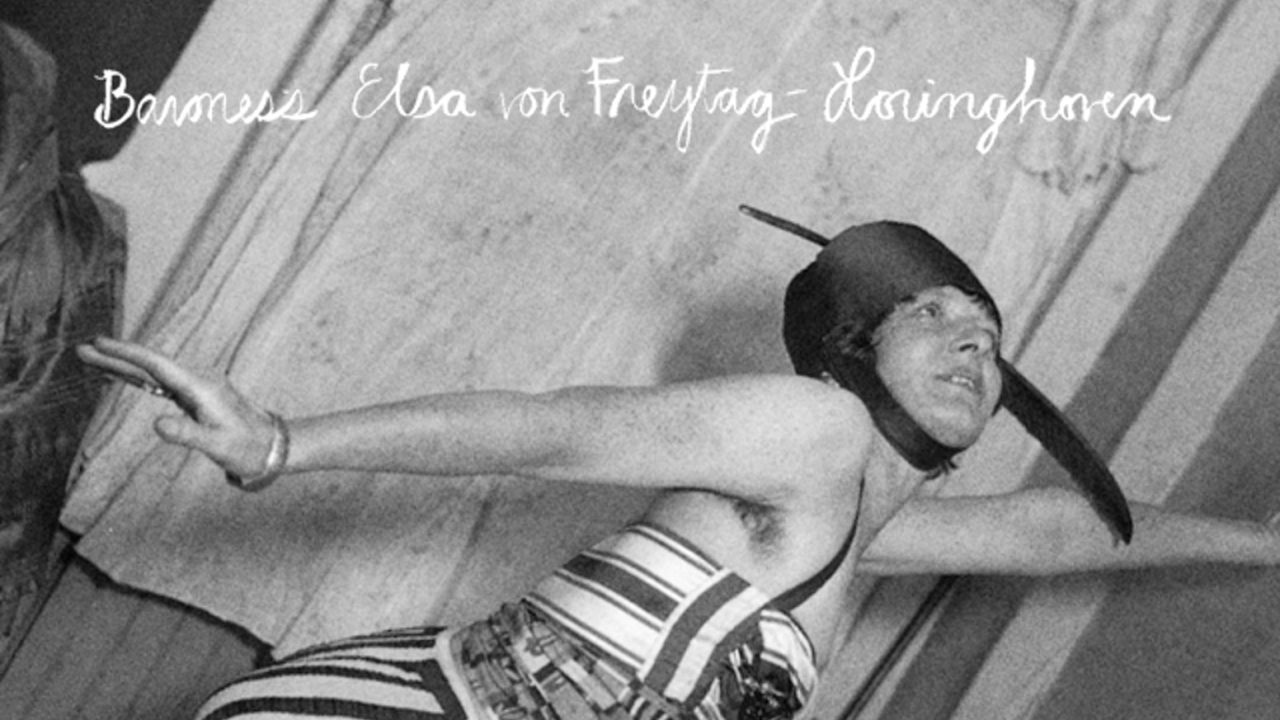
“On a regular day, Baroness Elsa von Freytag-Loringhoven wore brightly colored makeup, postage stamps on each cheek, and a shaved head shellacked in various hues. Her accoutrements also included live birds, packs of dogs, a tomato-can bra, arms full of bangles, and flashing lights. Her unconventionally forthright poetry and rugged found-object sculptures—often incorporated into her outfits—unsettled social hierarchy and accepted gender norms, and distinctions between art and life. The Baroness was a dynamo in New York’s literary and art scene at the turn of the century, part of the Arensberg Salon group that included Marcel Duchamp, Man Ray, Beatrice Wood, Francis Picabia, Mina Loy, and many others.”Marcel Duchamp: The Art of the Possible
“This documentary explores the life, philosophy and impact of one of the most influential early 20th century modernists. The film breaks down Marcel Duchamp's legacy, applying it to historical events and trends in modern day conceptual art, internet and meme culture.Featuring leading artists and thinkers in today's art world, the documentary reveals how Duchamp's vision forever shifted public consciousness, and our understanding of aesthetics, art, and the world we live in.” - Bauhaus
-
Photography at the Bauhaus, Heilbrunn Timeline of Art History, the Metropolitan Museum of Art
“Just as traditional media and materials were being subjected to intense reappraisal at the Bauhaus, Moholy-Nagy advocated unlimited experimentation with the photographic process. The photogram, created by placing objects on photographic paper and exposing them to light, exemplified the idea that the medium, formerly valued primarily for its ability to reproduce, was capable of producing entirely new art. In his 1926 Photogram (1987.1100.158 ), he deftly deals with light and issues then being explored in modern painting simply by using the play of light to create a radiant image of a hand and paintbrush floating serenely in dimensionless space.”Teaching and Learning at the Bauhaus, Getty: Art + Ideas
“This episode commemorates the hundredth anniversary of the opening of the Bauhaus, the influential school founded in 1919 by Walter Gropius in Weimar, Germany. Revered for its experimental art and design curriculum, the Bauhaus sought to erode distinctions among crafts, the fine arts, and architecture through study centered on practical experience and a variety of traditional and experimental media. Two exhibitions from the Getty, one of which is online, explore the Bauhaus curriculum from the point of view of the instructors and students, largely through pedagogical exercises, notebooks, and images. In this episode, Getty curator Maristella Casciato, research assistant Gary Fox, and head of web and new media at the Getty Research Institute Liz McDermott discuss these exhibitions, Bauhaus Beginnings and Bauhaus: Building the New Artist.”BBC Documentary – Bauhaus 100 – 100 Years of Bauhaus, BBC
“In 1919 an art school opened in Germany that would change the world forever. It was called the Bauhaus. A century later, its radical thinking still shapes our lives today. Bauhaus 100 is the story of Walter Gropius, architect and founder of the Bauhaus, and the teachers and students he gathered to form this influential school. Traumatised by his experiences during the Great War, and determined that technology should never again be used for destruction, Gropius decided to reinvent the way art and design were taught. At the Bauhaus, all the disciplines would come together to create the buildings of the future, and define a new way of living in the modern world.”1923, Art Since 1900: 1900–1944 (2nd edition)
Pages 191–195 This chapter covers the Bauhaus.Celebrating Six Trailblazing Bauhaus Women, Curbed
“As Sigrid Wortmann Weltge writes in the introduction to her book Women’s Work: Textile Art from the Bauhaus, female students ‘arrived at the school with an astonishing diversity of talents, convinced that this avant-garde institution would accept them as equals.’ Alas. Many of these students had already studied art elsewhere—and they were eager to learn from masters like Paul Klee, Wassily Kandinsky, and László Moholy-Nagy—but ‘they were segregated and given their own workshop, the Weaving Workshop, regardless of talent or inclination,’ Weltge writes.”Haus Proud: The Women of Bauhaus, The Guardian
“More women than men applied to the school in 1919, and Gropius insisted that there would be ‘no difference between the beautiful and the strong sex’—those very words betraying his real views. Those of the 'strong sex’ were, in fact, marked out for painting, carving and, from 1927, the school’s new architecture department. The 'beautiful sex’ had to be content, mostly, with weaving.” - Women of the Bauhaus
-
Celebrating Six Trailblazing Bauhaus Women, Curbed
“As Sigrid Wortmann Weltge writes in the introduction to her book Women’s Work: Textile Art from the Bauhaus, female students ‘arrived at the school with an astonishing diversity of talents, convinced that this avant-garde institution would accept them as equals.’ Alas. Many of these students had already studied art elsewhere—and they were eager to learn from masters like Paul Klee, Wassily Kandinsky, and László Moholy-Nagy—but ‘they were segregated and given their own workshop, the Weaving Workshop, regardless of talent or inclination,’ Weltge writes.”Haus Proud: The Women of Bauhaus, The Guardian
“More women than men applied to the school in 1919, and Gropius insisted that there would be ‘no difference between the beautiful and the strong sex’—those very words betraying his real views. Those of the 'strong sex’ were, in fact, marked out for painting, carving and, from 1927, the school’s new architecture department. The 'beautiful sex’ had to be content, mostly, with weaving.” - Surrealism
-
Photography and Surrealism, Heilbrunn Timeline of Art History, the Metropolitan Museum of Art
“Photography came to occupy a central role in Surrealist activity. In the works of Man Ray (2005.100.141) and Maurice Tabard (1987.1100.141), the use of such procedures as double exposure, combination printing, montage, and solarization dramatically evoked the union of dream and reality. Other photographers used techniques such as rotation (1987.1100.49) or distortion (1987.1100.321) to render their images uncanny.”Surréalisme
This is the first issue of Surréalisme magazine (1924). Note: it is in French. “Surréalisme was a magazine edited by Ivan Goll and published in one issue in Paris in October 1924.”How Two Curators Uncovered the Forgotten Story of the Egyptian Surrealists, Artsy
“Perhaps one of the most exciting discoveries of all was the existence of one of the Art and Liberty group’s contemporaries, Kamal Youssef, an artist who turned out to be alive, despite several sources claiming he had departed this mortal coil long ago. Youssef, 93, now lives on an Amish farm outside Pittsburgh, Pennsylvania. ‘He’s still painting every day!’ says Bardaouil. ‘We tracked him down through the most random set of coincidences. It turned out his best friend had been Art and Liberty member Hassan El-Telmisani (1923–87), and Hassan’s grandson’s cousin was in the process of tracking him down—and then along we came.’”Salvador Dalí “I’m Not a Good Painter” Interview
“I’ve always said I’m a very bad painter, because I’m too intelligent to be a good painter.”Mustache Intact, Salvador Dalí’s Remains Are Exhumed in Paternity Suit, The New York Times
“When the remains of the Surrealist painter Salvador Dalí were exhumed in Spain on Thursday night, forensics experts made a startling discovery: The artist’s trademark mustache was still intact. ‘The mustache kept its classic 10-past-10 position,’ Lluís Peñuelas, the secretary general of the foundation that oversees Dalí’s estate, told reporters on Friday, referring to the artist’s waxed and gravity-defying bristles, which Dalí kept pointed upward, like the hands of a clock. ‘Finding this out was a very emotional moment.’”The Flowering of the Crone: Leonora Carrington, Another Reality
“Perhaps the last surviving artist of the original Surrealist artist movement, as well as the famously former lover of Max Ernst, Carrington’s life and work is arguably not 'surreal’ at all, nor is it classifiable in any sense of the word. Indebted to Surrealism, Carrington is nonetheless possessed of unique personal visions born from a fantastical interior life, one based in Celtic legend, alchemy, fairy tales, Tibetan Buddhism, Tarot, Kabbala, astrology, Mexican healing traditions and other mystical practices.”Leonora Carrington: Britain’s Lost Surrealist, The Guardian
“Leonora Carrington escaped a stultifying Lancashire childhood to run off with Max Ernst and hang out with Picasso and André Breton in 1930s Paris. She fled the Nazis, escaped from a psychiatric hospital in Spain and became a national treasure in Mexico. What happened to one of Britain’s finest — and neglected — surrealists?”René Magritte
”You had better look twice! In the works of Rene Magritte, an absurd assembly of everyday objects appear on the canvas. The leading figure of the Belgian surrealists has a brilliant way of showing the viewer the phenomena of art, reality, perception and language. The artist’s subversive humour is thereby omnipresent, as in the silent movies that he produced with his friends. The filmmaker Adrian Maben penetrates Magritte’s fantastic picture-puzzle world. He does this by merging pictures, childhood memories, objects from Magritte’s apartment in Brussels, old film clips and interviews to create a portrait of a unique artist and human being.”First Manifesto of Surrealism (excerpt), Art in Theory 1900–2000: An Anthology of Changing Ideas
Pages 447–453 “Breton was introduced to Freudian analysis while serving in a medical capacity in the First World War. After the apparent exhaustion of Dada, Breton assumed the leadership of the left wing of the avant-garde, opposing the irrational and the work of the subconscious to the nationalism and technicism of the Esprit Nouveau group.To this end he articulated the definitive formulation of the concept of Surrealism. The term had been coined by Apollinaire, who had also promoted the idea of a ‘new spirit’. Breton's first ‘Manifest of Surrealism’ was originally published in Paris in 1924.”What is Surrealism?, Art in Theory 1900–2000: An Anthology of Changing Ideas
Pages 491–493 “Educated in philosophy, psychiatry and art history, but self-taught as a painter, Ernst served in the German army from 1914 to 1918 and was thereafter involved in the activities of the Dada group in Cologne. An exhibition of his collages was staged by the Dada group in Paris in 1921, and he moved to the French capital the following year, staying with Paul and Gala Eluard. His early paintings reveal an interest in the theories of Freud and in imagery associated with dreams and neuroses. He acquired a copy of Prinzhorn Artistry of the Mentally Ill on its publication in 1922. Following publication of Breton's first ‘Manifesto of Surrealism’ in 1924, Ernst claimed the technique of frottage a sa form of pictorial automatism compatible with the ‘automatic writing’ practised by the literary Surrealists.” - Other Artists of the Period
-
Louise Bourgeois: The Spider, The Mistress and the Tangerine: A Modern Artist and Feminist Icon
“A journey inside the world of a legend of modern art and an icon of feminism. Onscreen, the nonagenarian Louise Bourgeois is magnetic, mercurial and emotionally raw. An uncompromising artist whose life and work are imbued with her ongoing obsession with the mysteries of childhood. Her process is on full display in this intimate documentary, which features the artist in her studio and with her installations, shedding light on her intentions and inspirations. Filmed with unparalleled access between 1993 and 2007, Louise Bourgeois: The Spider, The Mistress and the Tangerine is a comprehensive and dramatic documentary of creativity and revelation.”
Response Questions
Remember to cite specific instances from the text to support your views.
- In the early twentieth century, you see photography fighting for legitimacy as an art form by trying to mimic the aesthetics of painting and drawing. About the same time, you see many painters abandoning representation in favor of pure abstraction. What do you make of this move to validation by mimicking another art form, while that other art form seeks legitimcay by abandoning its representational past? How might that inform your view of contemporary creative practices?
- Much art and design education centers around assumed values of craftsmanship, originality, authorship, and making. Duchamp and/or Freytag-Loringhoven threw a lot of that out the window with readymades. What do you make of readymades and what impact do you see on contemporary creative activity (think of copy-and-paste creations in the digital era, stock photography, and similar readymades)? Be sure to support your views, do not just state a stance without backup.
- Think back to our unit on languages and semiotics. Since much of semiotics is related to commonly understood languages, how might that play out with abstraction (think of Prisencolinensinainciusol)?