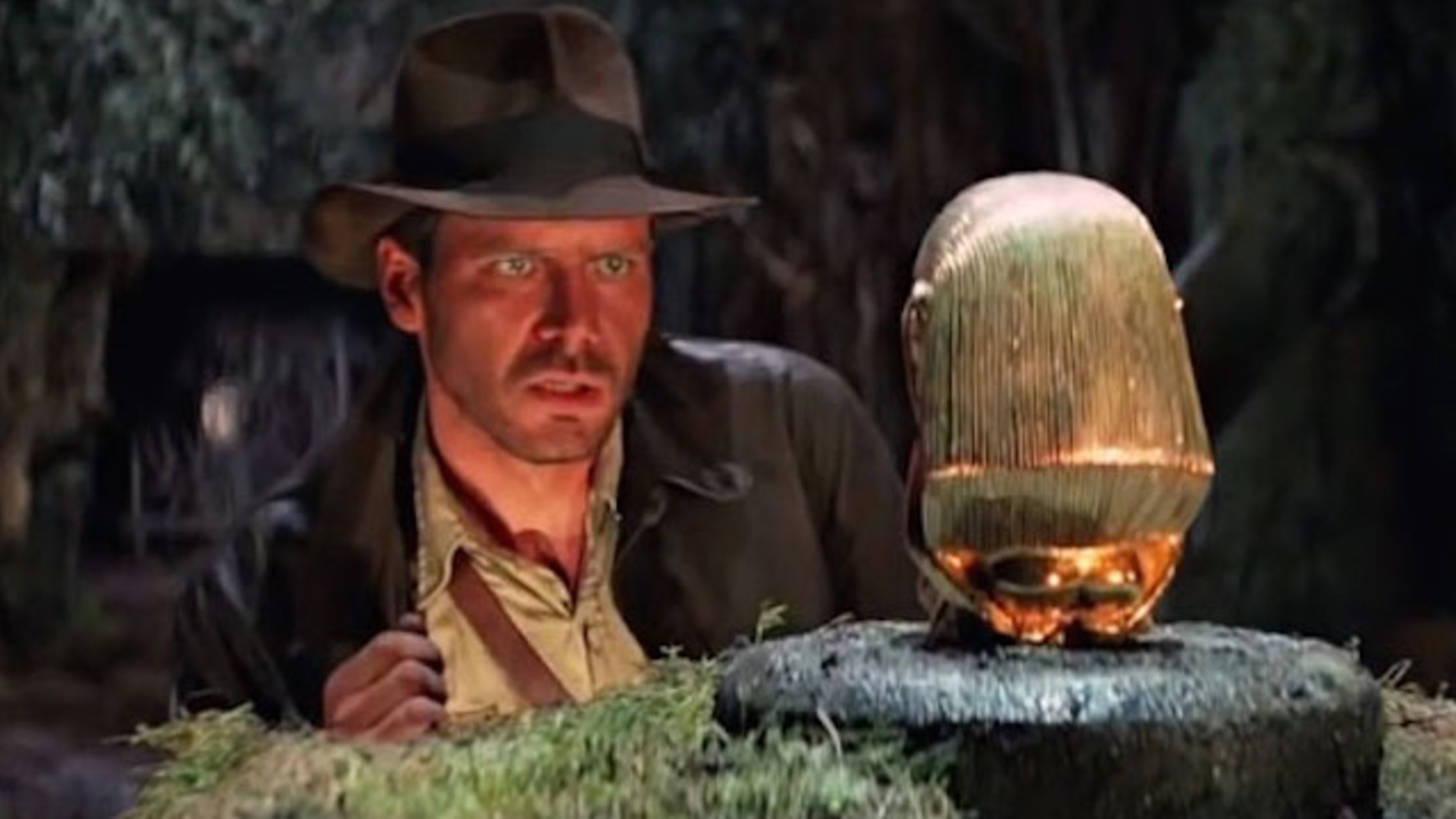
Directed by Steven Spielberg; written by Lawrence Kasdan, George Lucas, and Philip Kaufman
Why?
Experience governs how we understand our world. This experience can be gained empirically—through our senses—and logically—by learning from others and deducing from our experiences. Concepts, such as “design,” are primarily understood through witnesses. Practitioners and teachers define what design is by teaching your methods, materials, theories, and histories. Histories are generally what govern the others. What design
The past is what happened, history is how it is remembered. As such, it is important to look closely at what history is, how it is shaped and communicated, and how it molds our understanding of design and culture. We also need to differentiate between history—“A narration of incidents, esp. (in later use) professedly true ones; a narrative, a story”—and myth—“A popular conception of a person or thing which exaggerates or idealizes the truth.”1, 2 It also begs the questions, who is telling the stories, are we learning a true history or a mythology, can we understand design outside of history, and what might design look like that is void of history?
Required
Note: I am including the TED video, not so much for the life-coach, self-help aspect, but to consider what she is saying as a more personal way to contemplate how we tell the stories of history.
Supplementary Readings
- Historiography
-
The Stories We Tell Ourselves, The New York Times
“If we reflect on the stories we tell about ourselves, both to others and to ourselves, we may well find out things about who we are that complicate the view we would prefer to be identified with.”The Stories We Tell Ourselves, Psychology Today
“None of us wants to be seen as the villain of our own, or of other people’s, lives. Quite the opposite, we want to be regarded well. The stories we tell are attempts to maintain that respect. Even our confessions of failure are equally efforts to show that we are repentant, that we are good people at heart for whom the current malfeasance is mostly an irregularity.”Myth and History, Encyclopædia Britannica
“Myth and history represent alternative ways of looking at the past. Defining history is hardly easier than defining myth, but a historical approach necessarily involves both establishing a chronological framework for events and comparing and contrasting rival traditions in order to produce a coherent account. The latter process, in particular, requires the presence of writing in order that conflicting versions of the past may be recorded and evaluated. Where writing is absent, or where literacy is restricted, traditions embedded in myths through oral transmission may constitute the principal sources of authority for the past.”Why Design History? A Multi-National Perspective on the State and Purpose of the Field
“This article asks: what is the significance of design history within higher education? It reviews the practice and purpose of design history, in the education of historically aware and critically engaged designers, as an emerging independent discipline, and in terms of what the subject has to offer allied fields such as history, sociology, cultural studies, history of technology, area studies and anthropology. It considers the development and current state of design history as it is taught in the UK and non-Anglophone Europe (including France, Italy, Scandinavia, Spain, Turkey and Greece), in the US, Australia and East Asia. The argument that follows is grounded in recent design historical scholarship, combined with the views of design historians working in the abovementioned countries, in order to provide both a contemporary perspective on current practice and suggestions about possible futures.”The Redundancy of Design History
“Of course, this failure of design history to affect practice may be explained by the fact that most designers, on the whole, don’t read. But some do, and particularly those engaged in postgraduate or paper is not another clarion call to practitioners to underpin their practice with more history and theory. We have had enough of such ill-defined, badly informed invocations. Read? Read what? appreciate your traditions? Whose traditions? So, the key problem is not more design history but better design history.”What is History?, History Today
“Four historians consider the most fundamental question of all, one famously posed by E.H. Carr almost 60 years ago.”Myth, History, and Theory, History and Theory
“Myth and history are generally considered antithetical modes of explanation. Writers of each tend to distrust the data of the other. Many historians of the modern period see their task as one of removing all trace of myth from the historical record. Many students of myth consider history to have less explanatory power than traditional narra- tives. Since the Greeks, logos (word as demonstrable truth) has been opposed to mythos (word as authoritative pronouncement). In more general terms myth may be defined as any set of unexamined assumptions. Some modern historians have become aware that much so-called factual history is interfused with such assumptions. What we call history is at best mythistory. Some even suggest that there can be no real distinction between the discourses of myth and history, between fact and fiction.”Has The World Already Ended? Or Just History?, PBS Idea Channel
“Things are… tense…. It’s tough to deny that right now, the world can feel a bit like a standoffish middle school dance… with nukes. Foreign policy, geopolitics, international defense, and even long standing institutions like the European Union and, depending upon who you ask, democracy itself… have uncertain futures. Rather than indulging in our inner chicken little, it may be useful to know this isn’t, of course, the first time some people have felt like the end is nigh. As a matter of fact, depending upon who you ask–and we will… ask–it’s possible that either the world… OR HISTORY… has already ended; though at the end… of both of those things, and this episode, maybe we can find a beginning. Let’s talk some Francis Fukuyama and Jean Baudrillard.” - Unreliable Narrators
-
Every Marriage Is a Courthouse, This American Life
“The second cartoon Chris Ware and John Kuramoto made for our TV show, animating a story told by Radiolab host Robert Krulwich and his wife, Tamar.”Who Can You Trust? Unreliable Narrators, It's Lit!, PBS Digital Studios
“Who is the most powerful character in fiction? Villains may doom the world, heroes may save it, but no one has more control over the plot than the narrator - expositing the who, what, where, when and how directly into the reader’s mind. But how can you tell that the person telling you the story is telling you the whole story?”The Fix Is In, This American Life
“There are all sorts of situations in which we suspect the fix is in, but we almost never find out for certain. On today's show, for once, we find out. The whole program is devoted to one story, in which we go inside the back rooms of one multinational corporation and hear the intricate workings—recorded on tape—of how they put the fix in.”
- Mythology
-
Myth and History, Encyclopædia Britannica
“Myth and history represent alternative ways of looking at the past. Defining history is hardly easier than defining myth, but a historical approach necessarily involves both establishing a chronological framework for events and comparing and contrasting rival traditions in order to produce a coherent account. The latter process, in particular, requires the presence of writing in order that conflicting versions of the past may be recorded and evaluated. Where writing is absent, or where literacy is restricted, traditions embedded in myths through oral transmission may constitute the principal sources of authority for the past.”Myth, History, and Theory, History and Theory
“Myth and history are generally considered antithetical modes of explanation. Writers of each tend to distrust the data of the other. Many historians of the modern period see their task as one of removing all trace of myth from the historical record. Many students of myth consider history to have less explanatory power than traditional narra- tives. Since the Greeks, logos (word as demonstrable truth) has been opposed to mythos (word as authoritative pronouncement). In more general terms myth may be defined as any set of unexamined assumptions. Some modern historians have become aware that much so-called factual history is interfused with such assumptions. What we call history is at best mythistory. Some even suggest that there can be no real distinction between the discourses of myth and history, between fact and fiction.”What Is Myth? Crash Course World Mythology #1
“Welcome to Crash Course World Mythology, our latest adventure (and this series may be literally adventurous) in education. Over the next 40 episodes or so, we and Mike Rugnetta are going to learn about the world by looking at the foundational stories of a bunch of different cultural traditions. We’re going to look at the ways that people’s stories define them, and the ways they shape their culture. We’re going to learn about gods, goddesses, heroes, and tricksters, and a lot more. We’re going to walk the blurry line between myth and religion, and we’re going to like it.”
Response Questions
Remember to cite specific instances from the text to support your views.
- How much does history impact your view of design? Imagine that design did not exist as a concept—that animation, illustration, graphic design, and photography were never invented or developed. How might that alter the way that you work or the way that you talk about your work?
- If our understanding of design is based on its past performance, how might the stories that are perpetuated about design impact how it is practiced?
- Consider the sources of the histories you have been taught, particularly around art and design. How reliable are they? What biases might they hold? How might that shape your understanding of design?
- “History, n.,” Oxford English Dictionary, accessed January 2, 2021, https://www-oed-com.erl.lib.byu.edu/view/Entry/87324.
- “Myth, n.,” Oxford English Dictionary, accessed January 2, 2021, https://www-oed-com.erl.lib.byu.edu/view/Entry/124670.