Why?
These readings give examples of Postmodernism in action—double-coding, irony, parody, pastiche, satire, quoting, appropriation, sampling, remixing, and so on. When many of the underlying tenets of Modernism were questioned, it opened up many possibilities to artists and designers.
The punk movement took late Modernism’s tendency toward minimalism, but removed any utopic leanings. Simple, three-chord songs, played with very little musicianship, layered with snotty, antisocial lyrics were a mainstay of early punk, post-punk, and new wave. The music was a transition from the austerity, purity, and optimism of Modernism into the plurality, impurity, and cynicism of Postmodernism.
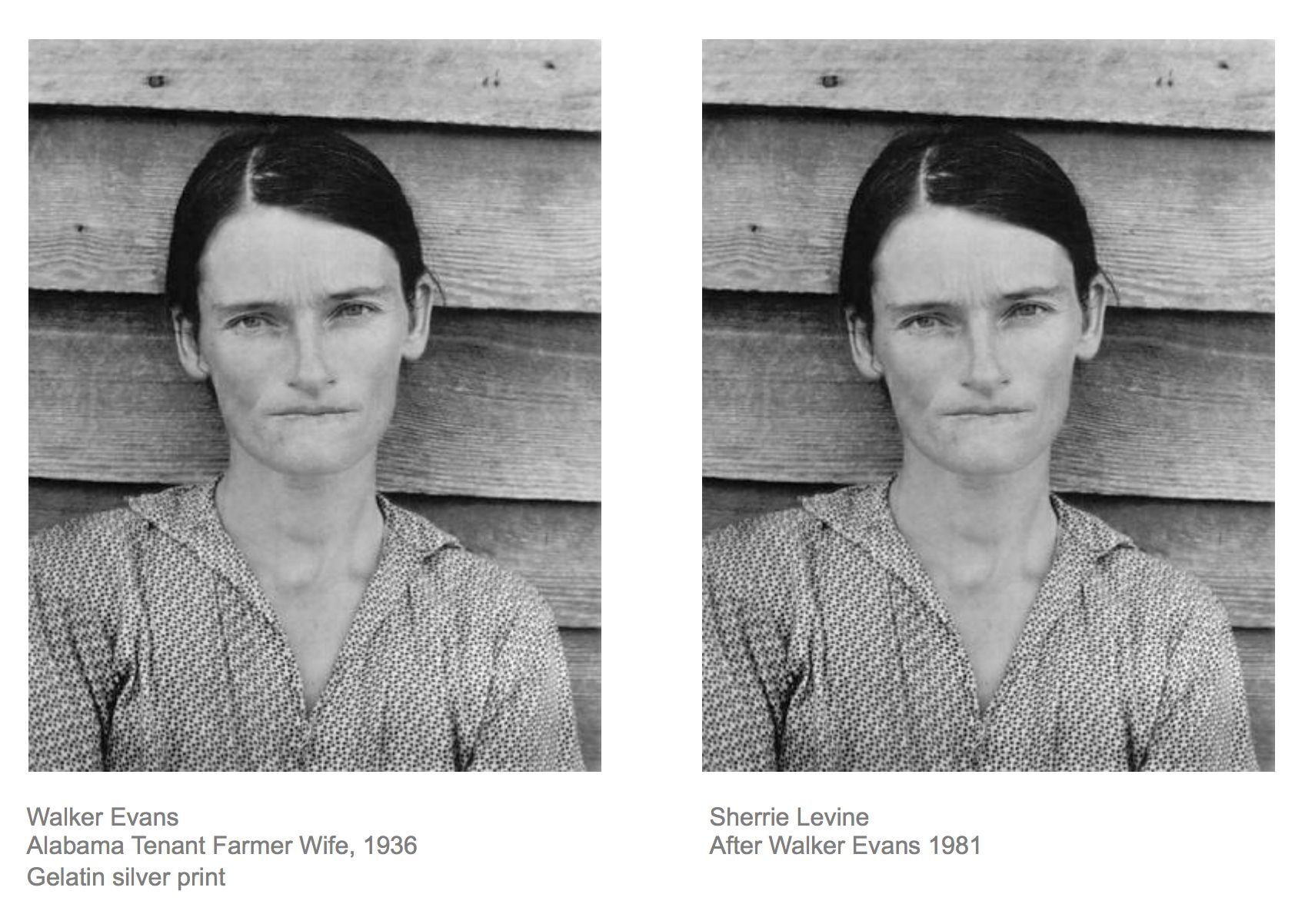
Hip-hop, arising in the 1970s, was a quintessentially postmodern art form— sampling from other artist’s records and pop culture. Other artists coming to prominence at the time were those of the Pictures Generation. Many of these artists quoted styles from the past within their work, and some just rephotographed the work of other artists. Although you may balk at the validity of some of these practices—i.e. Sherrie Levine or Richard Prince copying other photographers’ works—you should ask yourself, “What is my breaking point? Where do I draw the line between legitimate and illegitimate appropriation?” If you consider hip-hop a legitimate art form, but not Levine’s rephotographing of Walker Evans’ photographs, why is that?
Required
The Foundation, Season 1, Episode 1, Hip-Hop Evolution
Supplementary Readings
- Timeline
- The Pictures Generation
-
The Pictures Generation, 1974–1984
“This catalogue is published in conjunction with the exhibition The Pictures Generation, 1974–1984, on view at the Metropolitan Museum of Art, New York, from April 21 to August 2, 2009.” - Sarah Charlesworth
-
Sarah Charlesworth – Pictures Generation Artist, Interview 2004
“Sarah Charlesworth (1947-2013), along with Laurie Simmons, Barbara Kruger, Cindy Sherman, Richard Prince, Robert Longo, Charles Clough, was a seminal component of the conceptual wing that she had formulated in distinction, and the most intellectual investigator of media images of that group of groundbreaking artists. This montage of video clips is from a much longer interview that convened in 2004, and her invaluable contribution she made to educating us, the filmmakers, on what took place and her incisive views of the time she spent creating, and observing the changing landscape of the NY/international art world.” - Barbara Kruger
-
Barbara Kruger: In Her Own Words
Kruger talks about her history and work. - Louise Lawler
-
Louise Lawler | HOW TO SEE the artist with MoMA curator Roxana Marcoci, The Museum of Modern Art
“Can the exact same image have a completely different meaning if its title or medium is changed? Explore the work of one of today’s most influential female artists, Louise Lawler, in the new exhibition Louise Lawler: Why Pictures Now. MoMA curator Roxana Marcoci gives us a tour of the exhibition that charts Lawler’s continuous re-presentation, reframing, or restaging of the present, a strategy through which Lawler revisits her own images by transferring them to different formats—from photographs to paperweights, tracings, and works she calls “adjusted to fit” (images stretched or expanded to fit the location of their display).” - Sherrie Levine
-
Sherrie Levine; Mayhem
“Since the late 1970s, Sherrie Levine (b. 1947) has effectively rewritten the history of modern art by reprising images and objects—such as sculpture by Constantin Brancusi and Marcel Duchamp, photographs by Walker Evans and Alfred Stieglitz, and geometric forms from abstract modernist painting—and placing them before contemporary audiences to be experienced anew. This practice underscores the ways in which art accumulates different meanings over time and in different contexts. Levine suggests that how we see and understand things is conditioned by our own experiences, collective and singular, shared and private.” - Richard Prince
- Cindy Sherman
-
Cindy Sherman in “Transformation”, Art21
“The segment surveys thirty years of untitled works in which the artist photographs herself in various scenes and guises, grouped into informally-named series such as fairy tales, centerfolds, history portraits, Hollywood/Hampton types, and clowns. Sherman used a digital camera and green screen for her most recent series of society portraits, modifying each image’s ‘background with the same kind of license that a painter would take.’ Sorting through test shots at the computer, Sherman leads the viewer through her iterative process.”Robert Longo on Cindy Sherman’s Untitled Film Still #25 (1978), The Museum of Modern Art
“Artist Robert Longo speaks about his favorite Cindy Sherman work, "Untitled Film Still #25" (1978).” - Postmodernism in Photography
-
The Photographic Activity of Postmodernism, October
“That aspect of our culture which is most thoroughly manipulative of the roles we play is, of course, mass advertising, whose photographic strategy is to disguise the directorial mode as a form of documentary. Richard Prince steals the most frank and banal of these images, which register, in the context of photography-as-art, as a kind of shock. But ultimately their rather brutal familiarity gives way to strangeness, as an unintended and unwanted dimension of fiction reinvades them. By isolating, enlarging, and juxtaposing fragments of commercial images, Prince points to their invasion by these ghosts of fiction.”Chapter 7: Benjamin, Atget and the ‘Readymade’ Politics of Postmodern Photography Studies, Photography: Theoretical Snapshots
“In what follows, I trace the formation of photography studies and its coincidence with postmodern art criticism in the 1980s, as well as their dual investment in both Atget and Benjamin. Many theorists of postmodern art legitimated and even institutionalized not only a discourse on photography, but also certain photographic practices that might be said to be constitutive of photography studies. The American version of photography studies in particular originated in the postmodern debate ostensibly as a reaction against a formalist narrative of modernism promulgated by Clement Greenberg, in favour of a conceptualist one begotten by Marcel Duchamp – and thus replaced one canon with another. What, however, is excluded from each of these narratives?”Winning the Game When the Rules Have Been Changed: Art Photography and Postmodernism
“Often the reaction of art photographers to postmodernist photographic work is bafflement, if not a sense of affront. The irony is that photography, a medium which by its very nature is so utterly bound to the world and its objects, should have had, in a variety of ways, to divorce itself from this primary relationship in order to claim for itself a photographic aesthetics.” - Postmodernism in Graphic Design
-
The Art of Punk and the Punk Aesthetic, Design Observer
“For a musical and social movement that snarled in the face of authority and wasn’t averse to spitting at its friends, punk has received a great many shelf inches in the last 30 years respectfully devoted to histories, reassessments and eyewitness accounts. Today, there is even an academic journal exclusively devoted to the pursuit of punk and post-punk studies, which has just published its second issue. There can’t be much left to say about the music, clothing, media outrage and legendary gigs, but the graphic expression of punk has received less critical attention.” - Postmodernism in Illustration
- Early Hip Hop Soundtrack
-
Listen to the sounds of early hip hop. This is for background listening and does not count toward your supplementary work time.
- Hip Hop
-
Lights Out, 99% Invisible
This podcast lays out the myth behind the proliferation of hip-hop: “Caz also believes that the the 1977 blackout may have accelerated the growing hip hop movement, which was just beginning to put down roots in the Bronx. His theory: the looting that occurred during the blackout enabled people who couldn’t afford turntables and mixers to become DJs.” - Remixing, Sampling, and Appropriating
-
Everything is a Remix
In his four-part series, Kirby Ferguson outlines how remixing is a backbone of postmodern cultural production.RIP: A Remix Manifest: Mash-Ups, Copyright, and Culture Creation
“Join filmmaker Brett Gaylor and mashup artist Girl Talk as they explore copyright and content creation in the digital age. In the process they dissect the media landscape of the 21st century and shatter the wall between users and producers. Creative Commons founder, Lawrence Lessig, Brazil's Minister of Culture, Gilberto Gil, and pop culture critic Cory Doctorow also come along for the ride.”Appropriation in Contemporary Art, Inquiries Journal
“Appropriation refers to the act of borrowing or reusing existing elements within a new work. Post-modern appropriation artists, including Barbara Kruger, are keen to deny the notion of ‘originality.’ They believe that in borrowing existing imagery or elements of imagery, they are re-contextualising or appropriating the original imagery, allowing the viewer to renegotiate the meaning of the original in a different, more relevant, or more current context.” - Punk, Post-Punk, and New Wave Soundtrack
-
Listen to the sounds of the early punk, post-punk, and new wave of the 1970s and ealy ’80s. This is for background listening and does not count toward your supplementary work time.
- Punk, Post-Punk, and New Wave
-
The Story of Feminist Punk in 33 Songs, Pitckfork
“‘Feminism,’ ‘punk,’ and ‘feminist punk’ can have many definitions, culturally and personally. In attempting to capture the spirit and story of this lineage, we had to narrow down these enormous fields. We looked for songs that make their feminist messages clear—not just songs by punks who are feminists, and not songs that were ‘punk’ or ‘feminist’ in spirit alone. In this context, we defined punk as some kind of raw expression, not only an attitude. We looked for rallying cries that have questioned, explored, and destroyed stereotypes, in which the form of the music has mirrored the message. We believe they are classics that cross canons, set precedents, and uphold virtues for the idea of feminism in punk, and the artists who wrote them have moved punk forward.”Gary Panter, Matt Groening, and the Dual History of Punk and Comics: And the Outsider, DIY Ethic that Connects Them, Literary Hub
“Just about anyone who has paid any attention to pop culture in the past 30 years can picture Bart Simpson. He has popping saucer eyes, a red T-shirt, and what looks like a crown of jagged hair. First appearing on television in 1987, Bart is the perpetually-ten-year-old Simpson family son who quickly became a globally famous figure for pugnacity and rebellious disrespect (‘Don’t have a cow, man!’). What few people know, though, is that Bart’s iconic hairline is lovingly lifted from cartoonist Gary Panter’s punk everyman character Jimbo and his spiky hair—meaning that one of America’s most beloved pop culture characters actually springs from a key figure in its groundbreaking punk scene.”The Very Black History Of Punk Music, AJ+
“Stories about punk music tend to picture thin-framed white guys and girls with shaved heads, part of an angry, energetic scene born out of the working class angst of young white England in the 1970s. But the actual history of punk—as a type of music and movement – is more complicated than that. Black punks have been an integral and pioneering part of punk history—and they’re keeping the movement alive and growing today. Host Sana Saeed explores that history and talks to proto-punk band Death, musician and journalist Greg Tate, the band The 1865 and festival organizer Shawna Shawnté.”Punk Style: Articles of Interest #6, 99% Invisible
Note: Some adult language “For Punk, Avery Trufelman spoke with 99pi host Roman Mars; Don Letts, legendary DJ and filmmaker and creator of the documentary Punk Attitude; Claire Wilcox, senior curator at the Victoria and Albert Museum; Michael Costiff, a curator and long time neighbor of 430 Kings Road; Monica Sklar, fashion historian and author of the book Punk Style.”Lipstrick Traces: a Secret History of the Twentieth Century
“Looking for an answer, with a high sense of the drama of the journey, Marcus takes us down the dark paths of counterhistory, a route of blasphemy, adventure, and surprise. This is no mere search for cultural antecedents. Instead, what Marcus so brilliantly shows is that various kinds of angry, absolute demands—demands on society, art, and all the governing structures of everyday life—seem to be coded in phrases, images, and actions passed on invisibly, but inevitably, by people quite unaware of each other.”Please Kill Me: The Uncensored Oral History of Punk
“Though Britain’s notorious Sex Pistols shoved punk rock into the face of mainstream America, the movement was already brewing in the U.S. in the 1960s with bands like the Velvet Underground and Iggy and the Stooges. Through hundreds of interviews with forgotten bands as well as the ones that made names for themselves–including Blondie and the Ramones–Legs McNeil and Gillian McCain chronicle punk rock history through the people who really lived it. Please Kill Me is a thrash down memory lane for those hip to punk’s early years and an enlightening history lesson for youngsters interested in the origins of modern ‘alternative’ music.”The Art of Punk and the Punk Aesthetic, Design Observer
“For a musical and social movement that snarled in the face of authority and wasn’t averse to spitting at its friends, punk has received a great many shelf inches in the last 30 years respectfully devoted to histories, reassessments and eyewitness accounts. Today, there is even an academic journal exclusively devoted to the pursuit of punk and post-punk studies, which has just published its second issue. There can’t be much left to say about the music, clothing, media outrage and legendary gigs, but the graphic expression of punk has received less critical attention.”
Response Questions
Remember to cite specific instances from the text to support your views.
- The 1970s ushered in a new era of questioning concepts of originality and appropriation. With the Pictures Generation (of which Richard Prince was a part) and hip-hop, artists freely sampled and flat-out copied the work of others. What do you make of this?
- Think back to Duchamp/Freytag-Loringhoven and Fountain (1917). The artist appropriated the work of someone else—something that already existed—and slapped a signature on it. What started happening in the 1970s is a continuation of this same practice. Does anything about this concern you? If so, what and why? If not, why?
- What technological, economic, and political factors shaped the beginnings of hip-hop?
- Mr. Keedy indicated his frustration at what was to be an “ideological victory over the tyranny of style mongering” was co-opted as the clichéd “ugly, grunge, layered, chaotic, postmodern design of the 90s.” What do you make of this inevitable movement from the avant-garde to the commonplace? What does that mean about you and your individual styles and/or practices?
- Reflect on how attitudes shift, thereby creating new eras—from Modernism to Postmodernism, to Post-postmodernism, etc. Do you sense anything in the air that may indicate a new shift? What might you do to disrupt your field and help usher in a new way of looking at design?
- Postmodernist styles are coming back into vogue. So, an era that was about borrowing from the past is now getting sampled itself (typically by artists who weren’t alive or cognizant when it was popular in the first place). What do you think of this backward looking tendency?