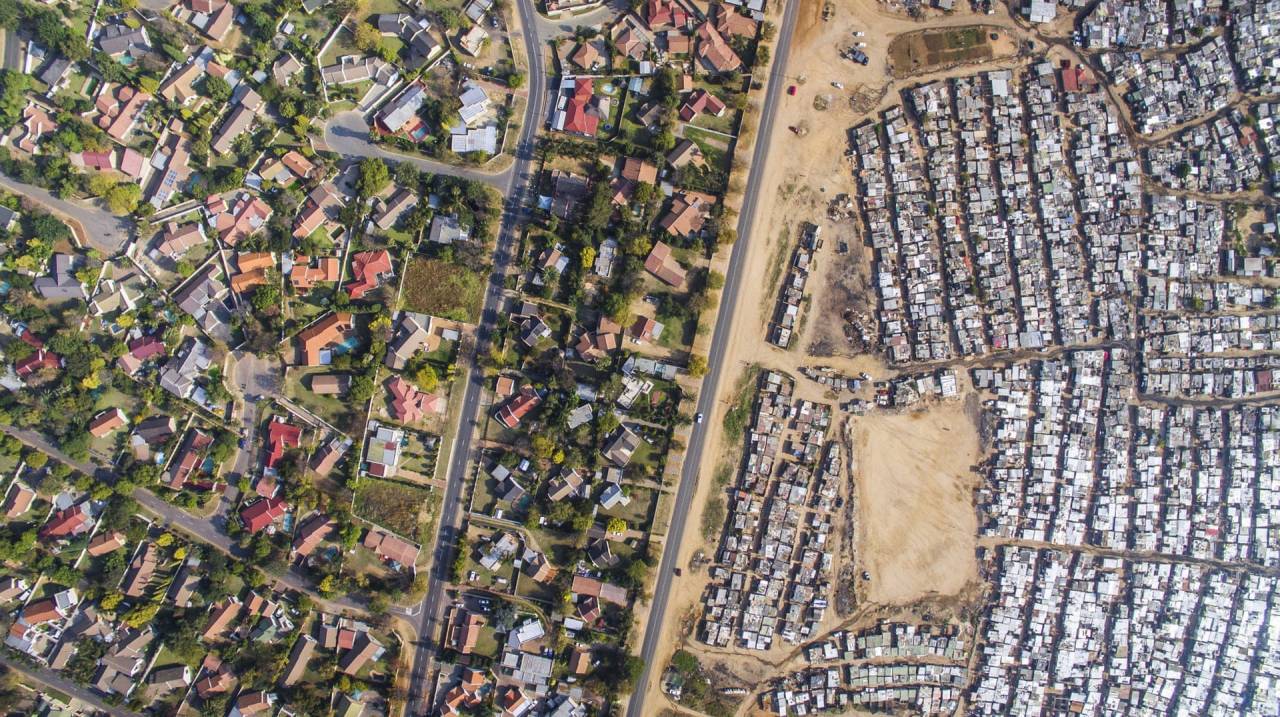
Kya Sands/Bloubosrand, Johannesburg, 2016
From Unequal Scenes, a series documenting segregation of urban spaces throughout the world
Why?
Now that we have introduced postcolonialism, the question is, what we we do with colonial histories (and present iterations) rather than just study them, and what does this have to do with art? I’m sure you can probably quickly identify a few points where postcolonialism and art intersect, but we want to dig a bit deeper and walk around the issue a bit to see it from different sides. You’ll also start to notice where this might overlap with our discussions of economy, gender, education, semiotics, and ethics.
Required
Supplementary Readings
- Race and Postcolonialism in Art and Design
-
Art On My Mind
“In her first book about art and the ‘politics of the visual,’ hooks, a writer known for her clarifying views on feminism and black women, addresses the deplorable absence of discourse on black artists, especially by black critics. Why, she asks, has art played a minimal role in the lives of most African Americans?”Where Are the Women of Color in New Media Art?, Hyperallergic
“With Santos’s encouragement, I decided it would be valuable to do a follow-up piece and include perspectives from WOC and QTWOC (queer or transgender women of color) artists and writers regarding Deep Lab, new media and technology-based art, and representation. We emailed a small questionnaire to 20 such women. Seven responded, and their comments are featured below along with Santos’s own answers.”Why Get an MFA?, The New York Times
“Do you care about the oppressive lack of diversity in M.F.A. programs—what Junot Díaz calls ’M.F.A. vs. P.O.C.’ [People of Color]—that seems to translate into the astonishingly narrow range of contemporary writing? How is any of this relevant for you?”ARTS.BLACK: An Editorial Note, Temporary Art Review
“Though we are in the age of ‘democratized media’, its facilitators and content are hardly reflective of the artists, and the individuals who consume it. The lack of Black writers in the critical arts realm influences an industry that is completely one dimensional.”This is What Intersectional Feminist Art Looks Like, Chicago Tribune
“The Vietnamese language does not have a word for feminism. But the country did and does have feminists, including Nguyen Thi Minh Khai, a revolutionary leader of the Indochinese Communist Party in the 1930s. Her elusive figure lurks everywhere and nowhere in "To Name It is to See It," a solo exhibition by Huong Ngo upstairs at the DePaul Art Museum.”The Age of the Algorithm, 99% Invisible
“Most recidivism algorithms look at a few types of data—including a person’s record of arrests and convictions and their responses to a questionnaire—then they generate a score. But the questions, about things like whether one grew up in a high-crime neighborhood or have a family member in prison, are in many cases ‘basically proxies for race and class,’ explains O’Neil. The score generated by the algorithm is used by judges when making decisions about the defendant. People with higher scores will often face higher bail, longer sentences, and lower chances of parole. Instead, O’Neil believes these results could be used to select people for rehabilitation programs or to better understand society’s structural inequalities.”How the Racism Baked Into Technology Hurts Teens, The Atlantic
“Last month, Twitter users uncovered a disturbing example of bias on the platform: An image-detection algorithm designed to optimize photo previews was cropping out Black faces in favor of white ones. Twitter apologized for this botched algorithm, but the bug remains.”“The Evolution of a Black Aesthetic, 1920-195”: David C. Driskell and Race, Ethics, and Aesthetics, Callaloo
“This article considers David Driskell's catalogue essay, "The Evolution of a Black Aesthetic, 1920-1950," in the context of the author, the times, and exigencies behind the exhibition "Two Centuries of Black American Art" (1976). Situated historically, Driskell's essay manifests the dominant voices and parameters relative to race and artistic practice in African-American art at that time (1970s). Nonetheless, it is also a deeply individualistic essay, written from the perspective of a practicing artist significantly indebted to modernist conceptions of art and scholastic aesthetic philosophy.”
Black Art: In the Absence of Light
Requires HBO subscription. “Inspired by the late David Driskell’s landmark 1976 exhibition, ‘Two Centuries of Black American Art,’ the documentary Black Art: In the Absence of Light offers an illuminating introduction to the work of some of the foremost Black visual artists working today. Directed by Sam Pollard (Atlanta's Missing and Murdered: The Lost Children) the film shines a light on the extraordinary impact of Driskell’s exhibit on generations of Black artists who have staked a claim on their rightful place within the 21st-Century art world. Interweaving insights and context from scholars and historians, along with interviews from a new generation of working African American curators and artists including Theaster Gates, Kerry James Marshall, Faith Ringgold, Amy Sherald and Carrie Mae Weems, the documentary is a look at the Contributions of Black American artists in today’s contemporary art world.” - Race in Art and Design Education
-
Decolonial Strategies for the Art History Classroom
“A (more) decolonized art history may be possible, if we are able to rethink both what we teach and how we teach it. How might this manifest through re-reading and reassessing the traditional canon? How might it manifest through challenging the traditional lecture format, inviting students to relate to each other and their own histories more closely? We come together in this open workshop format to discuss how we are working towards decolonizing our art history classrooms. This workshop unites educators committed to such a material reconfiguration of art history, as well as the potential impacts of such a reconfiguration beyond the classroom.”Decolonizing and Diversifying Are Two Different Things: A Workshop Case Study, Art History Teaching Resources
“There is a long history of decolonial work in educational spaces. We acknowledge that the tools we shared with participants during this workshop as well as the thoughts we share here are a small part of this process. We recommend continuing this work in conversation with others who are also attempting to decolonize their classrooms (as well as spaces outside of academia).”Why Get an MFA?, The New York Times
“Do you care about the oppressive lack of diversity in M.F.A. programs—what Junot Díaz calls ’M.F.A. vs. P.O.C.’ [People of Color]—that seems to translate into the astonishingly narrow range of contemporary writing? How is any of this relevant for you?”Episode 51: Race & Racism in Ancient & Medieval Studies, Part One: the Problem, The Endless Knot
“What are the problems surrounding race and racism in the fields of Classics and Medieval Studies today? Where did these fields come from, and how does that affect the way we think about the past, and how we construct the present? For this episode (and the next) we interviewed eight scholars and put it together into an exploration of these unfortunately timely topics. Thank you to Katherine Blouin, Damian Fleming, Usama Ali Gad, Rebecca Futo Kennedy, Asa Mittman, Dimitri Nakassis, Helen Young, and Donna Zuckerberg for their generous contributions of time and thoughtful discussion of these difficult subjects.”Episode 52: Race & Racism in Ancient & Medieval Studies, Part Two: Responses, The Endless Knot
“In part two of our discussion about racism, we talk about ways to respond to the problems in the field, in teaching, scholarship, and more.”Renowned Feminist Art Historian Amelia Jones Believes that the Discipline of Art History Should be Restructured to Embrace New Narratives and Diverse Voices
“What I am trying to do in my academic life is change art discourse. I want to change the field of art history. It is time to have a new narrative and it is time to bring new, more diverse voices to the field.”A Toolkit for Breaking Down Racialized Design in the Classroom, Racism Untaught, AIGA
“Constructing necessary conversations in the classroom about issues of race in design isn’t an easy or comfortable task to take on. Our lack of information, limited personal experiences, or the fact that the conversation has been absent from design classrooms during our own education, make many design educators reluctant to integrate the concept of race into their classrooms. Many institutions offer resources and methods on how to initiate the conversation and create awareness in the classroom in order to support greater diversity and inclusion efforts, but little hone in on the forms of racialized design that surround us everyday. Two design educators, Terresa Moses and Lisa Mercer, are passionate about creating a design approach for other educators that provide an informed and intentional process to analyzing racialized design, understanding how it is systemically perpetuated, and then working to unteach it. The following Q+A with Lisa and Terresa share their project titled ‘Racism Untaught’.” - Decolonizing/Decanonizing/Decentering
-
Decolonization is Not a Metaphor, Decolonization: Indigeneity, Education & Society
“Our goal in this article is to remind readers what is unsettling about decolonization. Decolonization brings about the repatriation of Indigenous land and life; it is not a metaphor for other things we want to do to improve our societies and schools. The easy adoption of decolonizing discourse by educational advocacy and scholarship, evidenced by the increasing number of calls to ‘decolonize our schools,’ or use ‘decolonizing methods,’ or, “decolonize student thinking”, turns decolonization into a metaphor. As important as their goals may be, social justice, critical methodologies, or approaches that decenter settler perspectives have objectives that may be incommensurable with decolonization. Because settler colonialism is built upon an entangled triad structure of settler-native-slave, the decolonial desires of white, nonwhite, immigrant, postcolonial, and oppressed people, can similarly be entangled in resettlement, reoccupation, and reinhabitation that actually further settler colonialism.”Decolonial Strategies for the Art History Classroom
“A (more) decolonized art history may be possible, if we are able to rethink both what we teach and how we teach it. How might this manifest through re-reading and reassessing the traditional canon? How might it manifest through challenging the traditional lecture format, inviting students to relate to each other and their own histories more closely? We come together in this open workshop format to discuss how we are working towards decolonizing our art history classrooms. This workshop unites educators committed to such a material reconfiguration of art history, as well as the potential impacts of such a reconfiguration beyond the classroom.”Decolonizing and Diversifying Are Two Different Things: A Workshop Case Study, Art History Teaching Resources
“There is a long history of decolonial work in educational spaces. We acknowledge that the tools we shared with participants during this workshop as well as the thoughts we share here are a small part of this process. We recommend continuing this work in conversation with others who are also attempting to decolonize their classrooms (as well as spaces outside of academia).”Do Not ‘Decolonize’ . . . If You Are Not Decolonizing: Progressive Language and Planning Beyond a Hollow Academic Rebranding, Critical Ethnic Studies
“ I have started to see the complexity inherent in how decolonizing has been co-opted from a vibrant and critical engagement to an academic buzzword. This was recently bought home to me when I saw a student wearing a rather colourful t-shirt with a ‘Decolonize the …” typed in boldface in the front. While it was unclear to me what they wanted to decolonize, I was troubled by the text on the shirt, not because of my dislike of buzzwords (I’ve used them before) or because of the student wearing it, but rather it was just at the end of a long line of hollow ‘decolonizing’ moves I had witnessed—online and offline. Within the academy, I have seen the sloppy attempts to ‘decolonize’ a syllabus or a programme without any real structural changes—in the programme, the class, the faculty, or the university. This is NOT decolonizing the syllabus, or the programme, or the university. To take on decolonizing work without having ever engaged with the long tradition of scholars who have written on decolonizing—is sloppy and opportunistic. Especially sloppy if you have not read the seminal Tuck and Yang article which asks you to not use decolonizing as a metaphor.” - Cultural Appropriation
-
Teenager’s Prom Dress Stirs Furor in U.S. — but Not in China, The New York Times
“When Keziah Daum wore a Chinese-style dress to her high school prom in Utah, it set off an uproar—but not because of its tight fit or thigh-high slit. After Ms. Daum, 18, shared pictures on social media of her prom night, a Twitter user named Jeremy Lam hotly responded in a post that has been retweeted nearly 42,000 times. ‘My culture is NOT’ your prom dress, he wrote, adding profanity for effect. ‘I’m proud of my culture,’ he wrote in another post. ‘For it to simply be subject to American consumerism and cater to a white audience, is parallel to colonial ideology.’ Other Twitter users who described themselves as Asian-American seized on Ms. Daum’s dress—a form-fitting red cheongsam (also known as a qipao) with black and gold ornamental designs—as an example of cultural appropriation, a sign of disrespect and exploitation.”Someone I’m Not: Chris Ware, Art21
“From his home and studio in Oak Park, Illinois, artist Chris Ware shares motivations and challenges for telling stories from the perspectives of others in his work. ‘I distinctly remember being told by my teachers, if you draw women, you’re colonizing them with your eyes,’ Ware recalls of art school. ‘Do you not draw women and then maintain an allegiance to some sort of experience that only you have had? Or do you try to expand your understanding and your empathy for other human beings?’”When Chefs Become Famous Cooking Other Cultures’ Food, NPR
“So you walk into the new Korean joint around the corner and discover that (gasp) the head chef is a white guy from Des Moines. What’s your gut reaction? Do you want to walk out? Why? The question of who gets to cook other people’s food can be squishy—just like the question of who gets to tell other people’s stories. For some non-white Americans, the idea of eating ‘ethnic cuisine’ (and there’s a whole other debate about that term) not cooked by someone of that ethnicity can feel like a form of cultural theft. Where does inspiration end? When is riffing off someone’s cuisine an homage, and when does it feel like a form of co-opting? And then there’s the question of money: If you’re financially benefiting from selling the cuisine of others, is that always wrong?”A Much-Needed Primer on Cultural Appropriation, Jezebel
“This can include unauthorized use of another culture’s dance, dress, music, language, folklore, cuisine, traditional medicine, religious symbols, etc. It’s most likely to be harmful when the source community is a minority group that has been oppressed or exploited in other ways or when the object of appropriation is particularly sensitive, e.g. sacred objects.”The Dos and Don’ts of Cultural Appropriation, The Atlantic
“‘It’s not fair to ask any culture to freeze itself in time and live as though they were a museum diorama,’ says Susan Scafidi, a lawyer and the author of Who Owns Culture?: Appropriation and Authenticity in American Law. ‘Cultural appropriation can sometimes be the savior of a cultural product that has faded away.’”Cultural Appropriation Bingo: Proving your Comments are Unoriginal and Ignorant, Native Appropriations
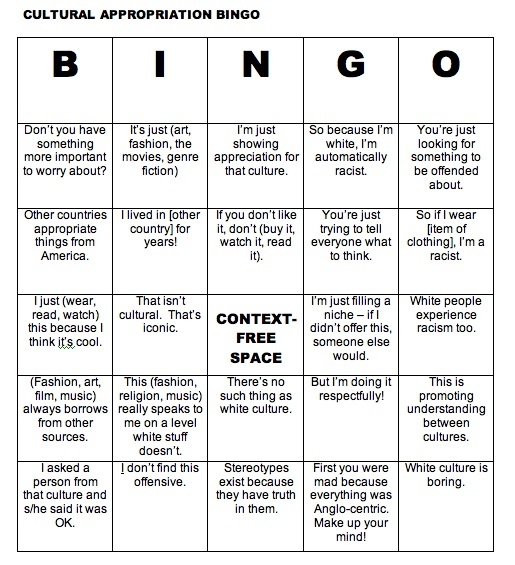
Dr. Sheila Addison
Cultural Appropriation BingoPretendians and What to Do with People Who Falsely Say They’re Indigenous Put Infocus, APTN News
“Pretendians – noun – A person who falsely claims to have Indigenous ancestry – meaning it’s people who fake an Indigenous identity or dig up an old ancestor from hundreds of years ago to proclaim themselves as Indigenous today. They take up a lot of space and income from First Nation, Inuit and Metis Peoples. It’s not a new phenomenon – but the conversation about what to do about these fraudsters continues to evolve. In the wake of the most recent identity scandal that rocked the arts world and ended with award-winning filmmaker Michelle Latimer apologizing for falsely claiming connection to Kitigan Zibi, some are calling for harsh penalties for anyone who can’t back up their identity claim – fines of $250,000 or five years in jail.”
- Afrofuturism
-
The Origins and Impact of Afrofuturism, African and Afro-Diasporan Talks
“‘The Origins and Impact of Afrofuturism’, with Naima Keith and Zoe Whitley, curators of 'The Shadows Took Shape’ on at Studio Museum until March 2014.”Afrofuturism Takes Flight: from Sun Ra to Janelle Monáe, the Guardian
“Culturally, Afrofuturism’s reach is vast. It encompasses the literature of writers such as Octavia E Butler and Ishmael Reed, films such as John Sayles’s The Brother From Another Planet, and the visual art of Jean-Michel Basquiat and Ellen Gallagher. It has been retrospectively applied to the work of musicians ranging from Jimi Hendrix and Sun Ra to Public Enemy and Lee "Scratch” Perry. It has an expansive and pliant musical heritage, which film-maker and Afrofuturist author Ytasha Womack argues stretches all the way back to ancient African griot traditions; she also notes the frequent references to Egyptian astronomy and the pyramids.“George Clinton, Sun Ra And The Sci-Fi Funk Of Afrofuturism, WBUR
“Cultural critic Mark Dery coined the term 'Afrofuturism’ in 1993 to describe the particular strain of science fiction concerned with black experiences. P-Funk’s universe was inspired by Clinton’s love of television shows like ‘Star Trek’ and films like ‘Close Encounters of the Third Kind.’”Space is the Place
“Avant-garde jazz musician Sun Ra stars in the movie version of his concept album Space Is the Place. Not following a linear plot line, this experimental film is a bizarre combination of social commentary, blaxploitation, science fiction, and concert performance. The opening scene is set in an intergalactic forest, with Sun Ra introducing his plan to use music as salvation for the black community. Back on Earth, he wears a disguise as Sunny Ray, a piano player in a 1940s Chicago strip club who causes an explosion with his sounds. Switching to a scene in a desert, he plays a card game called "The End of the World,” with the Overseer (Ray Johnson), who is dressed in white and drives a white Cadillac. Sun Ra pulls out a spaceship card and the Arkestra play the song “Calling Planet Earth” as their spaceship lands in Oakland, CA. Perpetually dressed in sparkling gold robes and headdresses, he sets out to save the black people from oppression.“The Mundane Afrofuturism Manifesto
"The undersigned, being alternately pissed off and bored, need a means of speculation and asserting a different set of values with which to re-imagine the future. In looking for a new framework for black diasporic artistic production, we are temporarily united in the following actions. […] The most likely future is one in which we only have ourselves and this planet.” See also the Mundane Afrofuturist Manifesto page on Martine Syms' site.We Are in the Future, This American Life
“One of our producers, Neil Drumming, has recently become fascinated with Afrofuturism. It's more than sci-fi. It’s a way of looking at black culture that’s fantastic, creative, and oddly hopeful—which feels especially urgent during a time without a lot of optimism.” - Intersectionality
-
Introduction, Black Feminism Reimagined: After Intersectionality
“In Black Feminism Reimagined Jennifer C. Nash reframes black feminism's engagement with intersectionality, often celebrated as its primary intellectual and political contribution to feminist theory. Charting the institutional history and contemporary uses of intersectionality in the academy, Nash outlines how women's studies has both elevated intersectionality to the discipline's primary program-building initiative and cast intersectionality as a threat to feminism's coherence. As intersectionality has become a central feminist preoccupation, Nash argues that black feminism has been marked by a single affect—defensiveness—manifested by efforts to police intersectionality's usages and circulations. Nash contends that only by letting go of this deeply alluring protectionist stance, the desire to make property of knowledge, can black feminists reimagine intellectual production in ways that unleash black feminist theory's visionary world-making possibilities”Mapping the Margins: Intersectionality, Identity Politics, and Violence Against Women of Color, Stanford Law Review
“The problem with identity politics is not that it fails to transcend difference, as some critics charge, but rather the opposite—that it frequently conflates or ignores intra group differences. In the context of violence against women, this elision of difference is problematic, fundamentally because the violence that many women experience is often shaped by other dimensions of their identities, such as race and class. Moreover, ignoring differences within groups frequently contributes to tension among groups, another problem of identity politics that frustrates efforts to politicize violence against women. Feminist efforts to politicize experiences of women and antiracist efforts to politicize experiences of people of color' have frequently proceeded as though the issues and experiences they each detail occur on mutually exclusive terrains. Although racism and sexism readily intersect in the lives of real people, they seldom do in feminist and antiracist practices. And so, when the practices expound identity as "woman" or ‘person of color’ as an either/or proposition, they relegate the identity of women of color to a location that resists telling.”Demarginalizing the Intersection of Race and Sex: A Black Feminist Critique of Antidiscrimination Doctrine, Feminist Theory and Antiracist Politics, The University of Chicago Legal Forum
“One way to approach the problem of intersectionality is to examine how courts frame and interpret the stories of Black women plaintiffs. While I cannot claim to know the circumstances underlying the cases that I will discuss, I nevertheless believe that the way courts interpret claims made by Black women is itself part of Black women's experience and, consequently, a cursory review of cases involving Black female plaintiffs is quite revealing. To illustrate the difficulties inherent in judicial treatment of intersectionality, I will consider three Title VIP cases: DeGraffenreid v General Motors,5 Moore v Hughes Helicopter6 and Payne v Travenol.”The Urgency of Intersectionality, TED
“Now more than ever, it's important to look boldly at the reality of race and gender bias -- and understand how the two can combine to create even more harm. Kimberlé Crenshaw uses the term "intersectionality" to describe this phenomenon; as she says, if you're standing in the path of multiple forms of exclusion, you're likely to get hit by both. In this moving talk, she calls on us to bear witness to this reality and speak up for victims of prejudice.”Age Against the Machine: The Fatal Intersection of Racism & Ageism In the Time of Coronavirus, Intersectionality Matters with Kimberlé Crenshaw
“On this episode of Intersectionality Matters, Kimberle Crenshaw is joined by two timely voices—Ashton Applewhite, author of This Chair Rocks: A Manifesto Against Ageism, and Willie ‘J.R.’ Fleming, Executive Director of the Chicago Anti-Eviction Campaign—to discuss how ageism, and its varying intersections with race, class, ability, and gender, is materializing in the fight against COVID-19.”What Slavery Engendered: An Intersectional Look at 1619, Intersectionality Matters with Kimberlé Crenshaw
“In this episode, Kimberlé chops it up with Dorothy Roberts, a professor at the University of Pennsylvania and a leading scholar in race, gender, bioethics, and the law. In a conversation that merges intersectional inquiry with The 1619 Project, which interrogates America’s history of slavery in order to understand racial disparities in 2019, Crenshaw and Roberts shed light on the lasting consequences of slavery, segregation, and White Supremacy, and their impact on Black women specifically. Their timely conversation highlights the relationship between the legacy of slavery and instances of modern oppression against Black women, such as the curbing of welfare, forced sterilization, and mass incarceration.”This is What Intersectional Feminist Art Looks Like, Chicago Tribune
“The Vietnamese language does not have a word for feminism. But the country did and does have feminists, including Nguyen Thi Minh Khai, a revolutionary leader of the Indochinese Communist Party in the 1930s. Her elusive figure lurks everywhere and nowhere in "To Name It is to See It," a solo exhibition by Huong Ngo upstairs at the DePaul Art Museum.”The Combahee River Collective Statement
“One issue that is of major concern to us and that we have begun to publicly address is racism in the white women’s movement. As Black feminists we are made constantly and painfully aware of how little effort white women have made to understand and combat their racism, which requires among other things that they have a more than superficial comprehension of race, color, and Black history and culture. Eliminating racism in the white women’s movement is by definition work for white women to do, but we will continue to speak to and demand accountability on this issue.”Why I’m Giving up on Intersectional Feminism, Quartz
“As the honeymoon wore off, I began to notice some things I hadn’t before. For starters, many white women announced themselves as intersectional feminists, yet, were still completely detached from the lives and issues of cis and trans black women and women of color. I also noticed that black women and women of color weren’t too quick to join the intersectional movement either. Instincts and too many bad experiences in white-centered environments made them very distrustful of intersectional feminism.”
Response Questions
Remember to cite specific instances from the text to support your views.
- How can racism be woven into images, objects, services, content, systems, and aesthetics?
- How might you check yourself and your work against inadvertent racism or cultural insensitivity?
- How do we accommodate and make space for fluid and complex cultural identities, and therefore culture rooted in complex issues?
- How are issues of “quality” used as code for exclusion? What are the measuring sticks used to ascertain “quality?” Are those measuring sticks racist or sexist?
- How might you deal with the pitfalls of representing cultures/races/nationalities that are not your own?